A Drone Strike at Chornobyl and Three European Leaders Rally Behind Ukraine

A Drone Strike at Chornobyl and Three European Leaders Rally Behind Ukraine
In the early hours of 7 June 2026, at approximately 2am local time, a Russian Shahed drone struck the reception building of a spent nuclear fuel storage facility located roughly 15 kilometres from the Chornobyl power plant. The Guardian reported that the targeted structure was empty of fuel containers at the time of impact and that no spike in radiation levels was recorded in the surrounding area. The International Atomic Energy Agency was briefed by Ukrainian authorities, with the IAEA noting that large quantities of nuclear material are stored at the broader site. Russia had not publicly commented on the strike as of 7 June 2026.
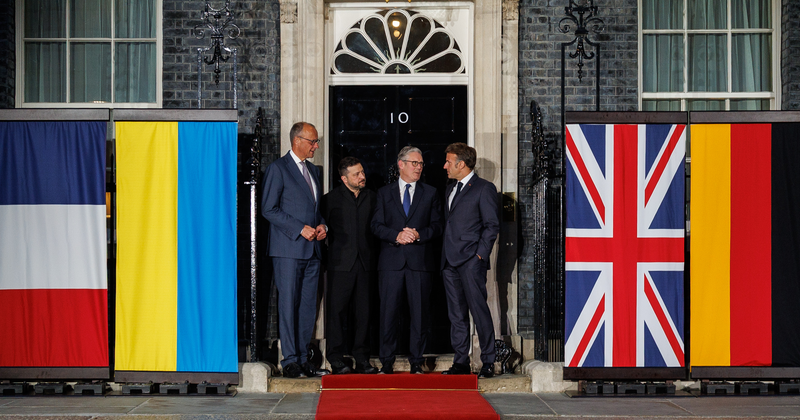
Within hours, President Volodymyr Zelenskyy characterised the attack as deliberate and "extremely vile." But he was not alone in his response. That same day, he met with British Prime Minister Keir Starmer, French President Emmanuel Macron, and German Chancellor Friedrich Merz — the leaders of Europe's three largest economies. While this E3 summit had been scheduled before the drone strike, the strike became the immediate focal point of their discussions. UK Government
What Happened at Chornobyl, and Why It Matters
To understand what this strike actually threatened, you need to know the difference between spent nuclear fuel and an active reactor. Spent fuel — the radioactive leftover from a reactor that has already run — sits in special containers designed to cool it down and prevent radiation from escaping. A strike on a spent fuel facility creates a contamination risk rather than a nuclear explosion risk. If the containers were breached, radioactive particles could spread into the surrounding area, but the fuel itself cannot undergo a runaway chain reaction.
In this case, the reception building that was hit is essentially the intake and logistics hub for the facility — not the main storage vault. It was empty of fuel containers at the time of the strike. Ukrainian authorities confirmed that no radiation anomaly was detected afterward. The immediate danger, in other words, was avoided.
Still, the fact that the International Atomic Energy Agency issued a statement noting the large volume of nuclear material at the site is worth attention. The IAEA does not issue warnings casually. When it flags the presence of nuclear inventories near a strike, it is creating an official record of the risk — a signal that the situation is being taken seriously enough to document.
We cannot yet know whether Russia was deliberately choosing a target that would send a message without triggering a major radiation incident, or whether the strike was simply less precise than intended. Russia's pattern — neither confirming nor denying strikes on sensitive infrastructure when the optics are poor — leaves that question unanswered.
Russia Escalates: The Oreshnik Missile
The Chornobyl strike did not happen in a vacuum. Two weeks earlier, in late May 2026, Russia carried out a massive drone and missile attack on Kyiv. This time, it deployed a new weapon: the hypersonic Oreshnik missile — Reuters reported Russian confirmation on 24 May. Zelenskyy had warned of the incoming strike a day before it happened, whether based on advance intelligence or as a deliberate attempt to shape the narrative beforehand.
The Oreshnik is a sophisticated intermediate-range ballistic missile system. Think of it as Russia's attempt to deploy a weapon capable of outrunning Ukrainian air defences through sheer speed — claims suggest it travels at hypersonic velocities, though independent verification is limited. Russia used it alongside Shahed drones and conventional cruise missiles in a layered attack designed to overwhelm air defences through volume and diversity. It is the kind of tactic you see when one side has an advantage in firepower but faces a shortfall in manpower or conventional forces on the ground.
The broader context here is important. Russia faces a widening gap in military and economic support from Western allies to Ukraine — every new European summit promises additional weapons and aid. The escalatory logic from Moscow's perspective appears to be: raise the perceived cost of continued Western engagement faster than the West can absorb it politically.
The E3 Summit: Tying Together Europe's Response
The meeting on 7 June between Starmer, Macron, Merz, and Zelenskyy was not primarily about grand gestures. It was about coordination. The four leaders aligned their diplomatic calendar around three upcoming multilateral gatherings: the G7 summit at Evian, a meeting of the Coalition of the Willing (countries supporting Ukraine outside formal NATO structures), and the NATO summit in Ankara.
The leaders discussed increased military support pledges to be announced at the NATO summit in Ankara. This matters because NATO summits produce communiqués — formal, collective statements from all member states — that carry institutional weight and political durability. A commitment announced at an Ankara NATO communiqué carries more long-term significance than a bilateral announcement between two countries.
The inclusion of the Coalition of the Willing is another strategic choice. This is a grouping of countries that want to support Ukraine militarily without triggering questions about whether they are obligated to defend NATO members under Article 5 (the NATO clause stating that an attack on one is an attack on all). It allows non-NATO partners — and even some allies anxious about escalation — to stay engaged without facing doctrinal pressure.
On the economic front, the leaders discussed intensifying pressure on Russia's war economy. This is standard language at European summits, but it has gained real operational meaning. Western sanctions experts have shifted focus toward what they call "secondary sanctions" — targeting third-country companies, particularly in the Gulf, Central Asia, and Southeast Asia, that have been selling Russia the dual-use goods and components its defense industry needs.
What Comes Next: Evian, Ankara, and the Question of Pace
The G7 summit at Evian will be the first major multilateral gathering after the E3 meeting, and the Chornobyl strike will be fresh in everyone's minds. European leaders will face pressure to respond to the targeting of nuclear infrastructure with concrete action — whether a new round of sanctions, a formal referral to the International Atomic Energy Agency, or a strengthened military commitment.
The sequencing — Evian, then the Coalition of the Willing meeting, then Ankara — is deliberate. It is designed to build momentum across different formats, locking in incremental commitments at each stage before the NATO summit, where the stakes are highest for institutional credibility.
For Zelenskyy, the political value of sitting alongside the leaders of Britain, France, and Germany just days after being targeted by Russia's newest missiles was significant. It sent a message: Ukraine's leadership is not isolated; Europe's largest economies are coordinating on its behalf.
But here is the harder question that no summit communiqué will answer: Is the West moving fast enough to keep pace with Russian escalation? The Oreshnik deployment and the Chornobyl strike together suggest Moscow is willing to take larger risks. The E3's response — more summits, more pledges, more pressure on Russia's economy — may prove adequate. But whether this approach holds up through Ankara, and beyond, remains unclear.