Europe's 2026 Wildfire Season Pushes North — and Strains the EU's Shared Firefighting System
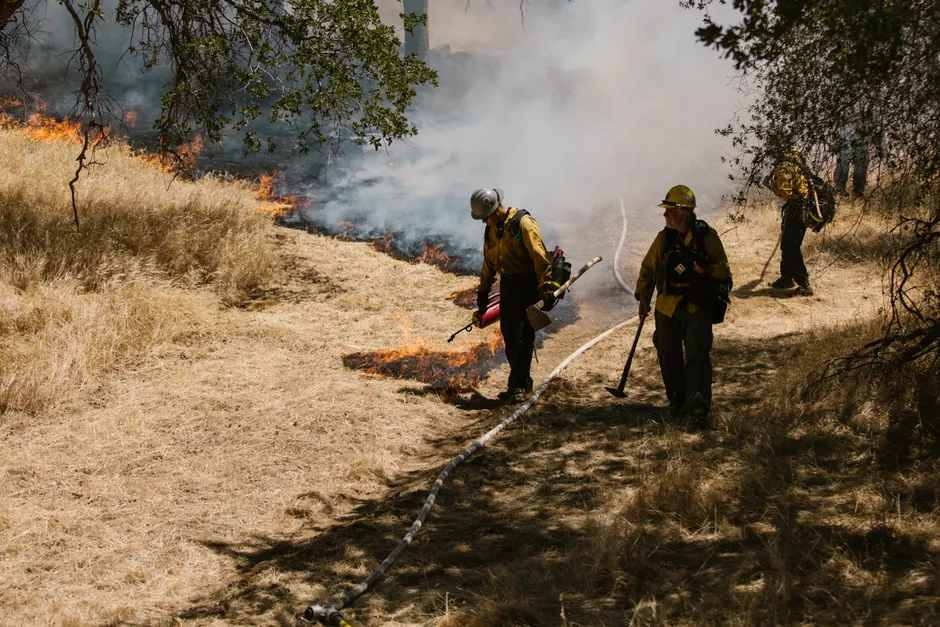
A record wildfire in Belgium's High Fens nature reserve has burned through 1,600 hectares by mid-August 2026, leading Belgium to activate the European Union's civil protection mechanism — a system that lets EU member states request firefighting help from other member countries when their own resources are overwhelmed. In response, Sweden sent water-bombing aircraft, and the Czech Republic and the Netherlands dispatched helicopters. The fire, burning since Friday, is being fought by local firefighters, farmers, and the army. European Commissioner Hadja Lahbib confirmed the extra equipment was on its way. (BBC; Reuters; Asharq Al-Awsat)
Firefighter Gregory Melotte told Belgian broadcaster RTBF that crews managed to slow the fire coming from the open plain to stop it from reaching the fir forest. The High Fens — a raised peat bog and woodland area in eastern Belgium near the German border — is not normally considered a high-risk fire zone, which makes the scale of this blaze unusual for the region.
Meanwhile, in south-western France, 650 residents evacuated their homes as a wildfire burned through the Landes forest. That fire started on Thursday and, according to authorities, reignited on Saturday after crews thought they had it under control. More than 500 firefighters were deployed to tackle it. (BBC)
Forest fires were also reported in Croatia, Spain, and Serbia since Friday, following a summer of extreme heat across the continent. In the Netherlands, a fire in the Utrecht region burned roughly 4,500 square meters — smaller than a football pitch — and was fought by eight firefighting vehicles, each carrying six firefighters. (RTV Utrecht; BBC)
The EU's climate monitoring service, Copernicus, confirmed that western Europe experienced its hottest June-to-July period on record. This follows data showing that the 2023 wildfire season in Europe was among the worst this century, according to a European Commission report published in April 2024. The same report noted that 2022 was the second-worst wildfire season in the EU since 2000, based on the Copernicus European Forest Fire Information System. The EU Civil Protection Mechanism was activated 11 times in 2022 alone. (BBC; Reuters, April 2024)
The 2026 fire season has been especially severe for France. Wildfires there have burned more land in 2026 than in any year since 2006, with more than 100,000 hectares consumed. A Reuters report in late July documented thousands of people fleeing tinder-box conditions as warming persisted. (Reuters, July 2026)
The broader context here is one of rising transnational demand on the EU Civil Protection Mechanism. Think of it as a shared emergency closet: when one country's own firefighting capacity runs out, it can request equipment and personnel from other member states, coordinated through the European Commission's Emergency Response Coordination Centre. The mechanism's increasing activation frequency — 11 times in 2022, and now called upon by Belgium in 2026 — reflects both the growing intensity of European wildfire seasons and the fact that cross-border disaster response has become more routine and institutionalized. The deployment of Swedish aircraft and Czech and Dutch helicopters to Belgium shows the system in action: assets available in member states are rerouted on request.
What sets the current wave apart is its geographic breadth. Simultaneous fires in Belgium, France, Croatia, Spain, Serbia, and the Netherlands stretch the pool of shared firefighting assets at a moment when multiple member states may need reinforcement at the same time. That concurrency risk is the mechanism's structural vulnerability: if several large member states request water-bombing aircraft simultaneously, the available fleet may not cover all demands. The fact that Belgium — not traditionally a frontline wildfire state — is now drawing on EU reserves signals a widening of the fire zone northward and westward, consistent with Copernicus findings on record-breaking heat across western Europe.
For policymakers and emergency planners, the 2026 season reinforces the case for expanding the EU's rescEU reserve — a stockpile of collectively owned firefighting assets that supplements what individual countries contribute. The seasonal pattern is also shifting: fires are no longer concentrated in the Mediterranean basin but are appearing in temperate and boreal zones where vegetation and peatland are less adapted to fire, complicating suppression tactics. The High Fens fire, burning through peat bog, is a case in point. Peat fires burn deeper and longer than surface vegetation fires, can reignite after appearing extinguished, and require fundamentally different suppression strategies — which may explain the Landes fire's reported reignition on Saturday after initial containment on Thursday.


