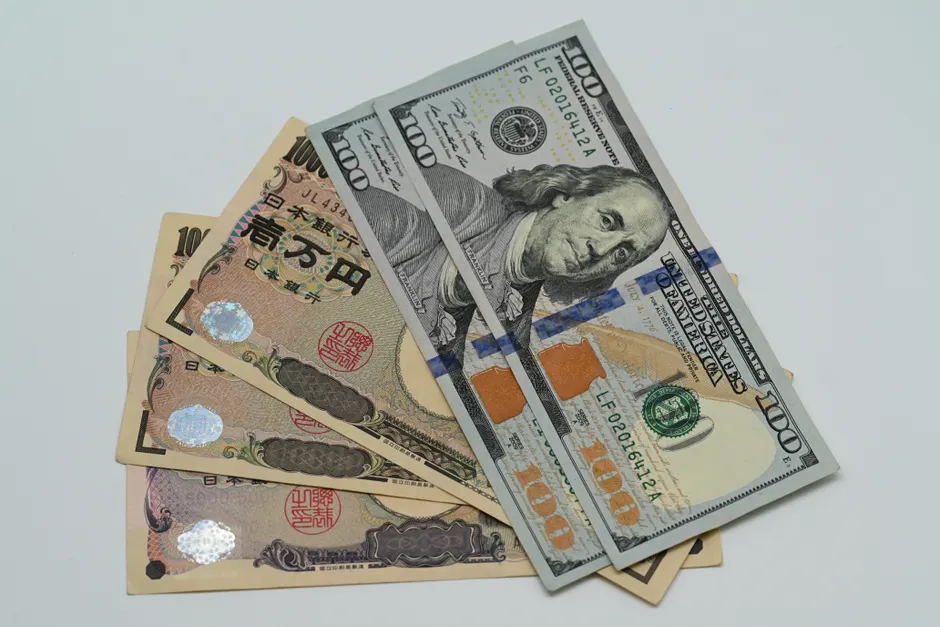
The Dollar's August Bounce: What Happened to the Yen, the Fed, and Your Money

The dollar strengthened nearly 1% against the yen in August 2026 while Asian currencies steadied in early trade, helped by fading expectations of a Federal Reserve rate hike (WSJ). The move capped a volatile stretch in which Japan's Ministry of Finance spent as much as $36.58 billion on currency intervention in early August to prop up the yen (Reuters).
Currency intervention is when a country's government or central bank buys or sells its own currency to influence the exchange rate. Japan bought yen and sold dollars, trying to push the yen's value up.
That intervention pushed the yen to a three-month peak against the dollar in early August, extending a rally from the prior week. The gains proved fleeting. By August 13, the yen weakened 0.04% to 159.48 per dollar (Reuters). A day later, on August 14, the yen had strengthened marginally to 159.37 per dollar, up 0.08%, but remained on track for a weekly decline of roughly 1% (Reuters). The latest figures are the most recent and supersede earlier data.
The yen's reversal tracks a broader shift in Fed rate-hike expectations. Fed funds futures — contracts that let traders bet on where the central bank's benchmark rate will land — were pricing in a 50% chance of a September 2026 rate increase as of August 11, down from 58% a week earlier (Reuters). Bond traders went further on August 13, stopping short of fully pricing in any Fed rate increase this year amid a retreat in oil prices (Bloomberg). The euro edged 0.03% higher to $1.1528 on the same day (Reuters).
This repricing was swift. In June 2026 the dollar climbed to a two-month peak as a 25 basis point rate hike was generally expected and almost fully priced in, according to a Scotiabank analyst (Reuters). A basis point is one-hundredth of a percentage point, so 25 basis points equals 0.25 percentage points. The turn came in early August, when weak US jobs data pushed out rate-hike expectations and the benchmark 10-year Treasury yield fell 2 basis points to 4.649% (Reuters). A Treasury yield is the return an investor earns for lending to the US government; when yields fall, it signals lower growth or inflation expectations.
The backdrop is a Federal Reserve in transition. In December 2025, investors were dialing back expectations of 2026 US rate cuts amid skepticism about Kevin Hassett, the frontrunner to succeed Jerome Powell as Federal Reserve chair (Reuters). That same month, a widely expected Fed rate cut was seen as potentially arriving just in time to support Asia's emerging-market currencies, including the Indian rupee and Philippine peso (Bloomberg). In March 2026, Fed Governor Stephen Miran said it was too early to alter the outlook for four 2026 interest-rate cuts (Bloomberg). New York Fed President John Williams said on August 3 that rates remain well positioned, with inflation expected to ease during the second half of 2026 (Bloomberg).
Gold edged toward $4,400 an ounce on August 13 as traders weighed the Fed's rate path alongside Middle East tension (Bloomberg). The convergence of falling rate-hike odds, geopolitical risk, and a softer dollar into August has lifted bullion to levels that reflect both monetary-policy uncertainty and safe-haven demand.
The broader context here matters for anyone watching currencies, bonds, or commodities. The trajectory from June's near-fully-priced hike to August's sub-50% odds has compressed into roughly six weeks. Several catalysts drove that repricing: weak labor data, retreating oil, and dovish Fed commentary. What matters for currency markets is whether the 159 level on dollar-yen holds without further intervention. Japan has already committed $36.58 billion, and the yen is back near where it was before the spending began. The 50% September odds leave enough ambiguity that a single hot inflation print or a hawkish Jackson Hole signal could reverse the drift quickly. Asian currencies have consolidated rather than rallied on the softer Fed-hike calculus, which suggests the market is treating the current pricing as provisional rather than decisive.