Apple Overhauls EU App Store Fees: No More Per-Install Charge, New Commission Tiers

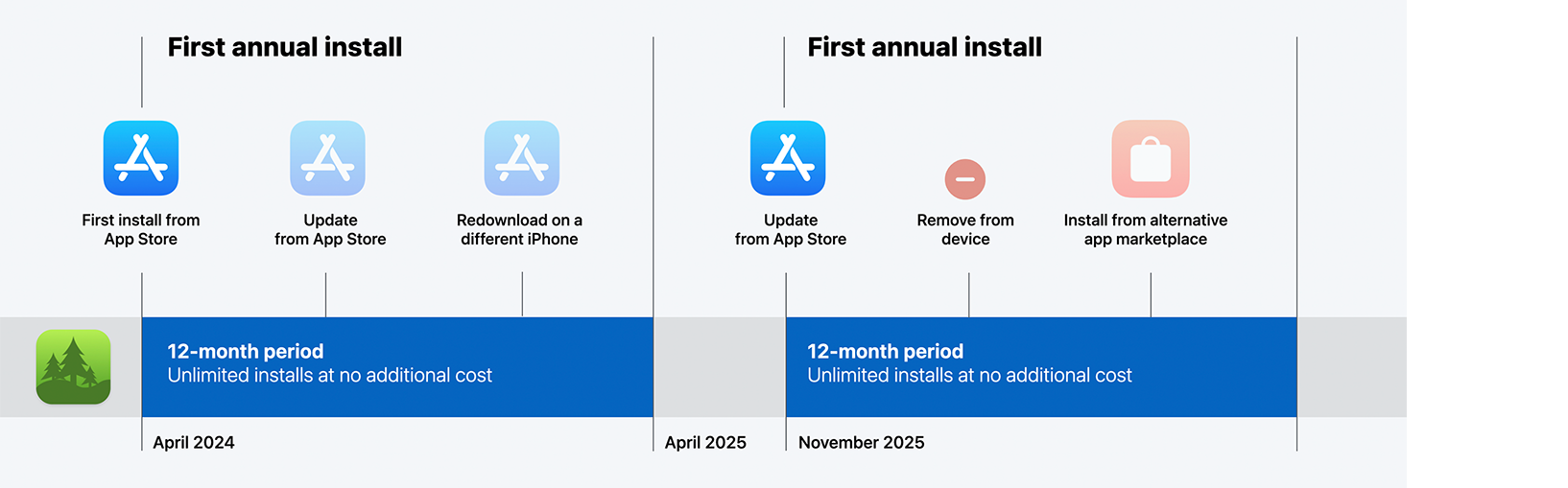
Apple will move every developer distributing apps in the European Union to a single set of business terms starting October 1, 2026, replacing the contested framework it introduced in January 2024 to comply with the Digital Markets Act. The new structure eliminates the per-install Core Technology Fee — a charge of €0.50 for each first annual install over one million that drew sustained criticism — and replaces it with a 5 percent Core Technology Commission on transactions happening entirely outside the App Store. In-store purchases carry tiered commission rates depending on the payment method used. The Verge
Think of the old system as a menu with two different price lists, and the new system as one menu for everyone. Under the unified terms, App Store apps that use Apple's in-app purchase system are charged a 26 percent commission. Developers using alternative payment providers (third-party payment processors) within the App Store pay 20 percent. Purchases that link out of an app to an external website incur a 15 percent commission. Digital transactions for apps distributed entirely outside the App Store — via web distribution or alternative app marketplaces — are subject to the 5 percent Core Technology Commission. Reduced rates apply to developers enrolled in the App Store Small Business Program, Mini Apps Partner Program, or Video Partner Program.
The previous fee structure was built around three components: a reduced commission, the Core Technology Fee, and a store services fee. Apple will no longer charge an initial acquisition fee, a store services fee, or the per-install Core Technology Fee. Apple had estimated that under the prior terms, fewer than 1 percent of developers would have paid the Core Technology Fee, but the fee drew fire from developers and regulators alike for its unpredictability and potential to penalize free-to-install apps with high install volumes. Apple Developer
Developers can now offer both in-app purchases and alternative payment systems simultaneously within a single App Store app in the EU, but must maintain whichever payment options they select for a 12-month commitment period. Web distribution remains restricted to the EU and carries eligibility requirements: a developer must be a publicly traded company or have completed a financial audit from a licensed accountant. The Verge
The new terms also introduce child safety rules specific to the EU. Kids' apps in the App Store cannot include links to external websites for completing transactions. App Store apps cannot link out for purchases when the user is under 13. Users under 18 must obtain parent or guardian permission to make a purchase using an alternative payment method inside an App Store app.
The announcement arrives after a protracted regulatory confrontation. Apple first altered its App Store rules in 2024 to comply with the DMA, a regulation the EU introduced in 2022 to reshape how designated gatekeeper companies design their products. The European Commission subsequently fined Apple after finding that its App Store anti-steering practices — rules preventing developers from telling users about cheaper payment options elsewhere — violated the DMA, and Apple lost its bid to exclude the App Store and iOS from the regulation's scope. In June 2025, Apple indicated it would move to a single EU business model by January 1, 2026. The October 1 effective date delivers on that commitment, with a revised fee architecture. Apple Newsroom
The unified terms consolidate what had been a two-track system. The prior model required developers to choose between standard terms and the Alternative Terms Addendum for Apps in the EU, creating a split ecosystem where the optimal path depended on an app's install volume, monetization model, and distribution channels. Consolidating into a single framework removes that decision point — but the new commission rates are different from both the prior standard 30 percent (or 15 percent for small businesses) and the reduced rates under the alternative terms.
For developers, the practical calculus shifts. A developer using Apple's in-app purchase under the old standard terms paid 15–30 percent. Under the new terms, that rate is 26 percent — lower than the old standard rate but higher than the small business rate. The 5 percent Core Technology Commission on fully out-of-store transactions is the lowest rate Apple has offered on digital goods in the EU, though it still attaches a cost to distribution that occurs entirely outside Apple's infrastructure. The 12-month lock-in on chosen payment options introduces a planning constraint that did not exist under the prior framework, where developers could switch between standard and alternative terms.
Simultaneously with the EU changes, Apple adjusted developer proceeds in six countries effective August 21. Brazil sees a 3.5 percent IOF (Imposto sobre Operações Financeiras) applied to developer proceeds. Canada's digital services tax is no longer applicable to developer proceeds. Estonia's VAT rate on developer proceeds increased from 22 percent to 24 percent. Romania's standard VAT rose from 19 percent to 21 percent, and its reduced VAT rate for news, magazines, books, and audiobooks increased from 5 percent to 11 percent. The Philippines introduced a 12 percent VAT for developers based outside the country. Vietnam saw multiple changes: VAT on developer proceeds for organizations outside Vietnam increased from 5 percent to 10 percent; individual developers outside Vietnam face a new 5 percent personal income tax replacing the prior corporate income tax; the reduced 0 percent VAT rate for news, magazines, and books no longer applies; organizations in Vietnam no longer have FCT remitted by Apple on end-customer sales but face a 5 percent FCT on Apple's commission; individual developers in Vietnam face a 2 percent PIT replacing CIT, plus a 5 percent FCT on Apple's commission. Apple updated Exhibits B and C of the Paid Applications Agreement to reflect the Philippines and Vietnam changes. Apple Developer News
Pricing for apps and in-app purchases in the Philippines and Vietnam will be updated September 8 for developers who did not select those storefronts as their base. Prices remain unchanged where the Philippines or Vietnam is the base storefront, for auto-renewable subscriptions in any region, and on storefronts where developers manually manage pricing rather than using automated equalized prices.
Apple's App Store adjustments are not confined to the EU. The company announced iOS changes in Brazil in June 2026 reflecting an agreement with competition regulator CADE. In Japan, the vast majority of developers on the App Store pay a reduced 10 percent commission. The EU changes, however, are the most structurally consequential: they replace a two-track system with a single framework, eliminate the most controversial fee mechanism Apple introduced under DMA compliance, and set commission rates that apply uniformly regardless of whether a developer uses Apple's distribution and payment infrastructure or opts for alternatives.
The broader context here is that the EU settlement removes the per-install fee that had become the focal point of developer and regulator criticism, and replaces it with a transaction-based commission that more closely mirrors traditional App Store economics, at different rates. Whether the European Commission considers the new structure fully compliant with the DMA's anti-steering and alternative-distribution provisions is the open question that will determine whether October 1 marks the end of this regulatory chapter or another interim step.