Apple Replaces Per-Install EU App Fee With Flat 5% Commission
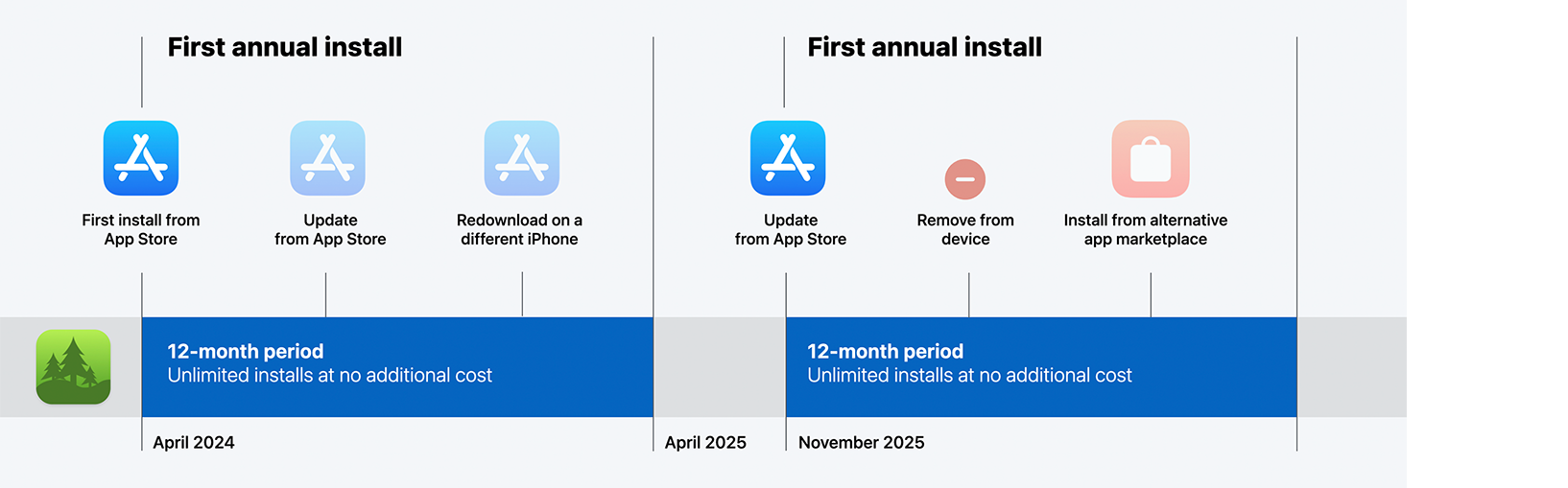
Apple announced on August 18, 2026 a simplified commission structure for apps distributed in the European Union, replacing the per-install Core Technology Fee with a flat 5% commission on digital goods sold through apps distributed outside the App Store or on the web in the EU (TechCrunch).
The new terms set Apple's in-app purchase fee at 26% for EU apps, down from the 30% charged under its traditional terms. Most developers will still qualify for a discounted 15% rate through existing programs: the App Store Small Business Program, the Mini Apps Partner Program, the Video Partner Program, and for auto-renewing subscriptions after their first year. Apps using alternative payment processors — meaning third-party services other than Apple's own in-app purchase system — will pay a 20% commission, dropping to 10% for developers enrolled in those special programs (TechCrunch).
Developers will be locked into their chosen payment configuration, whether Apple in-app purchases, external payments, or a combination, for 12 months under the new terms. External links remain barred from apps in the Kids category, and users under 18 will need parental approval before completing purchases outside the App Store (TechCrunch).
The fee overhaul arrives after the European Commission fined Apple 500 million euros in 2025 for noncompliance with the Digital Markets Act, with regulators threatening further penalties (TechCrunch). The DMA requires Apple to permit sideloading (installing apps from sources other than the App Store), third-party app marketplaces, and alternative payment systems in the EU, regardless of whether they meet Apple's own standards (Apple Newsroom).
Apple also loosened the requirements for operating an alternative app marketplace in the EU. Previously, developers had to demonstrate either significant financial backing or show at least two years of participation in Apple's Developer Program plus an app with more than one million first annual installs in the EU during the previous calendar year. Under the revised rules, those thresholds no longer apply. Apple added alternative paths to demonstrate financial backing, including public company status, financial audits, and qualifying venture capital funding (TechCrunch).
The prior fee structure, in place since Apple's initial January 2024 EU compliance announcement, layered multiple charges on apps distributed outside the App Store. As recently as February 2026, Apple charged a 15% store services commission on web sales for apps distributed via alternative app stores, alongside a 5% payment processing fee for Apple in-app purchases and a 5% Core Technology Fee (TechCrunch). The original Core Technology Fee, introduced in January 2024, assessed €0.50 for each first annual install of iOS and iPadOS apps beyond one million per year (Apple Newsroom). Developers operating alternative app marketplaces in the EU were also subject to the Core Technology Fee on every first annual install of their marketplace app (Apple Developer), and the Communication and Promotion of Offers terms set additional marketplace fees at 17% and 27%, with a €0.50 per-install charge on apps distributed through those marketplaces (Apple Developer).
The substantive change here is the shift from a per-install model to a revenue-based commission. The Core Technology Fee drew sharp criticism from developers because it imposed a fixed cost per user regardless of whether that user ever generated revenue, creating particular risk for free-to-play apps and ad-supported models with high install volumes but low per-user monetization. Replacing it with a flat 5% on digital goods ties Apple's take to actual transactions, which is more predictable for developers' unit economics and removes the install-count cliff that made scaling risky under the old structure.
One detail that deserves attention is the 12-month lock-in on payment method selection. Developers evaluating whether to move users to alternative payment processors will need to commit to that path for a full year, which raises the stakes of the decision. A developer that switches to external payments at the 20% rate and finds conversion rates dropping outside Apple's frictionless in-app purchase flow cannot easily course-correct mid-cycle. The lock-in also complicates A/B testing between payment approaches.
The loosened marketplace requirements open the door to a broader range of alternative app store operators. Removing the one-million-install and two-year-tenure thresholds means smaller entities with credible financial backing, now demonstrable through audits or VC funding rather than raw scale, can enter the marketplace space. Whether that translates into meaningful competition for the App Store depends on consumer discovery and trust, neither of which Apple's policy changes address.
Apple has been moving toward similar commission structures in other jurisdictions. In December 2025, the company announced a 5% Core Technology Commission on digital goods for iOS apps distributed outside the App Store in Japan (Apple Newsroom). In June 2026, Apple extended alternative marketplace and payment options to Brazil, while warning that the changes opened new avenues for malware, fraud, and privacy risks (Apple Newsroom). That same month, Apple reported that the global App Store ecosystem facilitated over $1.4 trillion in developer billings and sales in 2025 (Apple Newsroom.
The EU changes, taken alongside the Japan and Brazil moves, suggest Apple is converging on a model where it charges a lower, flat percentage on out-of-store digital goods rather than a per-install fee, while maintaining higher commissions on in-app purchases and alternative payments processed within its ecosystem. The net effect for developers depends on their distribution mix, monetization model, and scale, but the direction of travel is toward simpler, revenue-tied economics that align Apple's compensation with actual transactions rather than install counts.


