Ukraine's Allies Convene in Kyiv Seeking Winter Air Defence Commitments

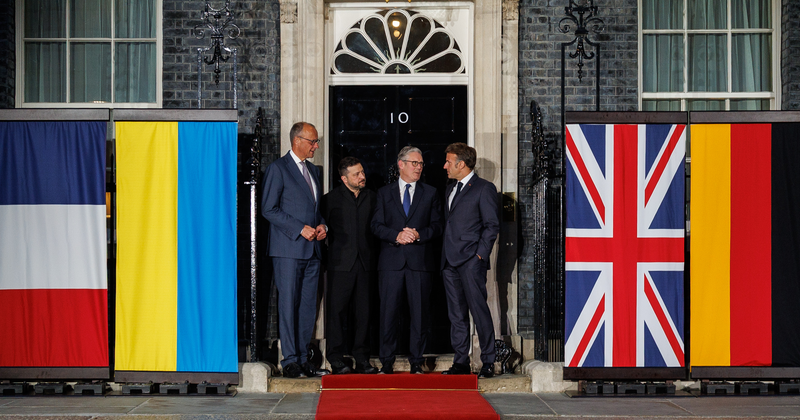
On 24 August 2026 — Ukraine's Independence Day — Kyiv hosted a Coalition of the Willing leaders' meeting chaired jointly by the United Kingdom, France, and Germany. Over 30 countries gathered to coordinate additional air defence support and increase pressure on Moscow. France had announced the meeting earlier in August as Russia escalated its airstrike campaign Le Monde.
UK Prime Minister Andy Burnham attended in person, making the Kyiv meeting his first foreign trip since taking office. European Council President Antonio Costa was also present. The summit followed a National Flag Day gathering on 23 August, when Nordic and Baltic leaders met President Volodymyr Zelenskyy in Kyiv and pledged to boost their support Al Jazeera.
At the top of Ukraine's agenda: interceptor missiles — the projectiles that air defence systems like the Patriot fire to shoot down incoming threats. Zelenskyy presented allies with a stark trajectory. Ukraine received 675 Patriot interceptor missiles across all of 2023, 364 across 2025, and a projected 264 for 2026. He is now seeking a package of at least 300 Patriot interceptors for the upcoming winter. The request follows weeks of sustained Russian missile and drone attacks on Kyiv that drove record numbers of the capital's residents into metro stations and basements for shelter.
Norway committed to providing another 85 billion kroner ($9.1 billion) in 2027, matching the level of support it gave Ukraine the previous year. At the coalition meeting, allies announced additional air defence support for Kyiv as well as exercises of the force to be deployed after a ceasefire, according to Le Monde.
The Kyiv summit caps a summer of accelerating diplomatic and industrial activity on air defence. On 13 July 2026, Ukraine and key Western allies announced a dedicated air-defence coalition that would include jointly developing a new anti-ballistic missile system Reuters. Days earlier, on 9 July, Zelenskyy confirmed that Ukraine and the United States had reached a political agreement on licences for domestic production of Patriot interceptors Reuters. Zelenskyy said in July that Ukraine and its partners could within twelve months jointly develop a mass-produced, low-cost air-defence system with missiles Arkansas Online.
The downward trend in Patriot deliveries that Zelenskyy laid out — from 675 to 364 to a projected 264 — is the backdrop against which the 300-missile winter request must be read. Think of it like a household budget shrinking each year while heating costs climb. Even if the winter request is fully met, the package would only approximate 2025 levels, which were themselves roughly half of 2023's total. The gap between Kyiv's asks and what allies have delivered has narrowed somewhat with the licensing agreement and the July coalition announcement on joint anti-ballistic missile development. But the immediate winter window leaves little time for new production lines to yield results.
Meanwhile, the fighting on both sides of the border continues to inflict civilian casualties. Russian authorities reported that two children were killed and nine other people wounded, including seven minors, when drone debris struck a private childcare centre in Krasnodar, Russia, on 24 August. The e-commerce company Ozon reported fires at its warehouses in Krasnodar and Makhachkala early that morning and evacuated sites in Adygeysk and Nevinnomyssk due to drone-attack threats. Stavropol region Governor Vladimir Vladimirov said a drone attack on an industrial area had been repelled.
In Ukraine's Kharkiv region, at least two women were killed and five wounded when a Russian drone hit an electric train on 23 August. A separate attack on the outskirts of Kharkiv city killed three people and injured eight. All casualties were reported by Al Jazeera.
The 24 August meeting also advanced planning for the post-ceasefire force that the coalition has been assembling — a contingent meant to serve as a deterrent after any future ceasefire. Exercises for that force were announced alongside the air defence commitments. This dual-track approach, pairing immediate interceptor deliveries with longer-term force planning, reflects a coalition strategy that treats air defence shortages as both an urgent battlefield problem and a structural gap requiring domestic production solutions.
Zelenskyy has framed Ukraine's vulnerability in geopolitical terms, arguing that Russia was able to start the war precisely because Ukraine remained in a "grey zone" outside any alliance. His repeated calls for air defence — dating back to an April 2024 appeal for a minimum of seven Patriot or other high-end systems, reinforced at the June 2026 G7 summit where leaders committed to providing more air defence capabilities — have gradually translated into licensing agreements and joint development plans. The delivery numbers he cited in Kyiv, however, suggest implementation remains the binding constraint.
The broader question is whether diplomatic breakthroughs in licensing and joint development can outpace the winter's demands. The coalition's next steps will likely be measured not in communiqués but in missile counts over the coming months.