European Gas Prices Have Doubled in a Year. Here's What's Driving It.
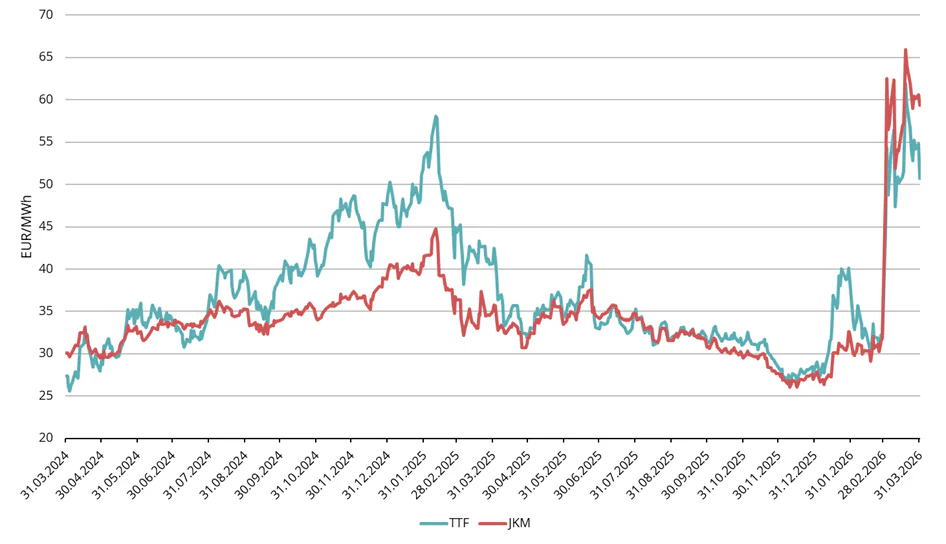
European natural gas prices settled at 68.47 EUR/MWh on August 25, 2026, barely changed from the day before. That flat daily reading, though, masks a sharp run: the TTF benchmark (Europe's main gas price reference, set at the Dutch Title Transfer Facility) was up 17.39% over the trailing month and 103.65% year-on-year as of late August, according to Trading Economics data. The ICE Dutch TTF Natural Gas Futures contract for October 2026 delivery traded at 68.500 EUR/MWh on the same date, while CME Group's Dutch TTF options contract (TTFU6) settled at 68.565 EUR/MWh on August 24, up 4.10% (2.700 EUR/MWh) from its prior close.
For context, EUR/MWh means euros per megawatt-hour, the standard pricing unit for wholesale gas in Europe. A year of doubling means household energy bills and industrial fuel costs face sustained upward pressure — even when the daily price barely moves.
The current price level is more than double the average seen just two quarters ago. The ICE Endex TTF front-month benchmark averaged 40.148 EUR/MWh during Q1 2026, per Elenger's gas market overview published April 17, 2026. That Q1 average itself was already a more than 33% increase over Q3 2025 levels. The trajectory from that quarterly average to the current €68 range implies a roughly 70% jump over roughly five months, driven by compounding supply-side stressors rather than any single shock event.
European gas storage has been on a deteriorating path throughout 2026. AGSI data reported storage at 44% of total capacity on January 26. By early March, Gas Infrastructure Europe showed levels at roughly 30%, about 9 percentage points below the same point in 2025, with TTF already trading around 65.79 EUR/MWh at that stage, according to Reuters. By August, stocks had fallen to record lows, exposing the region to price spike risk, as Reuters reported on August 5.
Think of storage as a battery. Europe enters winter drawing down that battery and recharges it over spring and summer. When the battery is already low before heating demand peaks, any supply disruption gets amplified into much higher prices.
The storage deficit has already fed into the power market. European winter electricity contracts traded at a premium exceeding 20% above the next-year benchmark in late May 2026, the highest seasonal spread since 2022, amid concurrent gas and hydro shortfalls, per Reuters. That spread — the gap between winter-delivery prices and the following year's strip (a 'strip' is a series of futures contracts priced for consecutive delivery periods) — signals that market participants expect materially tighter supply conditions in winter relative to the cal 2027 period.
The record-low August storage levels coincided with a U.S.-Iran war that tightened global LNG supply, Reuters reported. LNG, or liquefied natural gas, is gas cooled to liquid form so it can be shipped on tankers — Europe has relied on flexible LNG cargoes since losing Russian pipeline gas flows. The conflict constrained that flexible cargo availability, compounding the structural storage deficit with a flow-based supply shock. TTF's responsiveness to LNG supply is well established; the August data shows that geopolitical risk premia (extra price cushion reflecting war-related supply risk) remain embedded in the front of the curve — the nearest-delivery contracts — when inventory buffers are thin.
The scale of the 2026 price move stands out against ABN AMRO's November 2025 forecast, which projected TTF would average around €34/MWh for the full year, described as slightly below seasonal norms. The actual price path has run at roughly double that level in recent weeks.
The broader context here is that pre-conflict modeling frameworks assumed adequate LNG supply to refill storage. They did not account for the geopolitical disruption that materialized. This gap also reveals an asymmetry in gas price forecasting: base-case scenarios build in mean reversion (the assumption that prices eventually return toward their historical average), while tail events driven by supply-side shocks can persist far beyond the time horizons those models cover.
Looking at what this means for market participants, the convergence of record-low storage, a geopolitical LNG supply constraint, and a winter power premium at multi-year highs creates a fragile setup heading into the heating season. The TTF curve is pricing scarcity, not just elevated fundamentals. ABN AMRO's €34 forecast assumed the opposite. The gap between that projection and the current €68 spot price is a measure of how much geopolitical risk has been re-priced into European energy in 2026, and how quickly supply-side assumptions can be invalidated when storage buffers are already depleted. With winter electricity contracts already signaling tightness and LNG flexibility constrained by conflict-driven supply disruption, the marginal cargo and the storage refill trajectory through autumn will be the variables to watch.
A 'marginal cargo' is the next available LNG shipment that a buyer can bid for — when supply is tight, the price of that single shipment can move the entire market.