European Gas Prices Drop 20% After US-Iran Ceasefire: What Traders Actually Need to Know
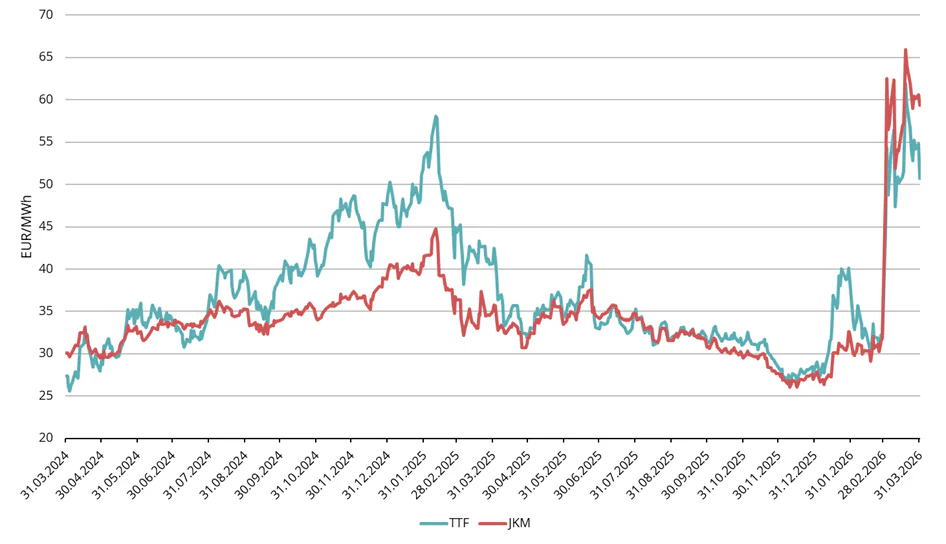
European natural gas prices fell sharply in early July 2026 following a US-Iran ceasefire agreement, with the Dutch TTF benchmark declining roughly 20%, according to WAFA. The move unwound a geopolitical risk premium that markets had baked into contracts for months—essentially a price cushion that traders add when they worry political tensions might disrupt energy supplies.
Before the ceasefire news broke, the TTF July 2026 contract was trading at EUR 42.525/MWh, per S&P Global. A 20% decline put spot pricing in the low EUR 34/MWh range—a genuine reprieve for factories and utilities managing their forward hedges, though still well above the 2019 baseline before the energy crisis hit.
S&P Global called this relief "welcome but limited," and there is reason to take that framing seriously. Iran is not a direct supplier to European gas infrastructure, but the ceasefire's real impact runs through global shipping lanes and the wider LNG market. When traders feared disruption in the Strait of Hormuz, they added a tail-risk premium to European prices—essentially insurance against a tighter global LNG supply that would leave fewer flexible cargoes available for European buyers. That premium has come out. But the drop does not solve the underlying supply pressures: European storage levels, Norwegian maintenance schedules, and the pace at which new US LNG export capacity reaches the market remain unchanged.
The price move landed during a period of extraordinary trading activity. Intercontinental Exchange reported that TTF natural gas average daily volume rose 28% year-over-year in July, with futures volume hitting a record 2.4 million lots. When a big directional move coincides with record trading volumes and open interest, a familiar pattern emerges: hedgers rush to rebalance their positions while speculators chase momentum, narrowing bid-ask spreads and pulling in traders who normally sit on the sidelines.
But the 28% volume surge reflects something deeper than one news event. European energy markets have been restructuring since 2022—more participants, more diversified supply routes, heavier use of derivatives by utilities and industrial buyers who once relied on long-term bilateral contracts. This structural shift means higher baseline volatility and larger hedging needs, which mechanically pushes exchange volumes higher even during quiet periods. A July 2026 record is consistent with that multi-year reorientation, not just a single-day spike around the ceasefire.
For market participants, the implications are mixed. The price drop cuts near-term input costs for gas-intensive businesses and gives utilities a window to replenish storage at lower levels. But hedgers locked into forward sales above spot prices are watching mark-to-market losses build. For LNG traders, narrower Europe-Asia spreads after European prices fall can shift cargo flows elsewhere—a feedback loop that tends to soften the initial move over weeks rather than sustain it.
The real question is whether the ceasefire holds. Regional ceasefires have a spotty track record, and any escalation would likely push the risk premium back into TTF prices quickly, particularly if storage fills came in weaker than seasonal norms. Traders and risk managers should view EUR 34/MWh as a floor that depends on the geopolitical situation staying stable, not as a new fundamental price anchor.
For now, European gas markets show an unusual profile: cheaper and more actively traded at the same time. That is not the typical setup—volume usually spikes when prices are rising and uncertainty is climbing. Whether the ceasefire marks a lasting repricing or a temporary dip before geopolitical risk resurfaces is the central question as Q3 2026 storage season approaches.