Plaud One: Earbuds With a Cellular Charging Case for Standalone AI Note-Taking
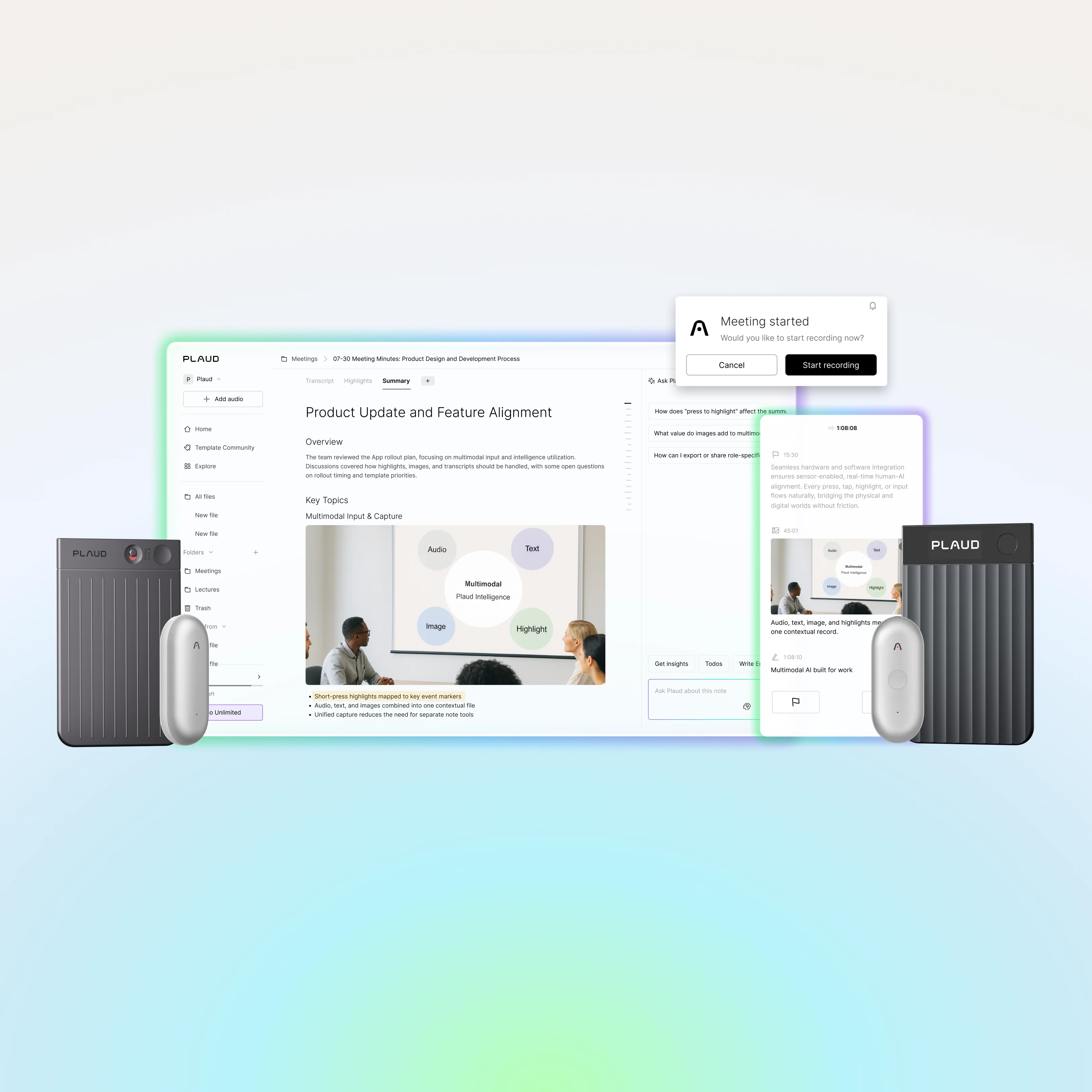
Plaud has launched the Plaud One, a pair of earbuds whose charging case carries its own eSIM — an embedded SIM card that connects directly to a cellular network — allowing users to invoke Plaud's AI agents without a phone or computer nearby. The product, announced August 27, 2026, extends Plaud's note-taking platform from a software-and-wearable business into the competitive earbuds category (TechCrunch).
The earphones serve two roles. As conventional earbuds, they pack 12mm drivers and active noise cancellation. As a recording device, they capture six hours of in-person meetings or three hours of calls on a single charge. Combined with the charging case, total recording capacity rises to 25 hours. The case itself functions as an independent recorder: Plaud says it captures voices clearly within a five-meter range, and it can take notes from in-person conversations independently of the earbuds.
The eSIM in the case is the distinguishing technical detail. With a cellular connection, users can instruct Plaud's AI agents remotely, which means the case can transcribe, summarize, and act on conversations without tethering to a smartphone or laptop. Plaud's AI agent integrates with Gmail, Google Calendar, Notion, and Slack, and can draft follow-up emails or generate documents and presentations based on transcribed content. The company plans to introduce a credit-based system for agentic tasks — meaning automated actions taken by the AI on the user's behalf — in a forthcoming update; buyers receive $200 in agentic-task credits at purchase.
Plaud One includes 300 free transcription minutes per month. Beyond that, paid plans start at $8.33 per month when billed annually. The launch is limited in quantity as the company gauges demand for AI-focused earphones.
The competitive field for note-taking earbuds already includes Viaim, Anker, Pocket, Comu, and Genspark. What separates Plaud's approach is the eSIM-enabled case functioning as a standalone AI agent endpoint. Rival products in this category have largely positioned themselves as earbuds with transcription features bolted on; Plaud is inverting that by making the case itself the primary compute and connectivity node.
Plaud, led by CEO Nathan Xu, claims an annual run-rate revenue of $100 million as of June 2026 and says it has shipped over 2 million AI notetakers. The company reports more than 2.5 million people using its hardware or software across its product line, which includes the NotePin wearable and Plaud Desktop software.
The monetization architecture here deserves attention. The Plaud One is not a one-time hardware purchase; it is a device that feeds a subscription and credit-based services layer. The 300 free monthly minutes are enough to demonstrate value but will exhaust quickly for anyone using the product for daily meeting capture. The $200 in agentic-task credits and the planned credit system signal that Plaud sees the earbuds as an on-ramp to recurring AI service revenue rather than a standalone peripheral. Whether that model holds depends on whether the agentic capabilities — drafting emails, creating documents, updating Slack — deliver enough utility to justify ongoing spend beyond what users already pay for general-purpose LLM subscriptions.
The five-meter capture range on the case also raises consent considerations that the product announcement does not address. A device that can record conversations across a room, transcribe them, and push summaries into Slack and Notion without a phone present is powerful and convenient for the user. It is less clear how it works for everyone else in that five-meter radius. Two-party and all-party consent laws vary by jurisdiction, and hardware that makes ambient recording trivial will eventually test those frameworks. This is not a new problem — it attended the original Plaud NotePin and every other always-on recording wearable — but an eSIM-equipped case that can act autonomously sharpens it.
The broader context here is the migration of AI agent interfaces from screens to ambient hardware. Plaud's product line already spans in-person recording (NotePin), phone-call capture, and online meetings, positioning it across the full spectrum of conversational surfaces. The Plaud One adds earbuds with a cellular-connected case to that stack. The company's self-description as "the world's No.1 AI note-taking brand" is a marketing claim, not an independently verified ranking, but the $100 million run-rate and 2 million units shipped give it a credible installed base.
The limited-quantity launch is a reasonable hedge. AI-focused earbuds sit in an awkward category: premium enough to require meaningful hardware investment, niche enough that demand is unproven. Plaud's rivals are still calibrating their own positioning in this space, and the category itself is less than two years old in its current form. A constrained first run lets Plaud measure conversion rates among its existing 2.5 million users before committing to volume production.
What this enables, if the execution holds, is a genuinely phone-light workflow for knowledge workers: walk into a meeting, set the case on the table, and leave with a transcribed summary already routed to the right tools. Whether enough professionals want that workflow badly enough to pay for it, month after month, is the question this limited launch is designed to answer.