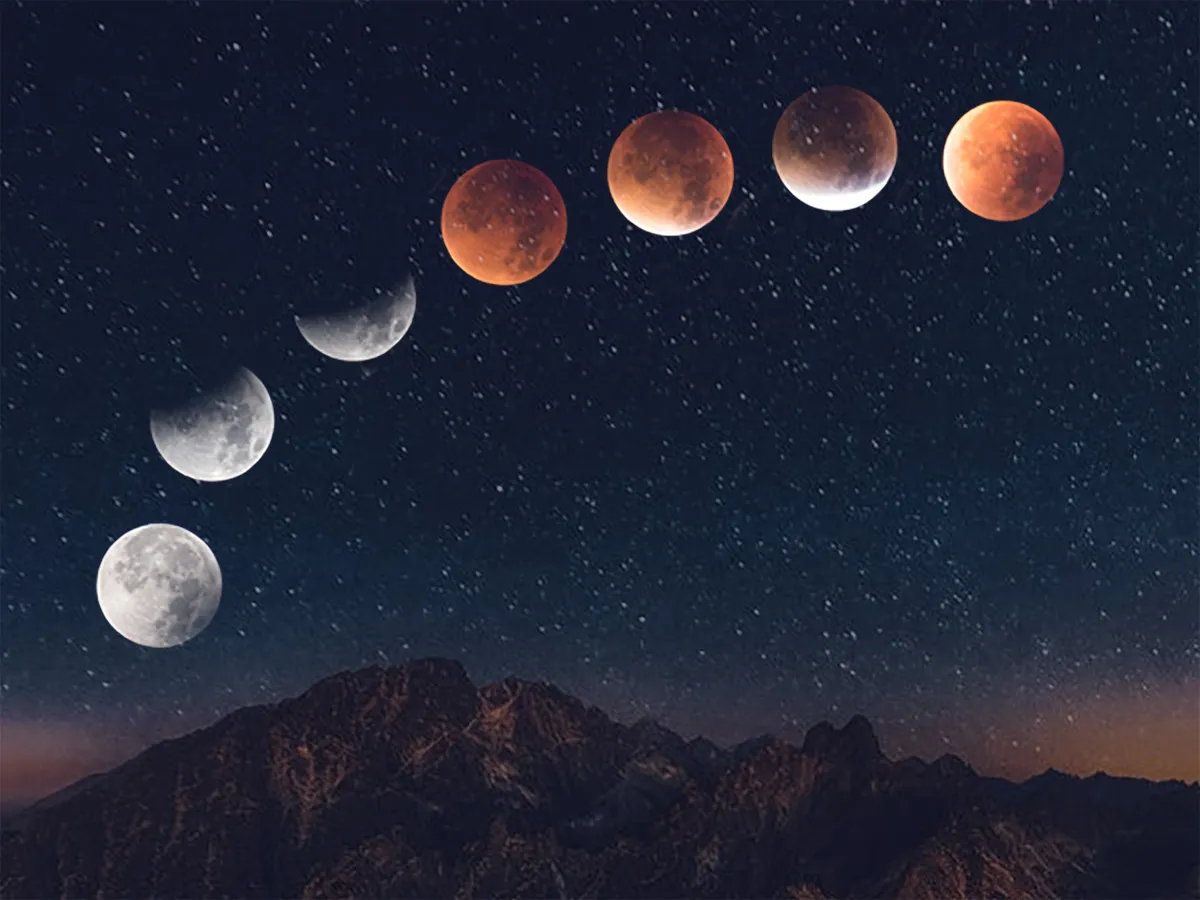
A Near-Total Lunar Eclipse Lit Up the Night Sky — and It Nearly Turned the Moon Red

On the night of August 27–28, 2026, skywatchers across the Americas, Europe, and Africa watched the Moon pass deep into Earth's shadow, reaching 96.2% coverage at peak (timeanddate.com). The Royal Observatory Greenwich recorded roughly 93% coverage for observers in the UK and Ireland during the early hours of August 28 (Royal Museums Greenwich). NASA's Scientific Visualization Studio placed the moment of greatest eclipse at 4:13 a.m. Universal Time, with optimal visibility across western Europe and western Africa (NASA SVS).
Though technically a partial eclipse rather than a total one, the depth of Earth's shadow coverage meant that many observers saw the Moon take on the reddish-orange hue widely associated with a "Blood Moon." BBC News reported that stargazers across the West had a chance to see this rare coloration at its most stark during the event (BBC News). The effect occurs when the Sun, Earth, and Moon align so that the Moon passes through Earth's shadow, and only longer-wavelength red light — bent, or refracted, through Earth's atmosphere — reaches the lunar surface (BBC News).
NASA explains that this reddish-orange appearance is caused by the same Rayleigh scattering process that makes the daytime sky blue and sunsets red. During a total lunar eclipse, the Moon appears dark red or orange, which is why it is sometimes called a "blood Moon" (NASA Science). At 96.2% shadow immersion, the August 28 event came close enough to totality to produce a comparable visual effect across much of the shadow-covered portion of the Moon's disk.
The August 28 eclipse followed a particularly active period for celestial events. On August 12, 2026, a total solar eclipse swept across Greenland, Iceland, northern Russia, the Atlantic Ocean, and Spain (NASA Science). NASA's August 2026 skywatching tips had flagged both the solar eclipse and the deep partial lunar eclipse as highlights of the month, alongside the Perseid meteor shower and bright Venus after sunset (NASA Science). The two eclipses fell within roughly two weeks of each other, a pairing that occurs because solar and lunar eclipses come in seasonal "windows" — periods when the geometry of the Sun-Earth-Moon system allows alignments in quick succession.
The broader context here is that 2025–2026 has been an unusually productive interval for lunar eclipse observers. BBC Newsround reported that between 2025 and 2026, stargazers were treated to three Blood Moon events (BBC Newsround). One of these was visible on March 13–14, 2026, depending on the viewer's location (BBC Newsround). Another, in March 2026, saw the full Moon peak across the UK on March 3 and appear as a Blood Moon in some parts of the world (BBC Newsround). The clustering of these events is tied to the Moon's orbital nodes — the two points where the Moon's tilted orbit crosses the plane of Earth's path around the Sun. When those nodes align with the Sun-Earth-Moon line repeatedly over a relatively short span, eclipse seasons become more productive. As the nodes drift out of alignment, the frequency of total or near-total lunar eclipses drops accordingly.
For observers in North and South America, parts of Europe, and parts of Africa, the August 27–28 event offered a near-total lunar eclipse without technically reaching totality (timeanddate.com). The distinction between a deep partial and a total eclipse is not merely categorical. The remaining sliver of the lunar disk outside the darkest part of Earth's shadow retains its normal silvery color, creating a visual contrast that some observers find more striking than the uniform red of a fully total event. The effect is most pronounced near the edge of the Moon farthest from the center of the shadow.
Looking at what this means for near-term skywatching prospects, the August 28 deep partial lunar eclipse caps a fortnight that began with the August 12 total solar eclipse across the North Atlantic and Arctic regions. That solar eclipse was the most significant of its kind in nearly 30 years, according to BBC News (BBC News). With the Moon's nodes beginning to shift, the current window of frequent, high-coverage lunar eclipses will narrow. The next sequence of comparable depth or totality depends on the recurrence of favorable node alignment, which operates on an approximately 18-year cycle known as the saros. Observers tracking the saros series associated with this eclipse will note that each successive member shifts slightly in timing and geographic visibility, meaning the exact viewing geometry of August 2026 will not repeat in identical form for roughly a decade and a half.
The August 28 event rounded out a month in which NASA's skywatching guidance pointed amateur and professional observers toward four major phenomena: the solar eclipse, the Perseids, Venus at peak evening brightness, and this deep partial lunar eclipse (NASA Science). For those positioned in the visibility corridor, the combination of 96.2% shadow coverage and the resulting red-on-silver contrast made it one of the more photographically distinctive lunar eclipses of the 2025–2026 window.