China's Humanoid Robot Games: A Mega-Scale Showcase With Engineering Rough Edges

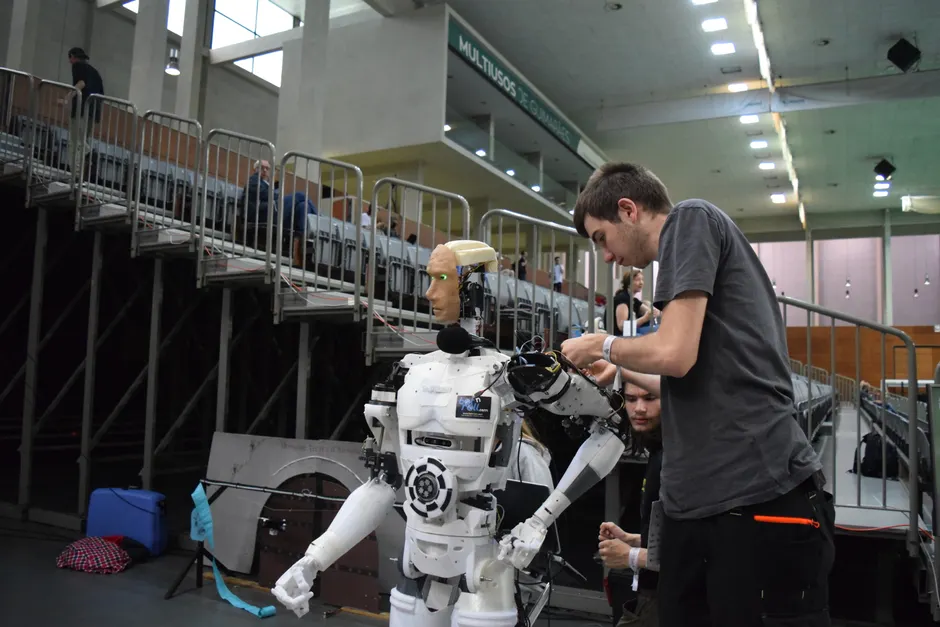
From 22 to 26 August 2026, Beijing hosted the second World Humanoid Robot Games, bringing together 666 teams from 16 countries across five continents and 2,056 humanoid robots into 50 competition events. The games were co-hosted by the Government of Beijing Municipality and opened with a ceremony on 22 August at the National Speed Skating Oval, known as the "Ice Ribbon." Over 2,000 humanoids built by more than 660 mostly domestic Chinese tech companies competed across the five-day programme (The Guardian; Beijing Municipal Government).
Reuters described the event as the latest and biggest incarnation of a competition with roughly a decade of history in China (Reuters). The Beijing municipal government framed the games as a "key window for showcasing innovation achievements, promoting scenario applications and international technical exchange, and an engine for developing the embodied intelligence industry," and as a "real-world training ground for the humanoid robot industry providing high-difficulty, full-scenario and extreme competitive environments" (Beijing Municipal Government, 23 August; Beijing Municipal Government, 27 August).
"Embodied intelligence" refers to AI systems housed in physical bodies that interact with the real world — think of it as artificial intelligence that can walk, grip, and navigate rather than just process data on a screen.
The competitions produced moments that swung between spectacle and setback. In the 100m sprint, robot sprinters reportedly ran quicker than Usain Bolt's world record before crashing into a padded wall. A Tiangong humanoid robot caught fire after finishing a 100m large-size group semifinal race (Reuters; The Guardian). The sprint results call for caution: the headline speeds almost certainly reflect tethered or rail-assisted configurations rather than autonomous free-running locomotion, though the verified sources do not specify the mechanical setup. The fires and crashes, meanwhile, point to thermal management (keeping batteries and motors from overheating) and structural integrity under dynamic load as unresolved engineering challenges for two-legged robots operating at competitive speeds.
China's dominance in humanoid production is quantified by the Mercator Institute for Chinese Studies (MERICS), which reports that China produced 12,800 humanoids in 2025, approximately 90% of the global total (The Guardian; MERICS). That figure helps explain the domestic-heavy exhibitor base at the games.
The broader context here is that China's advantage in the sector appears concentrated in manufacturing scale rather than in capabilities at the technological frontier — building lots of robots, not necessarily the most advanced ones. That distinction matters because production volume alone does not tell you who is closest to a genuinely useful, deployable humanoid.
The geopolitical backdrop is sharpening. In August 2026, US President Donald Trump banned imports of Chinese humanoids and four-legged robot dogs, citing cyber and national security concerns (The Guardian). The games took place weeks before Chinese President Xi Jinping was scheduled to land in Washington DC for a summit with Trump. The proximity is unlikely to be coincidental. Beijing has consistently used large-scale technology showcases as instruments of strategic signalling, and staging the games on the eve of a high-stakes summit positions the embodied-AI sector as a lever in the broader bilateral contest over emerging-technology supply chains.
On the competitive landscape outside China, Elon Musk's Optimus humanoid was reported to have finally entered production in August 2026 (The Guardian). That timing places Tesla's long-delayed commercialisation effort alongside a Chinese ecosystem that has already demonstrated volume output at the games, even if individual platform performance remains uneven.
What this means in practice is a sector caught between rapid industrial scaling and persistent technical immaturity. China's near-total share of humanoid production in 2025, as reported by MERICS, gives Beijing commercial leverage and a data-generation advantage through sheer deployment volume. The import ban from the United States, conversely, signals that Washington views the humanoid form factor as a category with sufficient security implications to warrant pre-emptive exclusion, placing it alongside semiconductors, telecoms equipment, and connected vehicles in the expanding perimeter of US-China technology decoupling (the gradual separation of the two countries' technology supply chains). The Xi-Trump summit will be the first face-to-face engagement between the two leaders since the ban took effect, and the embodied-AI industry now sits squarely within that negotiating frame.
The games themselves, with 50 events spanning what the Beijing government described as "full-scenario" competitive environments, function as both a benchmarking exercise and a stress test. The Tiangong fire, the sprint crashes, and the sheer volume of participating platforms collectively illustrate where the industry stands: manufacturing at scale, competing in public, and still working through the engineering fundamentals that separate a demonstration from a deployable product.