UK Telecoms Executives Warn That Slow Network Upgrades Could Cost Britain Its Place in the AI Race
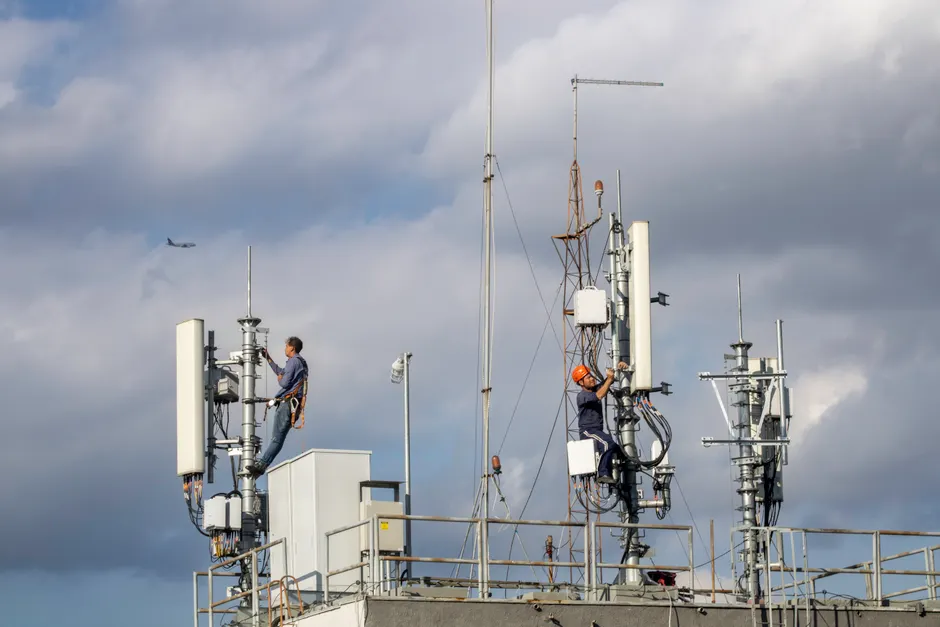
Senior UK telecoms executives warned on 29 August 2026 that Britain risks falling behind in the global AI race because network upgrades are not keeping pace with rival nations, according to reporting by The Guardian. The warning comes as AI applications increasingly depend on mobile networks that can handle huge amounts of data with minimal delay — the kind of performance the UK's current infrastructure struggles to deliver.
Andrea Donà, networks director at VodafoneThree — the UK's largest mobile operator — said British networks are "sub-optimal for current services" and that he is "embarrassed at the level of network quality." VodafoneThree has committed £11 billion to upgrade mobile masts for 5G standalone (5G SA) technology. 5G SA is the newest form of 5G: instead of leaning on older 4G equipment behind the scenes, it runs on a fully independent core network. That matters because 5G SA enables features like network slicing (dividing one physical network into multiple virtual networks, each tuned to a specific use case), ultra-low latency (near-instant response times), and the consistent, predictable performance that AI applications need.
But VodafoneThree is simultaneously reducing its nationwide mast footprint by 30%, consolidating sites as part of the Vodafone-Three UK merger integration. Around 96% of the upgrades the operator needs are on existing sites, yet more than half of those require some form of planning permission, creating a bureaucratic bottleneck that executives argue could stall deployment timelines.
The infrastructure gap is quantified in damning terms. A Which? report drawing on Opensignal data found that UK mobile coverage is worse than in any of the 27 EU member states and every other G7 member. The UK ranks 57th globally for overall network performance, 70th for download speeds, and 55th for the reliable quality needed for activities such as video calls, streaming, and gaming — the same real-time workloads that AI-driven applications will intensify.
Ofcom's most recent data, from its Connected Nations Spring 2026 update, reports that 5G standalone coverage outside premises ranges between 49% and 85% across the three main mobile network operators. While overall 5G coverage outdoors from at least one operator stands at 97% (up from 95% the previous year), the standalone figure matters: non-standalone 5G relies on a 4G core, which limits the latency and reliability gains that AI traffic demands. All four major UK mobile networks have launched 5G services, but the migration to true 5G SA architecture remains uneven.
Donà likened the risk of an AI-traffic crunch to the signal loss consumers already experience at large public events — a gig at Wembley, the British Grand Prix at Silverstone, or a rugby international at Twickenham — where concentrated demand overwhelms available capacity. AI traffic, distributed across millions of edge devices (phones, sensors, and other connected gadgets that process data close to where it's generated), would generalise that strain from stadium-scale events to everyday network conditions.
An unnamed senior telecoms executive described the AI-connectivity challenge as "nascent" but predicted it will become a "national competitiveness issue" comparable to the UK's historically slow full-fibre broadband rollout. The UK previously had one of the slowest broadband speeds in Europe, a deficit it has since addressed through full-fibre connections from BT's Openreach and other providers. The executive expects AI to be integrated into consumer devices within two or three years, compressing the window for infrastructure readiness.
The competitive stakes extend beyond UK borders. Nvidia CEO Jensen Huang said in November 2025 that China would "win the AI race" partly because of its energy subsidies for datacentres, framing the contest as one where national infrastructure policy — not just private capital — determines outcomes. The UK's planning-permission friction and coverage deficit place it on the wrong side of that equation.
The telecoms sector's own workforce transformation compounds the tension. BT announced in May 2023 plans to reduce its workforce by up to 55,000 jobs by 2030, more than 40% of its total, as it pushes into AI. In June 2025, BT's chief executive said advances in artificial intelligence could lead to deeper job cuts at the FTSE 100 company. Optus CEO Stephen Rue said AI will improve customer service and efficiency in telecoms, but that people are still required for decisions. Anthropic CEO Dario Amodei separately predicted AI could wipe out half of all entry-level white-collar jobs — a forecast that, if even partially realised, would reshape demand patterns on telecoms networks themselves.
The broader context here is one of timing misalignment. Network operators are investing — VodafoneThree's £11 billion commitment is substantial — but the pace of physical infrastructure deployment, constrained by planning permission regimes and site consolidation, is not obviously matched to the two-to-three-year horizon executives give for AI integration into consumer devices. The UK's full-fibre broadband catch-up showed that the country can close infrastructure gaps, but the political and regulatory machinery that enabled that build-out took the better part of a decade. The AI-readiness window is measured in years, not decades.
For policymakers, the Which? and Opensignal rankings offer a blunt benchmark: 57th globally for network performance is not a position from which any G7 economy should be launching AI-dependent services. Whether the planning-permission bottleneck becomes the focus of reform, or whether the UK repeats the pattern of slow recognition followed by accelerated catch-up that characterised its broadband history, will likely determine whether the infrastructure is ready when the devices arrive.