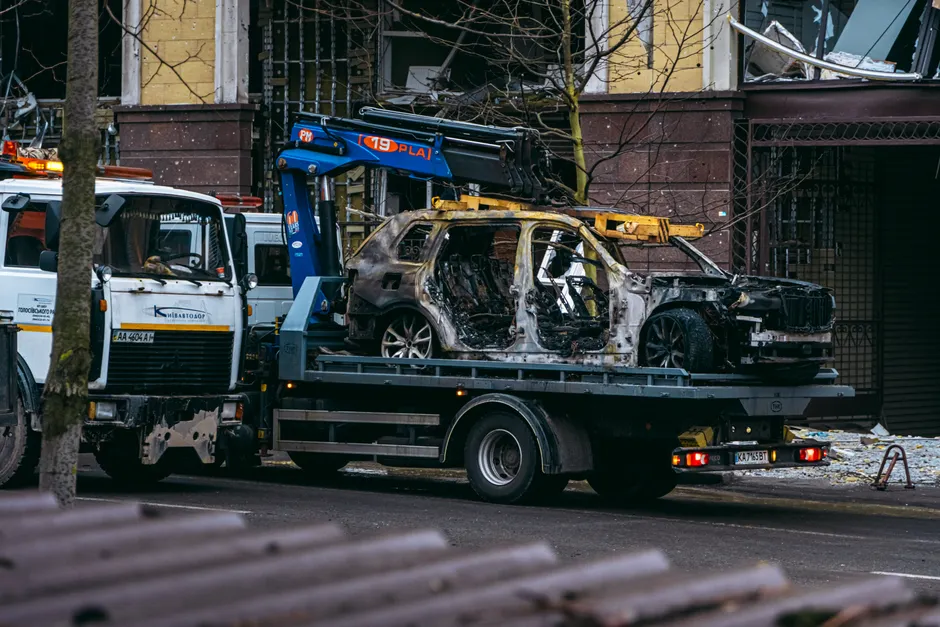
Russia's Drone Barrage on Kyiv Hits Record Intensity: What the Escalation Reveals

Kyiv experienced 13 air raid alerts in a single 24-hour period on August 27, 2026 — the highest daily count for the capital since Russia's full-scale invasion began in February 2022. The warnings continued into the early hours of August 28, with the city under alert 17 times between midnight and 9 a.m. as waves of Russian drones struck the capital for a second straight day (Kyiv Post).
One person was killed and two were injured in the Kyiv region during the August 27 drone attacks, according to Euronews (Euronews). The same hours-long assault also hit Ukrainian ports, industrial sites, and retailers' distribution centers with missiles and drones, widening the target set beyond the capital itself (Reuters).
The attacks were not confined to Kyiv. Ukraine's military reported that air defenses shot down or electronically suppressed 233 Russian drones across northern, southern, eastern, and central Ukraine during near-continuous air raid alerts that stretched into a third day (Kyiv Independent). The geographic spread across all four regional commands suggests an operational tempo designed to strain Ukrainian air-defense coordination along multiple axes at once, rather than concentrating firepower on a single sector.
The late August assault fits a pattern of escalating Russian aerial campaigns throughout 2026. In mid-May, Russia carried out its largest two-day aerial offensive of the war, launching 1,567 drones and killing at least 27 people (Reuters). Days later, a combined missile-and-drone attack with Kyiv as the primary target saw Ukrainian forces intercept 604 aerial targets, including 55 missiles and 549 drones, with at least two fatalities (Reuters).
On July 2, Russia launched hundreds of drones and dozens of missiles at Kyiv in a single wave, killing at least 21 people and wounding more than 90 (Reuters). Five days later, on July 7, Kyiv came under attack for the third time in a week as Russia fired ballistic missiles overnight and kept up jet-powered drone pressure through the day, killing at least three (Reuters).
The trajectory across these months points to a deliberate Russian operational shift. Drone sortie rates (the number of individual attack flights per engagement) have grown from the hundreds per major attack in May to sustained, multi-day campaigns by August. The 1,567-drone May barrage and the 233 drones intercepted in a single late-August engagement both reflect production and launch capacity that far exceeds 2024 levels. The August 27 record of 13 alerts in 24 hours is not a one-off anomaly but the crest of an upward curve visible since spring.
The broader context here is worth examining for what it reveals about the conflict's current phase. Russia's drone production has clearly scaled up. The shift toward targeting distribution facilities and retail logistics, as seen on August 27, extends the strike footprint into supply-chain infrastructure, potentially degrading civilian resupply networks alongside traditional military and energy targets. The reliance on wave-after-wave drone tactics, rather than single mass salvos, forces Ukrainian air-defense crews into sustained engagement cycles. This approach depletes interceptor missiles (the projectiles used to shoot down incoming threats) and wears down operator endurance over time. The August 27-28 sequence, with 17 alerts in nine hours overnight, is a case study in that method — think of it as a siege rather than a single battering ram.
For Ukraine, the interception rate remains high. The 233 drones shot down or suppressed in the latest wave, and the 604 aerial targets intercepted in the late-May combined attack, indicate that Ukraine's layered air-defense architecture (multiple defensive systems working at different ranges and altitudes) continues to function across multiple threat vectors. The human cost, however, persists: each major attack produces casualties, and the cumulative toll on civilian infrastructure and morale compounds with every wave.
The strategic question now is whether Russia can sustain this sortie density through the autumn. Historical patterns in this war suggest that aerial campaign intensity has fluctuated with munitions availability, weather conditions, and rotational cycles of strike packages. The August escalation may represent a peak before a logistical plateau, or it may mark a new baseline as Russian production lines continue to expand. Either way, Kyiv's air-defense calculus has shifted from intercepting episodic major strikes to managing near-continuous engagement.