Russia's Jet-Powered Drones Are Overwhelming Ukraine's Air Defenses

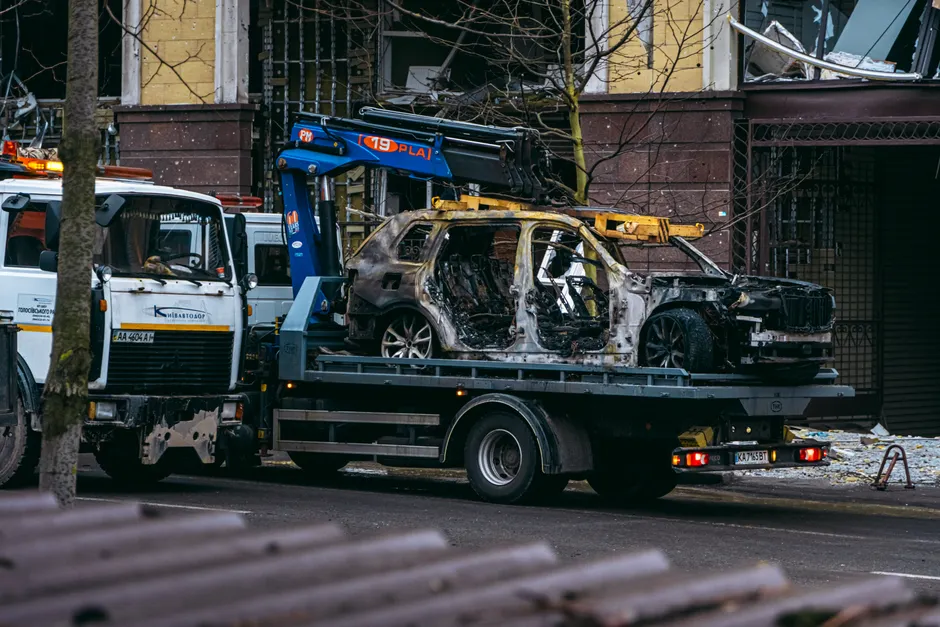
Russia has scaled up its use of jet-powered drones against Kyiv faster than Ukraine can field countermeasures, according to reporting from late August 2026, leaving the capital under near-constant assault and exposing widening gaps in air-defense coverage across the country. The drones reach speeds of roughly 300 miles per hour, stretching Ukrainian air defenses thin and producing a higher rate of successful strikes than earlier drone campaigns achieved, according to The Wall Street Journal. New York Times Wall Street Journal
The attacks continued into early September 2026. Kyiv has been under near-constant assault from jet-powered drones for days, unnerving parents of children attending underground schools, according to the New York Times. New York Times Ukrainian forces have significantly improved their ability to shoot down drones and have ramped up their own long-range drone production capacity, the Washington Post reported on September 2, 2026, but the pace of Russia's jet-drone deployment has outstripped these gains. Washington Post
Russia's current drone campaign builds on an earlier chapter in the same conflict. In December 2022, Ukraine used Soviet-era jet drones to target Russian military bases deep inside Russian territory, according to the New York Times, marking one of the first documented uses of jet-powered unmanned systems in the war by either side. New York Times The current Russian campaign, however, involves a different scale of deployment and a different generation of platforms. The Kharkiv National University of the Air Forces has documented that the Russian Federation actively uses "Shahed"-type strike drones and other unmanned aerial vehicles to carry out attacks on Ukrainian territory. Kharkiv National University of the Air Forces Ukrainian military-academic institutions have been working on counter-drone systems: the physics and radio-electronics department of the Ivan Kozhedub Kharkiv National Air Force University designed and developed systems to combat unmanned aerial vehicles at the request of a military customer. Ivan Kozhedub Kharkiv National Air Force University
The drone threat has also spilled beyond Ukraine's borders. A Russian drone struck Romania, a NATO member, and the failure to protect alliance territory increased anxiety about NATO's reliability, the New York Times reported in May 2026. New York Times That incident fed into a broader European concern that has only deepened since: in March 2026, the New York Times reported that European allies are increasingly concerned Russia is preparing to deliver advanced drones to Iran for use in its war with the United States. New York Times
The strategic picture here is multi-layered. On the tactical level, the core problem is an asymmetry in iteration speed — the rate at which each side can improve and deploy new technology. Russia has moved from modified propeller-driven Shahed variants to jet-propelled platforms that compress the engagement window for Ukrainian air-defense crews to a matter of seconds rather than minutes. Ukraine's countermeasures, including domestically produced interceptor drones and electronic-warfare systems (tools that disrupt or disable enemy electronics), developed through institutions like the Ivan Kozhedub Kharkiv National Air Force University, are advancing. But the development-to-deployment cycle for defensive systems is inherently longer than the modification cycle for offensive platforms. Think of it as a penalty kick in soccer: the goalkeeper must cover the entire goal, while the shooter only needs to find one open corner. A defender must account for multiple attack vectors, flight profiles, and counter-electronic-warfare measures, while the attacker needs to optimize for only one penetration path.
At the operational level, Russia's sustained, all-day drone campaigns appear designed not merely to destroy infrastructure but to exhaust Ukrainian air-defense stocks and personnel. Each interceptor missile expended in defense is a resource that cannot be replenished as quickly as Russia can produce or procure replacement drones. The economic math favors the attacker.
The NATO dimension compounds the problem. A single drone strike on Romanian territory did not trigger Article 5, the alliance's mutual-defense clause that treats an armed attack on one member as an attack on all. But it did expose the gray zone in which alliance members operate when Russian military activity physically reaches member-state soil without rising to the level of a deliberate armed attack. If Russia follows through on transferring advanced drone technology to Iran, the same platforms threatening Kyiv could appear on a different battlefield, complicating U.S. and allied force-protection calculations in the Middle East.
The broader question is whether Ukraine's gains are arriving fast enough. Ukraine's improved shoot-down rates and expanded long-range drone production capacity, noted by the Washington Post on September 2, suggest that the gap is narrowing, not widening, on certain metrics. Whether that improvement can keep pace with Russia's jet-drone scaling is the operational question driving the next phase of the war. Washington Post