Anker's IFA 2026 Charging Lineup Puts Screens on Nearly Everything
Anker used its IFA 2026 press day on September 3, 2026 to unveil a new lineup of charging devices — combo chargers, a power bank, laptop chargers, and charging stands — with built-in displays on almost every unit. The announcement was part of a broader 22-product reveal that also included headphones, earbuds, and power banks, as reported by Tom's Guide.
The flagship charging product is the Anker Nano Universal Charger. It works in over 200 regions and countries thanks to built-in US, UK, and EU plugs, and it can charge up to four devices at once through three USB-C ports and one USB-A port. Plug in a single device over USB-C and the charger delivers 100W — enough for a laptop. A circular display on the unit tracks temperature and voltage in real time. The physical design sits flush against the wall, which addresses a familiar frustration with bulky travel adapters: their own weight can lever them out of a wall socket. Anker did not share pricing or availability dates for the Nano Universal Charger at IFA 2026, per Engadget.
The Anker Nano Charging Station takes a different approach: slim enough to fit in a pocket, it skips the screen entirely. It has a foldable plug with a flat cable and charges six devices simultaneously across four USB-C ports and two USB-A ports. Anker says it can charge two 13-inch MacBook Airs and an iPhone 17 Pro to 50 percent in 30 minutes. That claim, if it holds up under independent testing, would put it among the faster multi-device desktop chargers on the market.
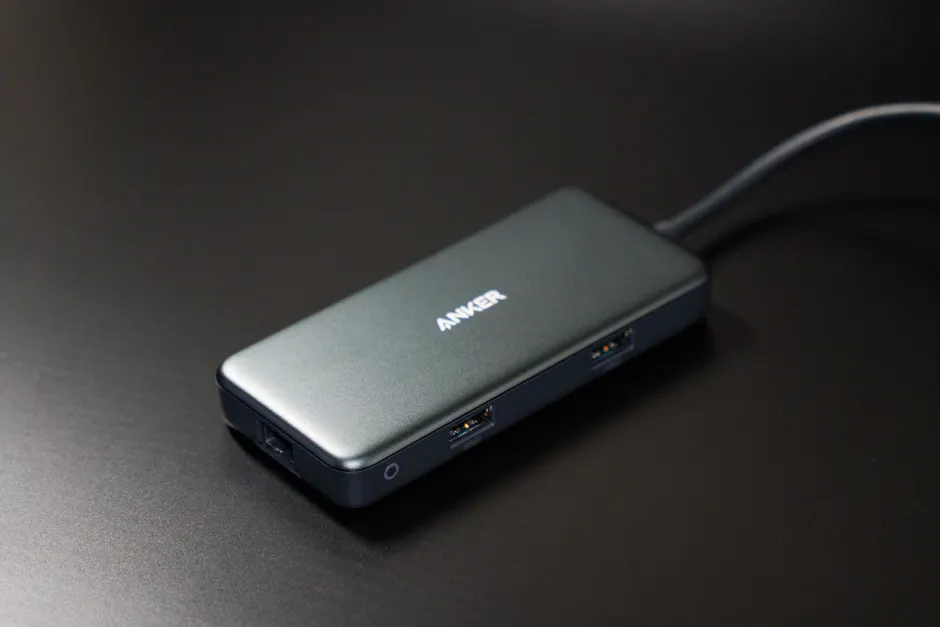
The Anker Desktop USB-C Hub rounds out the charging-adjacent lineup with a broad port selection: ethernet, three USB-A, two USB-C, HDMI 2.1, DisplayPort, and SD and TF card slots. Display output supports a single monitor at up to 4K 144Hz or 2K 240Hz, or dual monitors at up to 4K 120Hz and 2K 240Hz. The hub also includes a built-in screen that can show charging power, data transfer rate, a photo slideshow, or a Pomodoro timer. That last option is unusual for a hub and signals that Anker sees the display as a general desk interface rather than a strict monitoring tool.
Anker's Laptop Charger Pro introduces a more technically interesting feature: it can identify the connected laptop model and apply a charging curve specifically designed to slow battery degradation over time. Instead of pushing a fixed voltage, the charger adjusts its output based on the device it detects. OEM-branded chargers have offered something like this for years, but it has rarely appeared in third-party units, which typically rely on standard USB-PD negotiation — the protocol USB-C devices use to agree on how much power to draw.
All three products — the Nano Universal Charger, Nano Charging Station, and Desktop USB-C Hub — were shown without pricing or availability dates at IFA 2026.
The display-heavy approach fits Anker's recent direction. At CES 2026 earlier in the year, the company added visual interfaces to several chargers and consolidated its subsidiary brands under the Anker name. The existing Prime line of chargers and power banks already brought smart displays to multi-device charging, and Anker currently sells a charger with a built-in 1.65-inch HD display showing real-time power, temperature, and charging status. The IFA 2026 lineup extends that design language across more form factors.
In the power bank category, Anker's Prime Power Bank (26K, 300W) carries a 26,250mAh capacity and delivers 300W total output, including what Anker describes as a world-first stable 140W single-port output. Anker also sells a 140W power adapter with a built-in 5-foot power cord, and its SOLIX Power Dock is equipped with both 11kW three-phase and 7.4kW single-phase EV charger ports — placing the company's charging ambitions well beyond consumer electronics.
The broader question worth asking is how much telemetry users actually need from a charger. Temperature and voltage monitoring has genuine safety value, particularly in high-wattage GaN (gallium nitride) chargers pushing 100W or more through a single port. A Pomodoro timer on a USB-C hub is harder to justify on engineering grounds. The cost of a small display has fallen far enough that Anker can include one on a sub-$50 accessory without meaningful margin impact, and the differentiating value at retail is real — a charging brick with a screen stands out on a shelf more than one without.
The Laptop Charger Pro's device-specific charging curves are the more substantive development. Lithium-ion batteries degrade faster when held at high voltage at elevated temperatures for sustained periods. A charger that can modulate its output to match a specific laptop's thermal and battery management characteristics can extend the battery's cycle life — the number of charge-discharge cycles before capacity drops noticeably. If Anker's implementation works as described across a broad range of laptop models, it narrows the gap between OEM and third-party chargers in a way that raw wattage specs do not capture.
Anker did not provide pricing or availability for the core charging products at IFA 2026, and the company's X1 Pro is set to launch on Kickstarter on September 23. The absence of ship dates for the Nano Universal Charger, Nano Charging Station, and Desktop USB-C Hub means these products are announcements rather than shipping hardware, and the specifications and features described may change before retail availability.