Europe's Record Heat and Italy's Slow Race to Adapt

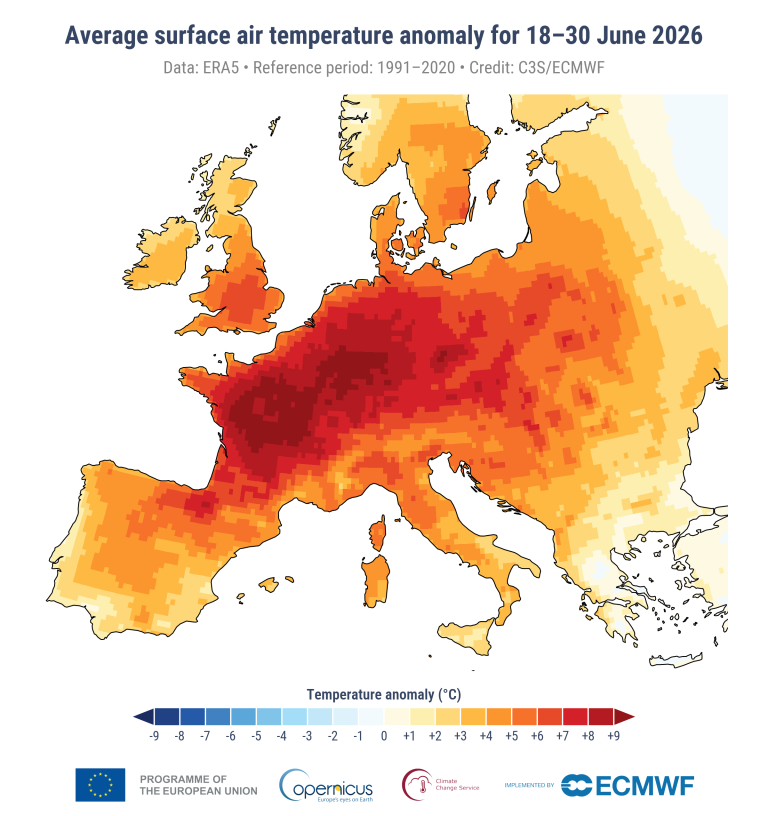
Western Europe lived through its warmest June–July period on record in 2026. June brought an average surface air temperature of 16.54°C — 0.56°C above the 1991–2020 average and the second-warmest June globally in the ERA5 dataset (ERA5 is a widely used climate reanalysis system that reconstructs historical temperatures using satellite and ground observations). July 2026 averaged 20.49°C over European land, 0.66°C above the same baseline, ranking as the eleventh-highest July on record for the continent. Globally, July 2026 was the joint-second warmest July, tied with July 2024. (Copernicus Climate Bulletin; Copernicus, July 2026; Copernicus, June 2026)
The mechanism behind the heat was well understood. Hot, dry air from North Africa formed a heat dome over the Iberian Peninsula, trapping warmth and pushing it toward France, Switzerland, and Italy. A heat dome is a high-pressure system that acts like a lid on the atmosphere, locking hot air in place and preventing it from dispersing. (NYT) The pattern mirrors the June 2025 heat wave, during which Italy issued heat warnings for 17 cities. (NYT)
Italy's vulnerability to these heat events is shaped in part by its built environment. According to Italy's national statistics institute (Istat), only about half of homes in Italy have air-conditioning. (NYT) More precisely, 56.0% of Italian households had dwellings equipped with space cooling systems in 2024, up from 48.8% in earlier years — a steady but incremental rate of adoption. (Istat) The figure masks significant regional variation. According to an ISTAT survey cited by ENEA (Italy's national agency for new technologies and energy), air conditioning adoption among Italian families stands at 51.2% in the South, 49.1% in the North, and 44.2% in the Center. (ENEA)
The regional distribution runs counter to what you might expect. The South, historically the hottest part of the peninsula, has the highest adoption rate, but even there nearly half of households lack space cooling. The Center, which includes Rome, lags furthest behind. The gap is not merely one of household comfort: during heat waves that trigger multi-city health warnings, the absence of cooling infrastructure in residential housing translates directly into heightened exposure for elderly and vulnerable populations, who bear the brunt of heat-related mortality.
The broader context here is the tension between adaptation and mitigation — two core concepts in climate policy. Adaptation means adjusting infrastructure and habits to cope with effects that are already happening; mitigation means reducing the emissions that cause those effects in the first place. Rising air-conditioning adoption in Italy, while improving resilience to extreme heat, increases electricity demand during peak summer periods, the very moments when grid stress is most acute across Southern Europe. The incremental pace of adoption, roughly 7 percentage points over several years, suggests that cooling infrastructure is expanding faster than it was a decade ago but remains well below saturation. In a region where summer heat domes are becoming a recurring climatological feature rather than an anomaly, the mismatch between the pace of infrastructure adaptation and the pace of warming is narrowing only slowly.
What remains unresolved is whether public policy will accelerate the closure of that gap. Italy's National Recovery and Resilience Plan includes building renovation targets tied to energy efficiency, but the extent to which those measures address residential cooling specifically, as distinct from winter heating, is less clear. The Istat data shows adoption rising steadily, but from a baseline that leaves a substantial portion of the population exposed during the kind of sustained heat events now occurring in consecutive summers.
The 2026 data, taken together with the 2025 heat warnings, points to a climatological pattern that Italy's housing stock is not keeping pace with. Heat domes from North Africa are not new, but their frequency, persistence, and geographic reach into France, Switzerland, and Italy are producing temperature anomalies that strain infrastructure designed for a cooler baseline climate. The Copernicus figures for June–July 2026 confirm that Western Europe is not merely experiencing warm summers; it is breaking records it has set only recently, in compressed intervals that leave little time for adaptation between events.