Motorola's Swarovski Razr Returns in Black, Joined by a $350 Wear OS Smartwatch

Motorola has announced a new Swarovski-crystal-adorned edition of its Razr flip phone, this time in a Pantone Meteorite (black) colorway with 35 hand-positioned crystals and a 32-facet crystal on the hinge. Last year's edition was white. The device features a leather-inspired quilted texture and ships with a clear protective case Engadget.
Under the crystals, the phone is the 2026 Motorola Razr. It runs on a MediaTek Dimensity 7450X chip — a mid-tier processor — with 8GB of RAM and up to 256GB of internal storage. The external display measures 3.6 inches; the internal AMOLED display is 6.9 inches. The main camera system is 50MP, and Motorola rates the battery at 36 hours per charge Engadget.
The Swarovski Razr will be available September 10 at $900. Early purchasers receive two bonuses: a pair of Moto Buds 2 Plus earbuds also covered in Swarovski crystals, and a base Moto Watch Engadget.
Motorola's product pages for its "Brilliant Collection" present the crystal Razr alongside Moto Buds Loop in a 256GB unlocked configuration, with a bundle version that includes Swarovski wireless earbuds and a custom carrying case. The Australian Brilliant Collection page refers to the handset as the "motorola razr 60" Motorola US, Motorola UK, Motorola Australia.
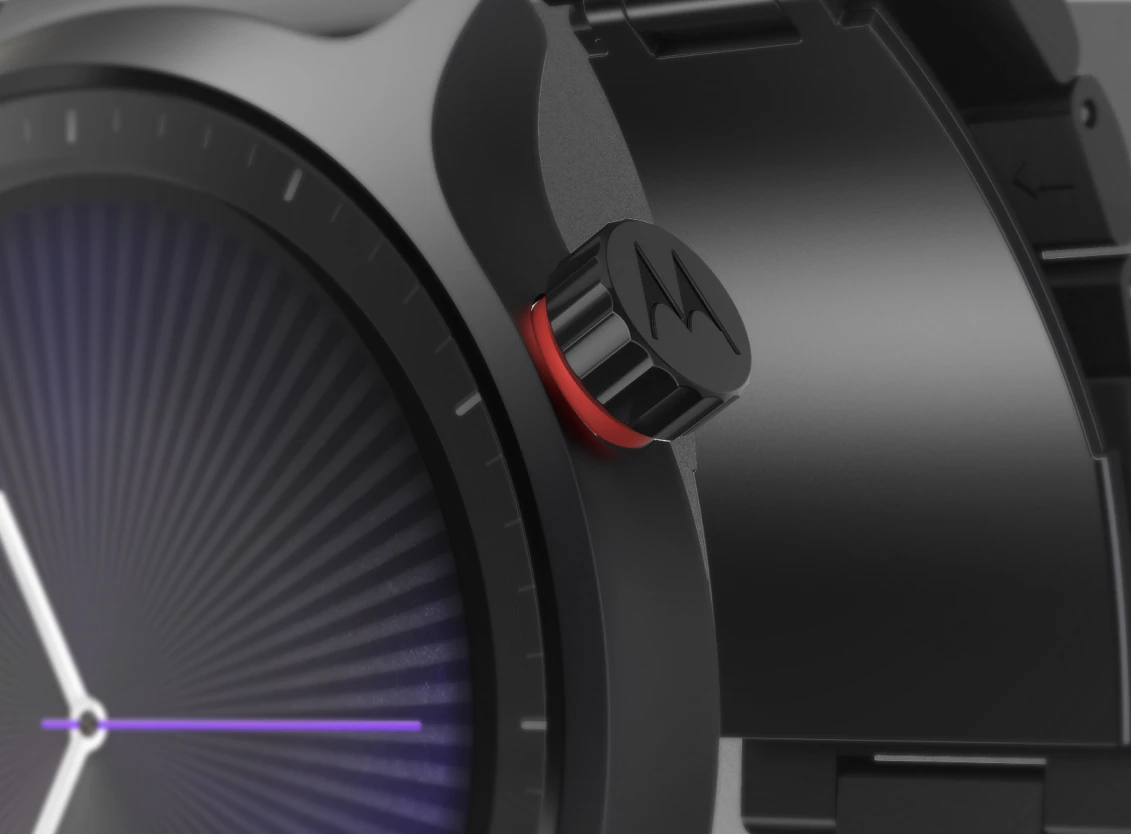
Alongside the Razr, Motorola announced the Moto Watch Ultra. The wearable includes LTE connectivity (meaning it can connect to cellular networks independently of a phone), dual-band GPS for more accurate location tracking, a large OLED display, Wear OS by Google, and an NFC reader for contactless payments. Battery life is rated at roughly two days. The Moto Watch Ultra also launches September 10 at $350 Engadget.
The pricing and some specifications reflect changes since the first Swarovski Razr was announced in 2025. PCMag reported last year that the crystal-covered Razr retailed for $1,000; the 2026 edition comes in at $100 less. The 2025 Brilliant Collection was also announced in a PANTONE Ice colorway PCMag, Motorola News.
The broader context here is Motorola's sustained push to position the Razr line not merely as a mid-range foldable but as a lifestyle-luxury product. The Swarovski partnership, now in its second iteration, pairs a phone whose internal specs place it squarely in the upper-mid-tier with an exterior treatment that draws from fashion-accessory playbooks. The Dimensity 7450X and 8GB of RAM are competent but not flagship-tier internals; the differentiator is entirely on the surface. That is a legitimate strategy in a foldable market where differentiation on hardware alone has proven difficult, and it mirrors what Vertu and others attempted in the pre-smartphone era, though at a far more accessible price point.
The Moto Watch Ultra is a more conventional launch. Dual-band GPS, LTE, and Wear OS place it in competitive territory with devices like the Pixel Watch 2 and Galaxy Watch lineup. At $350, it undercuts several established Wear OS competitors, though the two-day battery rating is modest by comparison with some Garmin or Amazfit devices in a similar price band. The inclusion of a base Moto Watch as a free bundle item with the Razr is more promotional incentive than a serious wearable play.
Motorola is also the official smartphone partner of FIFA, runs an online giveaway for Razr phones, offers a Moto Care extended warranty plan, and is currently promoting a Labor Day bundle with exclusive savings and free "moto things" Motorola Newsroom. These surround the hardware launches with a broader consumer-engagement effort that spans sports sponsorship, direct promotions, and after-sales protection.
What stands out across the two launches is the breadth of Motorola's September 10 lineup. A crystal-covered flip phone and a full-featured Wear OS smartwatch serve very different buyer profiles, yet both land on the same day at price points intended to pull buyers away from Samsung and Google. The Swarovski Razr at $900 is $300 less than the base Galaxy Z Flip 6 at launch, with a distinctive if polarizing exterior. The Moto Watch Ultra at $350 is aggressively positioned against Wear OS peers. Whether the strategy translates into sustained market share is a separate question from whether the products themselves are well-targeted. On paper, they are.