NASA's ERNEST Rover Completes 16-Mile Desert Test at 10x Operational Speed
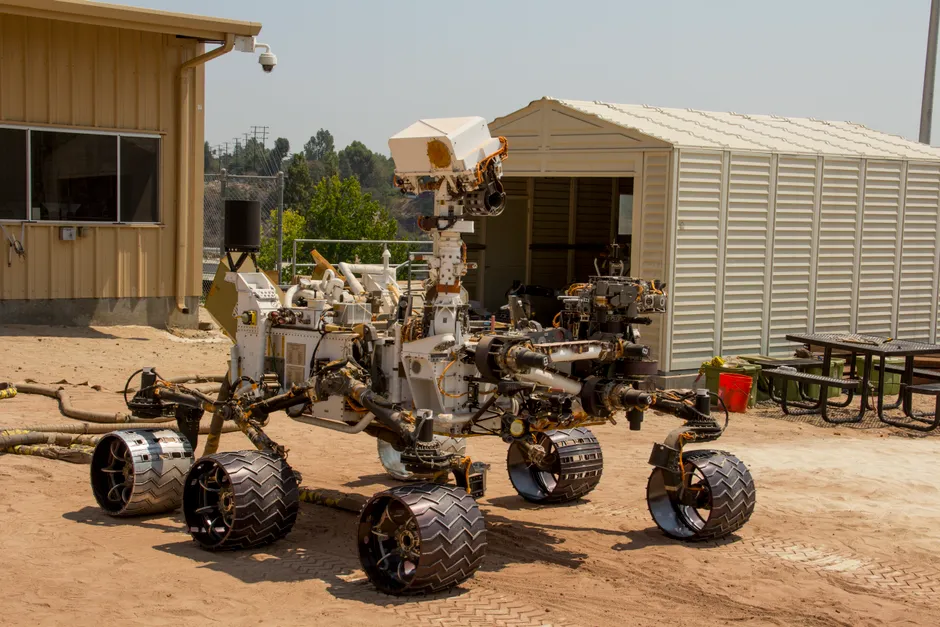
Engineers at NASA's Jet Propulsion Laboratory have completed a field test of ERNEST — Exploration Rover for Navigating Extreme Sloped Terrain — a 4-foot prototype that covered 16 miles over 37 hours of continuous driving, moving at speeds more than 10 times faster than current planetary rovers. NASA JPL
The test, conducted in a desert environment designed to mimic the terrain of the Moon or Mars, demonstrates a working path toward rover operations that could actually cover the distances future lunar and Martian missions require. Today's rovers move slowly and deliberately — NASA's Curiosity rover averages around 100 meters per hour under autonomous control — because commanding them in real time is impossible. The communication delay from Earth to Mars ranges from 3 to 22 minutes each way, which makes joystick-style remote control impractical. ERNEST abandons the remote-control model entirely.
Instead, ERNEST carries the autonomy onboard. The rover makes its own navigation decisions, reads the terrain through its sensors, and adjusts course without waiting for commands from Earth. This is critical: at Mars distances, a single round-trip command cycle can take 22 to 44 minutes. At that scale, speed and autonomy become inseparable.
Put the 16-mile distance in context. Apollo 17 astronauts covered roughly 22 miles across three days of lunar surface exploration — the farthest any human crew has traveled on another world. ERNEST matched most of that in a single test run, with no human operator in the loop.
The field test, published June 18, 2026, was designed to test the rover on loose, uneven ground and sloped terrain — conditions that have historically been problematic for planetary rovers. Loose soil slopes cause wheel-slip that limits both range and efficiency. ERNEST's design specifically targets that challenge.
JPL established a dedicated Rover Operations Center for Moon and Mars missions in December 2025, signaling institutional investment in next-generation surface mobility. ERNEST serves as a hardware testbed for the autonomy and mobility software that would eventually run on flight-qualified rovers bound for other worlds.
The path from a prototype in the desert to a rover actually landing on the Moon or Mars is long, expensive, and uncertain. JPL has run successful field tests before — the Rocky series and FIDO rover shaped the design of Spirit and Opportunity — and those programs still took years to translate into flight hardware. ERNEST's field performance is one data point in a much longer process, not a timeline or delivery schedule.
That uncertainty acknowledged, the 10x speed increase is the kind of benchmark that changes how missions are planned. Faster autonomous traversal alters the math on how far a rover can range from its lander, how many sites a single mission can sample, and whether a rover can serve as a supply relay to astronauts on the surface rather than only as a science instrument. The Artemis program's lunar goals — and any crewed Mars mission in the longer term — depend on surface mobility that today's rovers simply cannot deliver. ERNEST is one attempt to close that gap.