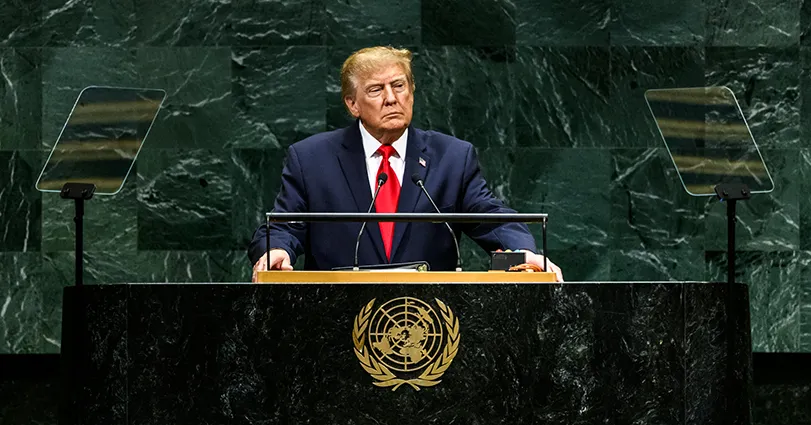
Trump to Address U.N. Assembly on Iran, Ukraine and Funding

President Donald Trump will address the U.N. General Assembly in New York on Tuesday morning.
His speech opens the U.S. turn in the general debate, the main series of speeches by world leaders, at the 81st session. The debate is scheduled for Sept. 22 to Sept. 26 and on Sept. 28, 2026. By tradition, Brazil speaks first, followed by the United States. The address falls inside U.N. High-level Week 2026, scheduled for Sept. 18 to Sept. 28. NPR
U.S. Ambassador to the United Nations Mike Waltz said Trump will address the need to ensure Iran never has a nuclear weapon. Iranian President Masoud Pezeshkian is expected to speak on Wednesday, the day after Trump.
Trump is expected to meet with Ukrainian President Volodymyr Zelenskyy on the sidelines on Tuesday. Reuters More than four years had passed since Russia invaded Ukraine as of September 2026. Wars in the Middle East and Ukraine, alongside artificial intelligence, are listed among the top concerns for leaders at this year's Assembly. Reuters
A U.N. panel recently called for stronger safeguards on artificial intelligence agents, systems that can act on their own. That recommendation arrives as delegations weigh rules for AI systems during high-level week.
Trump is scheduled to host Chinese President Xi Jinping in Washington following the U.N. appearance. He recently announced a new deal with Denmark over security of Greenland.
The New York trip follows a difficult stretch at home. Trump's approval rating was below 40% as of Sept. 22, 2026. Trump banned CNN, MS NOW and Politico from the White House, and the outlets have sued to regain access.
Trump's past General Assembly appearances have drawn sharp reaction. In his 2017 address, he threatened to totally destroy North Korea. In his 2025 address, he told leaders "your countries are going to hell." The White House said of the 2025 address that Trump delivered a rebuke to destructive globalism that has fueled endless conflict and chaos and framed the speech around sovereignty over globalism. White House
On funding and participation, Trump wants to slash U.S. funding for the United Nations and has stopped U.S. engagement with the U.N. Human Rights Council. Reuters
The days before departure were active on domestic policy. On Sept. 18, 2026, Trump signed an executive order on oversight and coordination between agencies in the H-1B work visa program, paired with a fact sheet and a proclamation titled "Restriction on Entry of Certain Nonimmigrant Workers." The same day, he extended Most Favored Nation drug pricing, a plan to tie U.S. prices to lower prices paid abroad, to every Medicaid program in America, and H.R. 5334 was signed into law. The White House published a Presidential Message on Yom Kippur on Sept. 20, 2026, and on Sept. 21, 2026, it published items including "White House Access Is a Privilege — Not a Right" and details from first lady Melania Trump ahead of Xi Jinping and Madame Peng Liyuan's visit to the White House.
The broader context here is sequencing and leverage. The speaking order puts Trump's Iran language on the record one day before Pezeshkian, which gives diplomats a clean text to respond to. The Zelenskyy meeting on the margins allows coordination without a formal Council product. And the Washington follow-on with Xi moves any trade and security discussion out of the large multilateral setting and into a bilateral meeting where the White House controls the schedule, the readout and the deliverables. The funding signal matters too. Required dues and voluntary U.S. support shape staffing and mandates across the system, so any renewed call for cuts or conditions will be read in New York as an instruction to budget negotiators as much as rhetoric for the hall.