Anthropic Says Claude Found a CRISPR-Like Enzyme in Phage DNA

Anthropic said on September 23, 2026 that its Bay Area wet biology lab has found a previously unknown enzyme system with "properties reminiscent of CRISPR." TechCrunch The company said Claude made the computational discovery and its own laboratory confirmed it with physical experiments.
The system was described as hidden in the DNA of bacteriophages, viruses that infect and replicate within bacteria. Anthropic said it can cut, copy and paste DNA. The announcement, titled "Claude discovers a novel enzyme system with CRISPR-like repeats," describes fundamental biology research in which Claude searched DNA datasets to find protein families scientists had not characterized before. Anthropic
The broader context here is that this is not a claim about a treatment. It is a claim about a nuclease system, a set of proteins that cut DNA, with possible use for genome editing tools if other labs can replicate and fully characterize the work.
Search at agent scale
Anthropic attributed the find to extended agentic work. Claude spent 21 hours of concerted effort searching data for candidate systems, using about 950 agents and 210 million tokens.
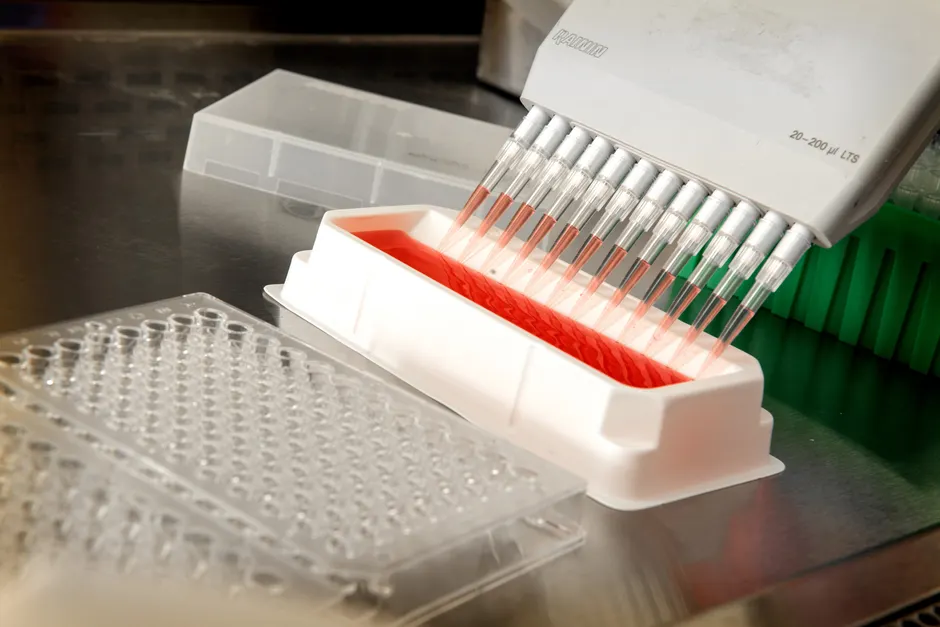
Chief executive Dario Amodei said the enzyme system was found "mostly, though not entirely, by Claude." Anthropic said all lab work at the Bay Area facility is performed by human scientists. Claude directed the analysis and candidate prioritization. Humans held the pipettes.
In my view, the computing scale is the telling part. Two hundred ten million tokens across 950 parallel agents in less than a day points to broad, concurrent searching through sequence space rather than a single long reasoning trace. Teams that run bioinformatics pipelines will recognize the pattern: generate hypotheses in bulk, filter aggressively, then test a narrow set at the bench.
Wet lab, human hands
Anthropic established the lab in spring 2026. The company said the Bay Area site works only at biosafety levels BSL-1 and BSL-2, lower safety levels for work that does not involve germs that infect people, and does not handle human pathogens.
The broader context here is what those safety limits allow. BSL-1 and BSL-2 phage and non-pathogenic bacterial work fits routine molecular biology: cloning, expression, in vitro cleavage assays, and sequencing confirmation. Mammalian pathogen work does not.
Reuters reported on September 18 that Anthropic had quietly set up the biology lab to go beyond computer simulation work. Reuters The same reporting linked the facility to a longer-term drug effort, including a stated goal to unlock treatments for rare diseases and an aim for Claude AI to direct robots in lab environments.
The lab was built in the spring and the discovery was announced in September, leaving months, not years, between commissioning and the reported result.
Infrastructure around the result
Anthropic offers Claude Science, an AI workbench for scientists pre-configured for genomics, the study of full DNA sets, single-cell analysis, proteomics, the study of proteins, and cheminformatics, computing with chemical data, backed by more than 60 scientific databases. Anthropic
For evaluation, Anthropic built BioMysteryBench around 99 real bioinformatics problems and reported that Opus 4.6 solved 77% of human-solvable questions. Separate research notes say Claude accelerated protein binder design from scratch and NMR analysis, a method for studying molecular structure, and made open-source models for predicting and designing biomolecules faster.
On process controls, Anthropic lists "Introducing the Life Sciences Verification Program" as an Announcements item dated September 17, 2026, "Improving Fable 5's biology safeguards" as a Product item dated August 7, and "Expanding our support for scientists" dated August 27. Model iteration continued in parallel, with Claude Fable 5.1 and Claude Mythos 5.1 introduced September 1 and Claude Opus 5.5 introduced September 22.
The broader context here is a move from benchmark biology to bench-linked biology. Token throughput and agent orchestration draw attention, but wet-lab bandwidth remains the scarce resource: expression, purification, controls, off-target profiling, and reproducibility across replicates. A 21-hour search still requires weeks of careful follow-up before genome engineers will accept a CRISPR-like label.
In my view, worth flagging are three questions specialists will ask first. What are the repeat architecture, guide requirements and PAM or equivalent constraints on where it can cut. What is the cleavage signature, efficiency and specificity relative to established editors in standardized assays. And where are the sequences, plasmids and raw assay data for independent verification.
In my view, the naming deserves caution. I have followed tool hype cycles for decades. CRISPR-like gets a headline. Cut, copy and paste gets a tool. If the sequences validate and other labs can express the system and reproduce editing with defined guides, researchers gain another programmable option to test alongside existing nucleases. That would follow a longer pattern in biotechnology, where discovery expands the parts list and engineering determines utility. The encouraging possibility is practical: faster traversal of uncharacterized phage diversity, with human scientists still closing the loop at the bench.