Meta Updates Ray-Ban Display With Voice Avatars and Smarter Navigation
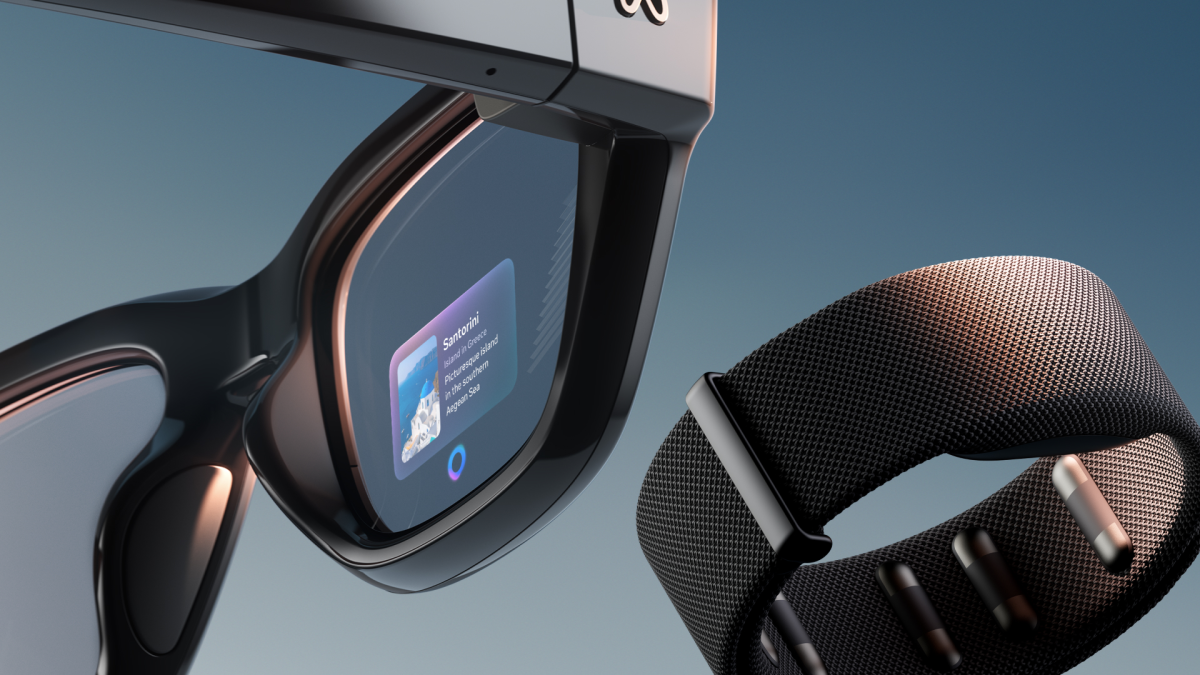
Meta announced new software features for Ray-Ban Display at Meta Connect 2026, one year after it introduced the glasses at the same conference. Engadget
The updates focus on calling, navigation and app discovery, along with availability in more countries.
The glasses show images through the lenses. They are controlled by a wristband that reads muscle signals, called an EMG band or neural band. The display adjusts contrast to the light around it, so content stays readable indoors and outside.
Ray-Ban Display first went on sale in the United States on September 30. Early store sales were limited to retailers including Best Buy and LensCrafters. The new announcements add software to that product. The hardware itself is unchanged.
Voice-driven holographic calling
The new calling feature adds holographic avatars. The Meta AI app creates a photorealistic hologram, a lifelike 3D face, that appears instead of the wearer's face during a call.
Meta said the hologram is controlled only by voice. The model studies what the person says and how it is said, then predicts facial expression. This removes the need for inward-facing cameras to track the face. In technical terms, the hard task becomes speech-to-expression inference, where delay, tone modeling and keeping identity stable are the clear limits.
The feature will enter early access in fall 2026 for WhatsApp users in the US. Meta has not shared details on resolution, frame rate or where the processing runs.
Using sound to drive the face removes extra sensors from glasses that have tight limits on heat and battery life. The trade-off is errors already known from voice and avatar systems. These include the wrong emotion, flattened expressions and glitches with background noise or overlapping speech.
Navigation, audio and system software
Meta expanded on-face navigation to cycling and public transit directions requested by voice command. People in the US and Canada will get this expansion first.
Directions can now refer to surroundings, such as turn left at the yellow house, instead of only street names. The system shifts from map-based steps toward guidance tied to what can be placed in the world, like a local giving landmarks rather than road numbers. Cycling and transit leave little time to look, and signs are easy to miss, so landmark cues can lower mental effort when location tracking is accurate.
A new Explore app is coming to both the glasses and the Meta AI app for finding compatible apps. Finding happens on the phone, use happens on the glasses.
Meta is also adding Dolby Atmos, a spatial audio format that places sound in space, to capture and playback, plus photo editing on the display, a more detailed calendar, phone notifications mirrored to the glasses and Threads for Community Feeds. The wristband allows fine control without touch. Still, detailed photo edits stay hard without a large screen to work on.
Availability and pricing
Ray-Ban Display is expanding to five new markets: the UK, Canada, France, Italy and Germany. The glasses can be ordered online in those markets and in the US.
The starting price is £749 in the UK and CA$1,149 in Canada. In France, Italy and Germany it is €899. Pre-orders start on announcement day, with availability on October 13.
The broader context here is a move from proving the design to expanding what the software can do. Year one showed that in-lens display plus wristband control can work as a daily input method. Year two centers on call presence, contextual directions and app discovery, areas where glasses can do something different from phones and watches instead of copying them. The split with discovery on the phone and action on the face follows the pattern set by earlier wearables with companion phone apps. Mirrored alerts and a fuller calendar look plain, yet they shape whether people keep wearing the device each day, because they cut phone checks and add scheduling context, along with native social feed access and richer audio for clips.
In my view, the holographic calling test is less about photorealism than about whether people accept it. I watched my kids embrace video filters and then drop them as soon as they felt false. Voice-generated expressions will succeed only if people on the call trust them in real conversations. Limiting early access to WhatsApp in the US lets Meta study that reaction in a controlled way before a wider release.
For developers watching this, the Explore app plus landmark directions point to glasses that outside apps can build for more easily. Persistent heads-up displays work best when third-party apps can use location, messaging and audio without draining the battery too fast. If Dolby Atmos capture brings spatial clips back into Meta's apps, creators gain a reason to treat the glasses as both a camera and a screen, which expands what the platform can do over time.