Trump and Xi Meet in Washington: Trade, AI and Taiwan at Stake

Chinese President Xi Jinping was expected to hold talks with U.S. President Donald Trump in Washington on Thursday, September 24, 2026, their third in-person meeting in a year. Trade, AI and the Iran war were listed as the expected agenda. Al Jazeera
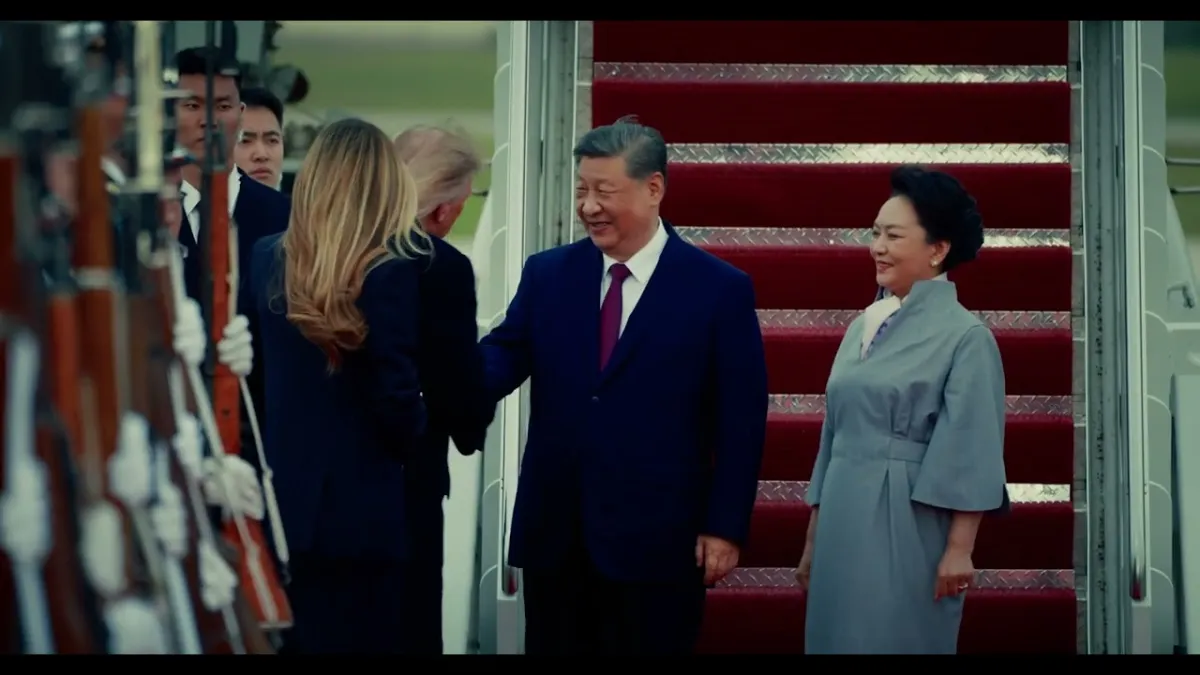
Trump and First Lady Melania Trump greeted Xi and Peng Liyuan at Joint Base Andrews in Maryland on Wednesday evening with a red-carpet welcome. No U.S. president had personally welcomed a visiting guest at Joint Base Andrews in six decades. China's CCTV reported Xi and Peng were accompanied by Cai Qi and Foreign Minister Wang Yi. The White House Video Library lists a September 23, 2026 video of the arrival.
The visit was Xi's first state visit to the U.S. in more than a decade. A state visit is the most formal type of visit, with ceremonies and official dinners. The White House said President Donald Trump and First Lady Melania Trump will welcome Xi Jinping to the White House on Thursday, September 24, 2026. White House
A ceremonial White House welcome was scheduled for Thursday morning with a military flyover and nearly 500 military personnel. A White House state dinner for Xi was expected to include Apple's Tim Cook, Nvidia's Jensen Huang and OpenAI's Sam Altman. The visit was to wrap up Friday morning with tea at the White House and a visit to the National Archives. The U.S. and China were expected to issue separate announcements instead of a joint news conference or statement.
Trade truce, tariffs and supply chains
The U.S.-China 11-month trade truce was set to expire in November but was extended until January 10. A truce here means a temporary pause in adding new trade penalties. Tariffs and sanctions were described as thorny issues alongside AI and the Iran war. CNBC Tariffs are taxes on imports. Sanctions are economic penalties that restrict business.
Trade in agriculture, energy and rare earths was described as major bargaining chips ahead of the summit. Rare earths are metals needed for phones, electric vehicles and weapons. Cross-border investment and supply chains were listed as likely features of the discussions. Supply chains are the networks that move parts and finished goods across countries. A White House Fact Sheet published in May 2026 stated that President Trump will welcome President Xi for a visit to Washington in fall 2026.
China's Foreign Ministry stated on September 21, 2026 that during his visit President Xi will have "an in-depth exchange of views with President Trump on major issues concerning bilateral ties and world affairs." On September 21, 2026, the White House Briefing Room listed an entry in which First Lady Melania Trump released details ahead of Xi Jinping and Peng Liyuan's visit to the White House.
AI incident channel and tech presence
The U.S. proposed a new notification mechanism with China "to alert each other of any AI incident serious enough to threaten national security." That would work like an early-warning hotline for dangerous AI failures. China's Foreign Ministry September 22, 2026 press conference transcript references AI governance as an important topic between President Xi and President Trump that week.
The guest list for the state dinner put private-sector AI capacity in the room. Cook, Huang and Altman were expected to attend. Their presence links the diplomatic track to compute, models and hardware supply. It also signals that export controls, investment screening and standards will be discussed in parallel to safety language. Export controls are rules on selling sensitive technology. Investment screening means government review of cross-border deals.
Taiwan, separate messaging and protocol
Taiwan's status was listed as a likely topic for the summit. Reuters In December, the Trump administration approved an $11bn arms sale to Taiwan, the largest ever, while a second $14bn package has been on hold for months. Trump described the Taiwan arms sales as "a very good negotiating chip."
Protocol details were also part of the record. The Andrews greeting broke a six-decade precedent. The White House program added a flyover, a 500-person military formation, a state dinner and an Archives visit. Separate announcements were planned rather than a joint statement.
The broader context here is a relationship managed through deadlines and waivers rather than settlement. An 11-month truce extended to January 10 keeps tariffs, agricultural purchases, energy flows and rare earths licensing in play as leverage. Each can be adjusted without a new agreement. That structure favors incremental announcements over binding text. Separate announcements let each side define outcomes for domestic audiences. That format reduces the risk of a public split. It also limits enforceability.
For negotiators and operators, three tracks will need to be read together. The trade track tests whether the truce holds past January. The technology track tests whether an incident notification mechanism can coexist with controls on chips, investment and data. The security track tests how Taiwan arms transfers and discussion of the Iran war interact with economic bargaining. Progress on one does not guarantee movement on the others. Failure on one could stall the rest.