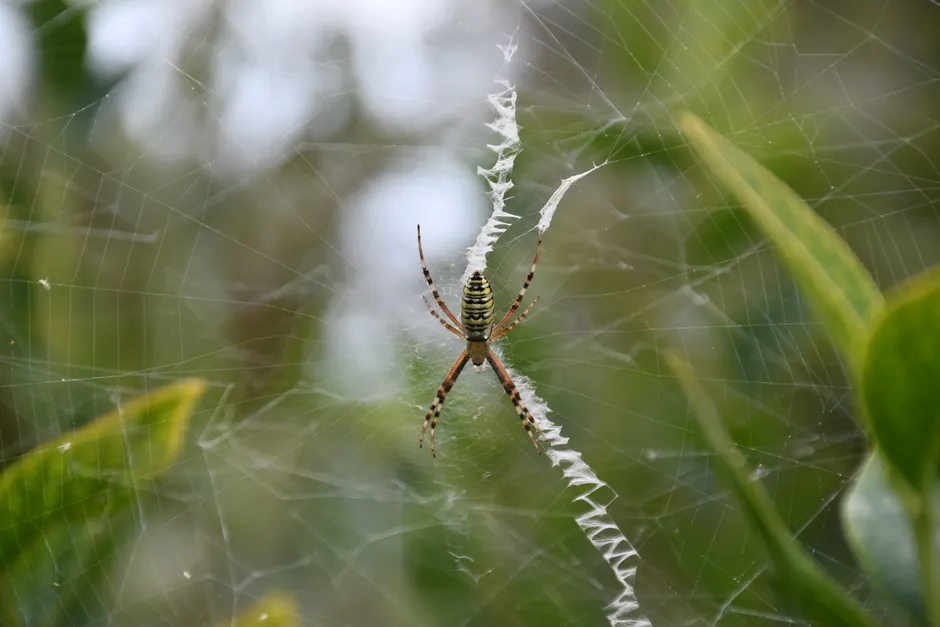
The Ballista Spider: How a Australian Predator Built a Spring-Loaded Ant Trap

Researchers at the University of Western Australia have discovered a new spider species in Far North Queensland's rainforests that uses a spring-loaded silk trap to launch prey into the air. The mechanism is precise enough to target a single ant species and violent enough to produce accelerations comparable to a severe car crash.
The spider takes its name from the ballista, the ancient Roman artillery that hurled projectiles at distance. The trap functions as a loaded mechanism held under tension — not a passive sticky web — until the ant's own defensive behavior triggers its release. ABC News reported the discovery on 23 June 2026, drawing on research published in Current Biology in June 2024.
Most orb-weaver and sheet-web spiders build generalist traps that catch whatever walks into them. The ballista spider has evolved something different: a snare calibrated to a single target — the green ant (Oecophylla smaragdina), a highly aggressive species that would overpower a small spider in direct combat. The trap avoids that confrontation entirely. When a green ant touches a trigger point on the web, the stored elastic energy in the silk releases, flinging the ant upward into a vulnerable position the spider can then exploit.
BBC News confirmed the catapult-like character of the trap and its specificity to a single ant species. Spider researcher and photographer Greg Anderson is among those involved in the work. The acceleration figures cited by Yahoo News — forces comparable to a severe vehicle collision — place the trap's performance alongside other known biological spring-loading systems: mantis shrimp strikes and trap-jaw ant bites. What makes this case unusual is that the spring mechanism is made of silk rather than rigid appendage.
Silk as an elastic storage medium is not new in spider biology — the stretchy silk in orb webs absorbs and releases energy when prey hits. But using that elasticity as an active launcher, rather than a passive shock absorber, is a different engineering problem. New Scientist described the structure as resembling a snare trap, distinct from both orb webs and funnel webs. The architecture suggests the spider invests significant time and silk in building and maintaining the loaded trap — a cost that makes sense only if the payoff from green ants, which are large, protein-rich, and plentiful in Queensland's rainforest canopy, justifies the energy spent.
This discovery matters for several reasons. Far North Queensland's wet tropics are a recognized hotspot for biodiversity, and the ballista spider shows that the canopy and leaf-litter creatures in that region remain incompletely catalogued. More broadly, specialist predator-prey relationships of this precision interest biomechanics researchers. Understanding how silk proteins can be tuned to store and release energy at the right rate has applications in materials science — particularly in designing bio-inspired fibers and microscopic mechanical systems.
The Current Biology publication provides the formal taxonomy and description of the mechanism. Field documentation, including video and photographs from Greg Anderson and others, has circulated widely since, offering the public a rare glimpse of a predation event that happens faster than the human eye can follow.
Queensland's rainforests have produced a succession of arachnid discoveries over the past two decades — from peacock spiders of the Maratus genus to new trapdoor spider species — and this finding follows the same pattern. Patient fieldwork in the right habitat continues to reveal organisms with problem-solving strategies that expand what we know arthropods can accomplish with their bodies and silk.