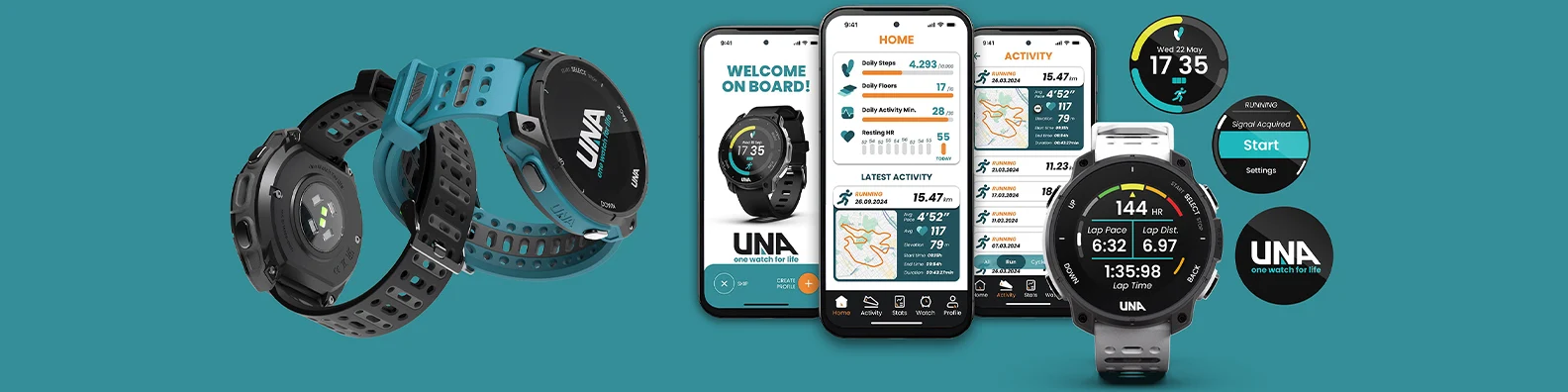
Una's $249 GPS Watch Trades Power for Repairability
Scottish startup Una is selling a $249 GPS running watch built to be taken apart, repaired and kept in use, with six swappable hardware modules secured by Torx T3 screws. Engadget detailed the device in a review published Sept. 28, 2026.
Una is based in Edinburgh, Scotland. It was founded by Lewis Allison, the former CTO of Scottish golf watch company Shot Scope. The company describes its goal as modular, repairable and open source hardware under the slogan "one watch for life." Its first product is a multi-sport GPS watch.
How it is put together
The hardware is split into sections. The face is a 1.2-inch Memory In Pixel LCD, a low-power display type that stays readable in daylight, at 240 x 240 resolution, covered by hardened mineral glass. Below that display module sit two separate sensor modules, one for GPS and one for Bluetooth. The Core section holds the computing and support hardware.
That Core uses a Cortex-M33 microcontroller, a small efficient chip, paired with 2.5MB of RAM and runs FreeRTOS, a lightweight operating system for simple devices. It also contains 4GB of eMMC storage plus a vibration motor, piezo speaker, altimeter and temperature sensor. Repairs need one tool. Each of the six parts can be removed and replaced with T3 screws, including the battery.
Power, sealing and open designs
The watch uses a 280mAh cell held in place with a T3 screw. Expected endurance is 7 to 10 days on a single charge with 20 hours of GPS use. The assembled hardware is IPX5-rated in total.
Una has posted its software, housing and circuit board designs to GitHub. For a buyer comfortable with hardware files, that means schematics, mechanical files and firmware are inspectable and forkable, not only the replaceable modules. The company previously secured over £300,000 in investment from SFC Capital, according to a March 2025 report in Scottish Financial News.
The trade-off
The broader context here is the trade-off Una accepted to make repair practical. A Cortex-M33 with 2.5MB RAM running FreeRTOS, MIP LCD and separate GPS and Bluetooth modules is a lean, predictable platform. It keeps power draw low, firmware size small and board divisions clean. It also limits what the watch can do compared with application-processor smartwatches that handle third-party apps, on-device voice and dense graphics.
In my view, that limit is the point to weigh. Modular mechanical design usually loses to integration on size, sealing and cost. Una holds the price at $249 while keeping IPX5 resistance and a claimed 20-hour GPS figure. IPX5 handles sweat and rain but not swimming, and MIP at 240 x 240 will look plain next to AMOLED. For runners who want logged tracks, basic navigation and week-scale battery without a sealed throwaway body, those are reasonable compromises.
Looking at what this means in practice, the open documentation may matter more than any single module. Access to housing and board files plus FreeRTOS firmware lowers the cost of third-party repair, battery replacement and sensor swaps. It also lets small shops or lab teams study failure modes, telemetry accuracy and long-term parts supply without reverse engineering. If Una can keep module inventory in stock, the "one watch for life" idea becomes a supply-chain commitment rather than a slogan.
Looking ahead, that outcome is not guaranteed, and scale will test it. Still, the direction is useful. Longer-lived, serviceable devices reduce e-waste and keep working hardware in the field, which helps users and developers alike.