Bose Brings Back Wired Earbuds With $99 Noise-Cancelling Pair
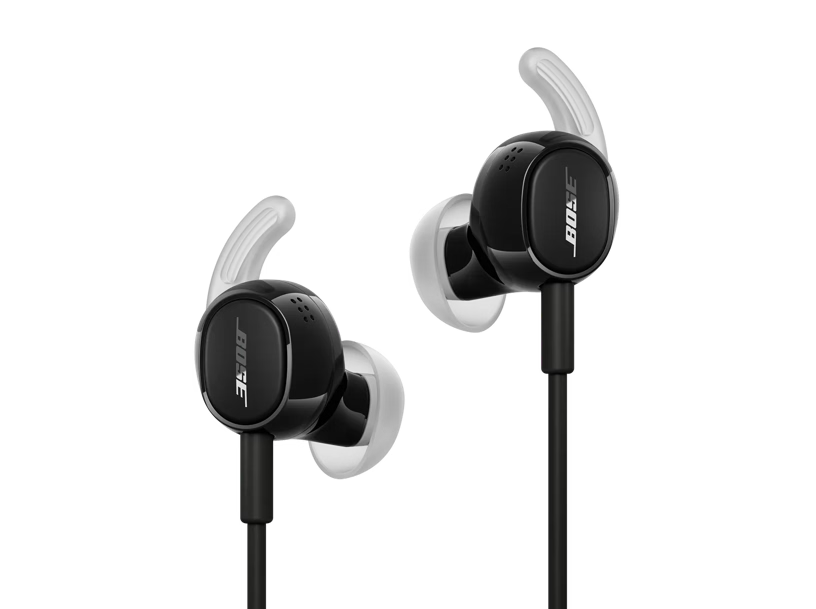
Bose has introduced its first wired earbuds since discontinuing wired earbuds in 2015. The Bose Noise Cancelling Wired Earbuds are available for preorder for $99 through Bose's online store. The Verge
The announcement was made on Sept. 28, according to contemporaneous reporting. Mashable The earbuds use a 4.2-foot cable ending in USB-C and support lossless audio, or sound without compression, with minimal latency, or delay. They come in black, white smoke, and limited-edition dewdrop mint. The Verge
Noise cancellation is handled by two microphones per earbud running Bose QuietControl technology. Users can switch between Quiet Mode, Aware Mode, and ANC-off with a button on the inline remote. The earbuds carry an IPX4 rating for water resistance, which covers splashes from any direction. The Verge
Bose maintains an official product page for the Bose Noise Cancelling Wired Earbuds on bose.com. There, Bose describes the product as offering immersive sound, a comfortable fit, and power noise cancellation.
The wired earbuds sit alongside Bose's current over-ear and in-ear lines. On August 6, 2026, Bose announced the QuietComfort Headphones (2nd Gen) as the next generation of its noise cancelling headphones. Separately, Bose introduced the SoundTrue Ultra In-ear Headphones as its first noise-isolating headphones.
The broader context here helps explain why wired still matters. Wireless took most product attention for a decade because it solved mobility and call handling. Wired kept a defined set of properties for technical work: a fixed physical connection, no pairing to manage, no radio interference to debug, and a delay floor set by the wire rather than by codec negotiation, the process where Bluetooth devices agree on compression, and retransmission.
In my view, that is the practical opening Bose is addressing. A USB-C wired earbud with onboard ANC and an inline mode control fits cleanly into desk setups, lab benches, shared workstations, and thin clients where Bluetooth policy is locked down or inconsistent. Lossless transport with minimal latency is relevant in the same environments, not only for music listening but for conferencing, monitoring, transcription review, and any task where lip sync drift or compression artifacts create extra mental effort. IPX4 does not make these a sport product, but it removes one common failure concern for commute and travel use.
Looking at what this means for buyers, the $99 preorder price and the three-mode ANC implementation lower the cost of keeping a wired option available. IT departments and individual engineers tend to standardize on what is predictable. A cabled USB-C device with Quiet Mode for focus work, Aware Mode for situational awareness in offices and labs, and ANC-off for direct monitoring covers those cases without adding another wireless device to provision, charge, and patch. For users who already carry a USB-C laptop or tablet as a primary machine, the cable length and inline remote reduce friction rather than add it.
The tradeoff here is plain to state. A fixed 4.2-foot tether constrains movement by design, and USB-C-only termination defines which hosts work natively. Those limits will decide whether this becomes a daily driver or a secondary tool kept in a bag for specific hosts and locations. Either outcome still leaves users with more choice than they had before, and choice at the transport layer is useful precisely because wireless convenience and wired determinism solve different problems.