Bose QuietComfort Headphones (2nd Gen) Bring Spatial Audio Down to $359

Bose has announced a second-generation version of its entry-level QuietComfort noise-canceling headphones, bringing features previously reserved for the pricier Ultra line down to the $359 price tier. Preorders open August 8 through Bose's online store and other retailers, with shipping expected to start August 13. The Verge
The original QuietComfort headphones launched in late 2023 at $349. The second-generation version costs $10 more, and that extra money buys a meaningful set of upgrades rather than a cosmetic refresh.
The headline addition is Bose's TrueSpatial immersive audio technology, previously available only on the higher-end QuietComfort Ultra. Bose's Immersive Audio modes use head tracking — the headphones sense the angle of your head and adjust the sound accordingly — to anchor audio to a fixed location in a room, creating a three-dimensional soundstage. Think of it like sitting in front of a pair of speakers that stay in place even as you turn your head. The tracking intensity can be reduced so that the sound moves with you instead of staying fixed, which is more practical when walking or commuting. A second Immersive Audio mode simulates a theater-like experience by spatializing audio to keep dialogue clear and centered during video playback or podcast listening.
The active noise cancellation (ANC) has been reworked as well. The six-microphone array better compensates for gaps in the ear cup seal — the physical contact between the ear cups and your head that blocks outside noise. This matters especially for glasses wearers, who often get a weaker seal because the temple arms break the cushion's contact. It is a practical gap in the first generation that Bose has now addressed directly. The ANC also adapts more fluidly to changing noise environments. The upgraded Aware mode, which lets outside sound in so you can hear your surroundings, now adjusts noise-canceling intensity in response to sudden changes such as a passing vehicle, rather than applying a fixed transparency level.
On the connectivity side, the headphones support Bluetooth 5.4 with multipoint pairing, meaning you can connect to two devices at once and switch between them without re-pairing — handy for moving between a laptop and a phone. A USB-C port enables both lossless wired playback (digital audio sent directly over the cable, bypassing Bluetooth compression) and charging, and the headphones can be used while charging. Battery life is rated at up to 24 hours, dropping to 18 hours when the Immersive Audio features are active. A 15-minute quick charge provides 2.5 hours of playback.
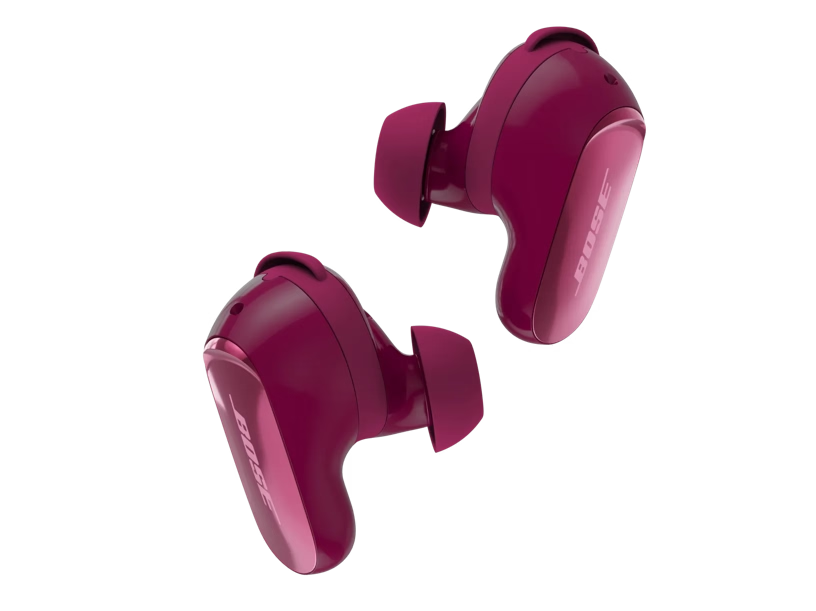
The physical design has been refreshed with a more comfortable, easier-to-adjust headband and improved button placement for more intuitive controls. Color options have expanded well beyond the conventional: black, white smoke, eucalyptus green, dewdrop mint, and rosewood mauve.
The broader context here is Bose's product stratification across the QuietComfort line. The QuietComfort Ultra Headphones (2nd Gen) retail at $449 and launched last fall with spatial audio as a differentiating feature. By bringing TrueSpatial down to the $359 tier, Bose narrows the gap between its entry-level and flagship headphones on the feature that has defined its recent marketing. The remaining differentiators at the Ultra level are presumably in driver tuning (the internal speakers that produce sound), build materials, and possibly ANC headroom — the maximum noise-canceling strength — though the verified facts do not specify those distinctions.
The USB-C lossless playback path on the new QuietComfort mirrors what Bose implemented on the Ultra Headphones (2nd Gen), which can receive 16-bit, 44.1kHz or 48kHz audio over USB audio. Bose has not specified the bit depth or sample rate for the second-generation QuietComfort's USB-C audio path.
For buyers who skipped the first generation, the value proposition is straightforward: for $359, the second-generation QuietComfort now bundles spatial audio, adaptive ANC, multipoint Bluetooth 5.4, and lossless USB-C playback into the entry tier. For existing first-generation owners, the calculus depends on how much glasses-friendly ANC and immersive audio matter to their daily use. The design improvements and button repositioning are incremental rather than transformative.
The color palette expansion — five options including two pastel greens and a mauve — signals Bose continuing to push beyond the black-and-silver convention that dominated headphone aesthetics for years. Whether that resonates with the pragmatic buyer who typically gravitates toward the QuietComfort line is a separate question from whether the technology inside justifies the price.