SteelSeries Rival Pro and Sensei Pro Swap 2.4GHz for UWB and Fixed Batteries for Swappable Cells
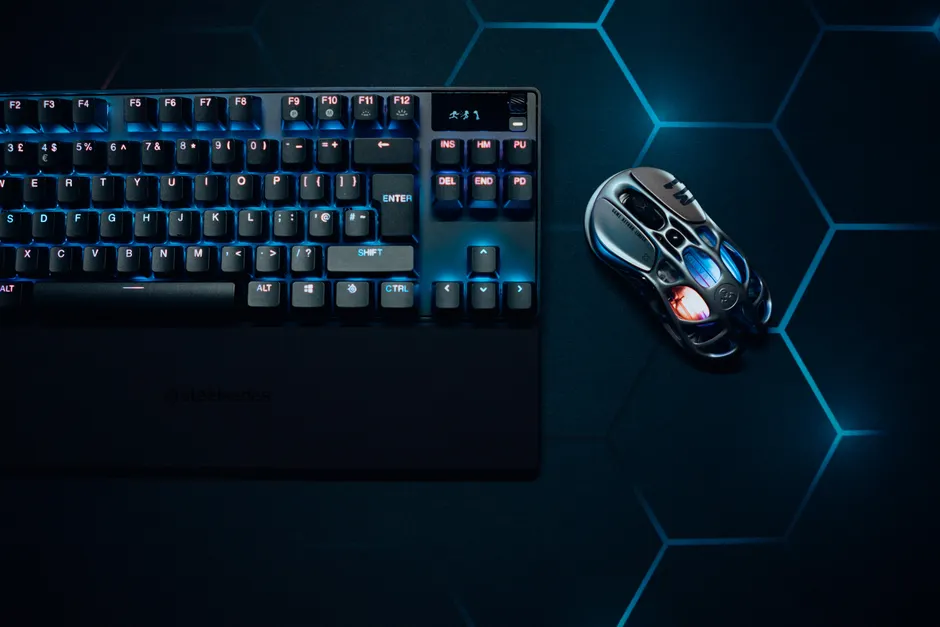
SteelSeries has introduced the Rival Pro and Sensei Pro, two wireless gaming mice that use ultra-wideband radio and swappable batteries. The Rival Pro has an ergonomic, right-handed shape and the Sensei Pro has an ambidextrous shape for left- or right-handed use. Both cost $179, are available to preorder now, and ship on October 13, according to The Verge.
Both standard models weigh 53 grams in black and 54 grams in white. SteelSeries will also sell miniature versions of both shapes that weigh four grams less and cost the same $179.
Power comes from circular batteries that can be removed and swapped. The mice ship with those batteries and a wireless base station that handles pairing. The station keeps a spare battery charged, so a low battery can be replaced without plugging the mouse in with a cable. SteelSeries calls the system "Infinite Power".
Battery life depends on polling rate, meaning how many times per second the mouse reports its position to the PC. Each battery lasts 16 hours at 8,000Hz polling and 60 hours at 1,000Hz polling. Running at the higher report rate cuts runtime by almost four times.
The wireless link avoids the usual 2.4GHz band used by Wi-Fi, Bluetooth, and many peripherals. Instead the mice connect to the base station over ultra-wideband, or UWB, between 6.4GHz and 9.056GHz. SteelSeries says UWB offers 20 times the bandwidth and lower latency. That headroom helps at 8,000Hz, where only 125 microseconds separate reports and the radio must handle channel access, retransmissions, and interference from nearby 2.4GHz devices. Using 6.4GHz to 9.056GHz keeps mouse traffic away from that crowded band, at least in principle.
Software manages the balance between speed and battery drain. The SteelSeries GG app adds SuperSync, which sets click reporting and motion-sensor reporting separately. A user can keep click reports at 8,000Hz for fast button response while lowering sensor reports to 4,000Hz to send less motion data and use less power. GG also adds Smart DPI, which changes sensitivity automatically when moving between gameplay and menus. DPI controls how far the cursor moves for a given mouse movement. GG now runs as a browser-based web app in Chrome or Edge, so no installed program is required for setup.
Details of the smaller models surfaced early in retail listings. The Rival Pro Mini appeared online before launch at 49 grams, which matches the four-gram reduction now confirmed for the miniature versions TechPowerUp. Other listings credited the Mini with a PAW3950 sensor, 100 million optical clicks, and 100 percent PTFE feet, which are low-friction pads under the mouse Yahoo Tech.
The broader context here is separation of jobs that used to be linked. Power becomes a base-station task rather than a limit inside the mouse. Click speed and motion tracking can be tuned separately instead of with one polling control. Avoiding interference becomes a choice of radio band rather than only better retry logic.
In my view, that separation is useful. Gamers have long traded light weight against long battery life and top report rates, because a sealed battery forced all three to draw from the same reserve. A battery that can be swapped during play changes that math. Worth noting for offices and shared labs is the browser setup in Chrome or Edge, which lowers install work but puts mouse settings under browser permissions and HID device rules that IT teams should review.
The long-term possibility here is more wired-like consistency without wires. If UWB holds a stable high-rate link clear of 2.4GHz crowding, and if split polling lets users keep fast clicks while easing off on motion data, ultralight wireless mice can stay light and stay in play without cables or charging docks that pause a game.