Destro Raises $8M to Coordinate Warehouse Robots and Workers
Destro emerged from stealth on September 30, 2026 with an $8 million seed round. The company was founded by Manthan Pawar and has built an AI intelligence layer for logistics that directs both robots and human workers. TechCrunch
Pawar earned a master's degree in robotics at NYU Tandon and spent roughly eight years in the U.S. supply chain and robotics industry. His positioning is direct: "One of the biggest reasons we are winning against robotics companies is because we are not a robotics company." Destro does not supply the hardware. It supplies the coordination. Pawar said Destro is on a path to be cash flow positive at the end of 2026.
The stack is split in two. Vision runs on the robot. It is based on open-weight vision-language-action models, meaning openly shared AI models that turn camera images and instructions into robot movement. Destro separately describes VisionOS as an on-robot intelligence platform that enables complex mobile manipulation, robots moving and handling objects, using AI models trained from human demonstrations. Business Wire
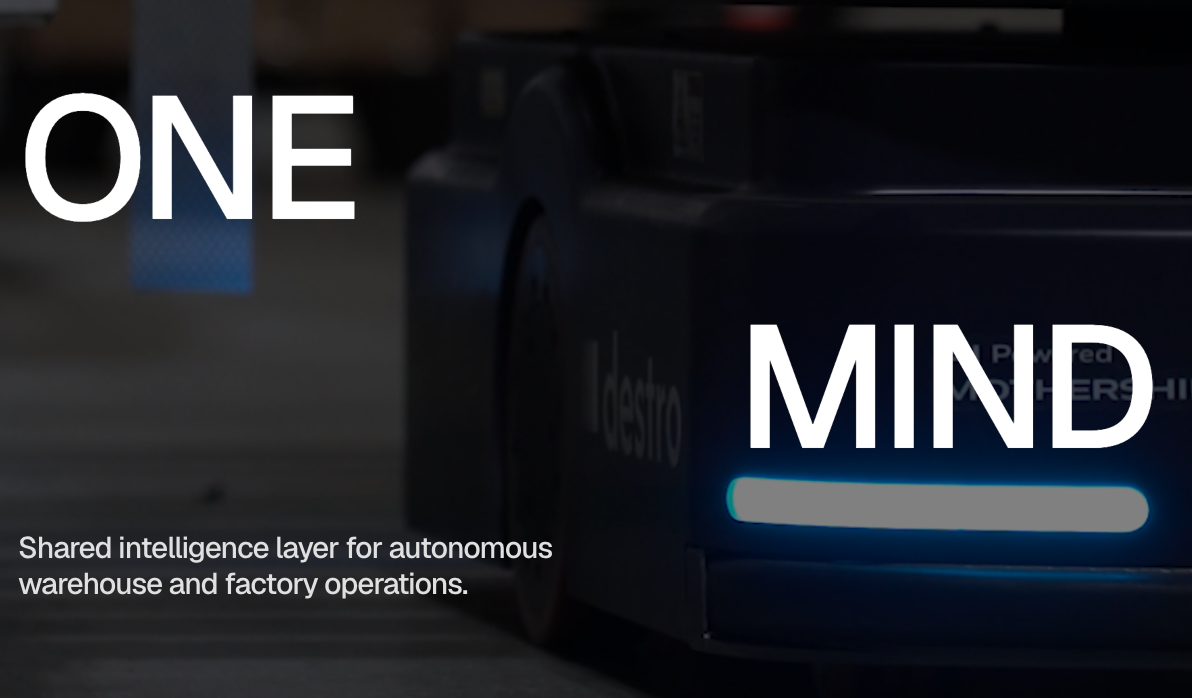
Mothership sits above Vision. It directs human workers, carts and trucks in the cross-dock workflow, where freight moves quickly from inbound trucks to outbound trucks with little storage. Rather than automating one robot task in isolation, the system assigns tasks across people and machines. Destro describes the wider approach as a shared intelligence layer for autonomous warehouse and factory operations, coordinating robots, people and workflows.
The first production test is with Yusen Logistics. Richard Brunelle is director of automation for the American logistics group at Yusen Logistics, with responsibility for automation across about 30 Yusen Logistics facilities in the U.S. Destro started with a pilot at a Yusen facility in the Pacific Northwest using three cart-moving robots built by Miva Robotics.
That pilot is now scaling. Destro is expanding the initial Yusen site to a full deployment of 26 robots and launching another pilot with 17 robots at Yusen's Southern California facility. The seed announcement was datelined Brooklyn, N.Y. Yahoo Finance
Yusen evaluated two other robot startups before choosing Destro. One offered point-to-point cart-moving, moving carts from A to B, without loading and unloading management. The other required a person to handle orchestration, the minute-by-minute assignment of who does what and when. Destro won by taking on that orchestration itself, covering inbound unloading, cart movement and outbound loading within one system.
The broader context here is familiar to warehouse teams. Point-to-point navigation stopped being the hard part some time ago. The failure is the handoff: a robot waiting for a cart, a worker waiting for a robot, a trailer door opening with no labor assigned. Cross-dock punishes partial automation because dwell time, the time freight sits waiting, is measured in minutes and the mix of freight, carts and people changes by the hour.
In my view, Destro is worth watching less for Vision than for Mothership. Vision-language-action models for mobile manipulation are now a crowded research area, and open-weight starting points lower the barrier further. Orchestration across mixed human and robot labor is less crowded and harder to demonstrate, but it is where warehouse operators feel the cost. If Destro can hold to its path to cash flow positive while scaling from three robots to 26 and then to a second site, it will have evidence that one intelligence layer can carry across hardware and facilities. That portability, more than any single deployment, is what would make this model durable.