OpenAI to Place Visual Ads Next to ChatGPT Images
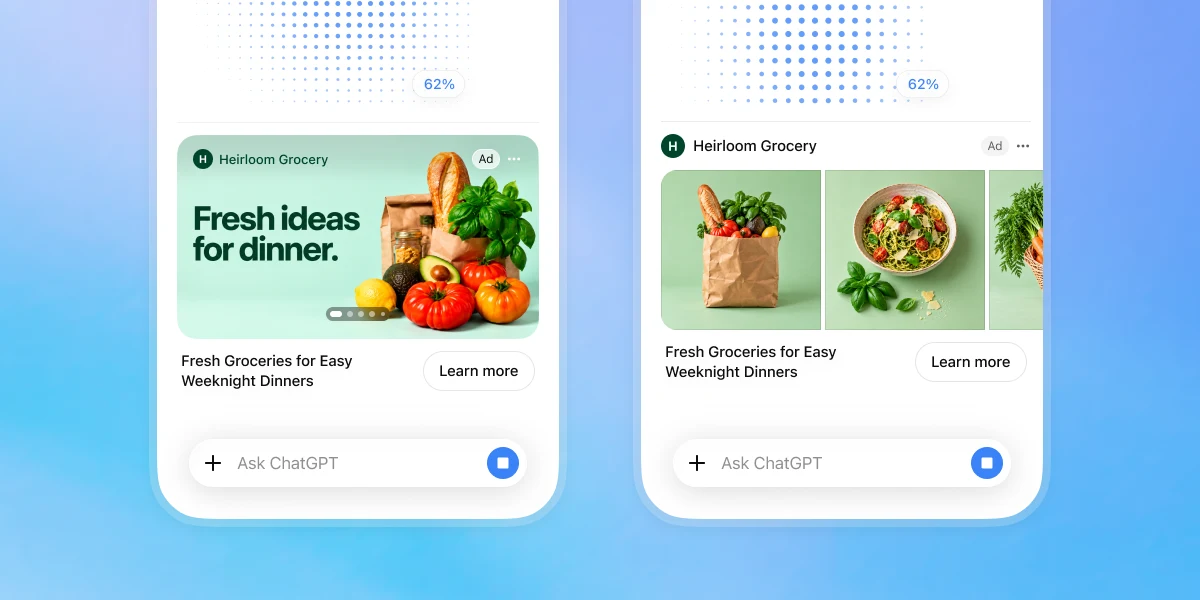
OpenAI is launching visual display ads that appear alongside images users ask ChatGPT to generate.
The units will begin appearing later in October 2026 in the United States only. Initial placements will feature products and services from a test group of advertisers, according to details reported by TechCrunch. The company lists the announcement on its news page as a Product article titled 'Building advertising for the way people use AI' dated Oct 5, 2026.
OpenAI states its ChatGPT ads will be clearly labeled and will not influence the answers ChatGPT provides. That separation of sponsored inventory from model output is central to the design described for the image-adjacent units. Ads were introduced earlier in 2026 to support free and low-cost subscription tiers, and were expanded to Free and Go tiers in India in August 2026. ChatGPT has 1.2 billion weekly users as reported in October 2026.
For advertisers, OpenAI is building a measurement stack familiar to performance marketers. It expanded ChatGPT ad measurement to include click attribution partners AppsFlyer, Triple Whale, Adjust, DV Rockerbox, Northbeam, Branch, Singular, Kochava, Airbridge and Tenjin. Click attribution connects an ad click to a later install or purchase. It expanded full-funnel advanced measurement partners to include Fospha, Measured and INCRMNTAL, which track the path from ad view to sale. It partnered with Haus, Measured and WorkMagic to help advertisers explore geo-based experiments around ads, which compare sales in areas that saw ads with areas that did not.
OpenAI is also developing brand suitability evaluation pilots with DoubleVerify and Integral Ad Science. That work addresses adjacency and suitability controls for generative output, where creative context is produced per prompt rather than selected from a fixed publisher page. Think of it as the difference between choosing a page for an ad and creating a new page for every reader. There are category controls as well. OpenAI bars advertisements for competing image- and audio-generating tools in ChatGPT, as reported by Yahoo Finance.
The image surface itself has been under active iteration. OpenAI unveiled an image-model update described as better at charts and diagrams in April 2026, following a ChatGPT update in December 2025 intended to generate images better and faster, as reported by Bloomberg. Separately, OpenAI's models accessed publicly available information from U.S. government websites including the Census Bureau and the SEC. OpenAI was preparing to file for an IPO that could give it a $1 trillion market capitalization, as reported by Reuters.
The broader context here is paying for AI at very large scale without breaking how people use it. Search trained advertisers to bid on intent expressed in keywords. ChatGPT image generation works differently. Intent is expressed in a creative brief, and the output is synthetic. Placing display units beside the result leaves the generation itself alone while opening high-attention inventory.
In my view, the telling detail is the emphasis on attribution, incrementality and geo-experimentation. That is the language of mature acquisition budgets, not brand experimentation. Click attribution, full-funnel measurement and regional lift testing are needed before large advertisers shift spending from search and social. If OpenAI can show added sales with clear labeling and trusted third-party checks, image-adjacent units could become a steady revenue layer that helps support free access while keeping model behavior separate from advertiser influence.