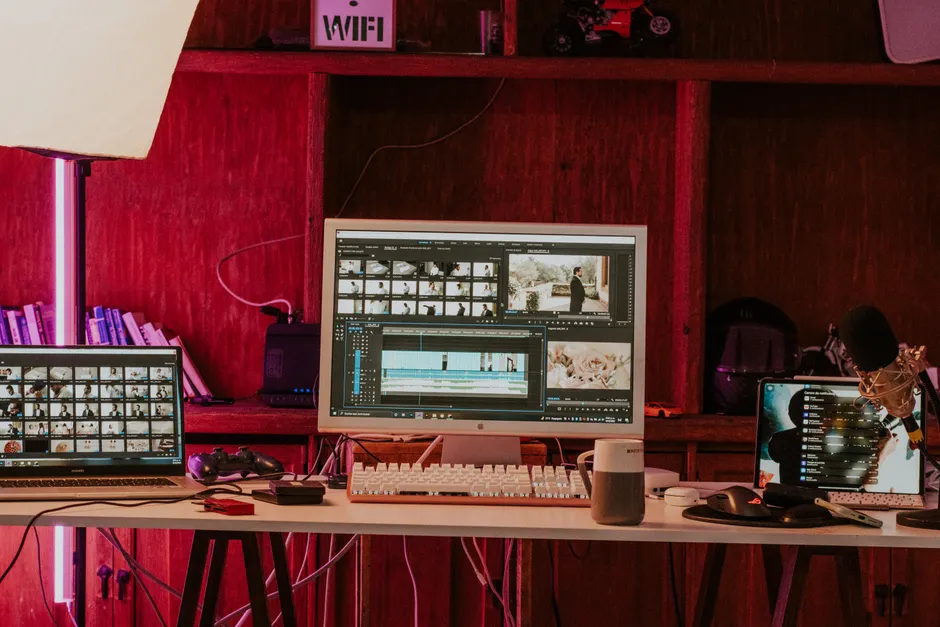
Ben Affleck's Push for Practical AI in Filmmaking
Ben Affleck spent the week of October 8, 2026, going viral for talking about AI like a practitioner.
The clips came from two interviews. One was an episode of GQ's "One More Question" series. The other was a conversation with Bloomberg's Lucas Shaw at the Screentime 2026 conference in Los Angeles. In both, Affleck discussed machine learning, neural networks, transformers, tensors, GPUs and inference in the context of filmmaking workflows TechCrunch. In brief, transformers are the standard design for current AI models, tensors are the data structures they calculate with, GPUs are the chips that run them, and inference is the step when a trained model generates output.
The attention followed Netflix's acquisition of InterPositive earlier in 2026. InterPositive is a filmmaking technology company founded by Affleck that develops AI-powered tools built by and for filmmakers, according to Netflix's acquisition announcement Netflix. Earlier reporting put the cash price at $587 million Los Angeles Times.
Affleck, who is CEO of Artists Equity, used the recent interviews to describe the technical work in more detail. On GQ, discussing convolutional neural networks, a type of model often used for images, and visual-effects workflows, he said he can write "pretty shitty Python scripts." He also said he visited OpenAI while exploring emerging technology.
The more technical claims concerned data and training. Affleck said he raised money and spent about eight months shooting with many cameras to create a dataset for late-stage training of open models for discrete filmmaking tasks. At Screentime, he described fine-tuning by taking open-source models and unfreezing the weights.
That description will be familiar to engineers working with open-weight releases. Unfreezing some or all layers for continued training on domain data is standard practice for specialization, particularly where the base model provides general visual or language priors and the production task requires tight control over style, continuity, geometry or identity. Affleck framed InterPositive's work as applying that approach to discrete problems in production rather than building foundation models, the large general models trained from scratch.
He also pushed back on the deal number. Affleck said the reported $587 million sale price is "not right" and noted he did not own the whole company.
On the social questions, Affleck kept the focus off the studio lot. He told the Bloomberg Screentime event that when he worries about AI, he worries about his kids in school Deadline. In a Bloomberg interview published September 30, he said he is more worried about the impact of artificial intelligence on children and society than about its impact on Hollywood. Bloomberg also published an October 1 video interview titled 'Ben Affleck on AI and Hollywood Economics' in which he discussed Hollywood economics, artist-focused business models and AI's role in the industry.
The broader context here is that Hollywood has spent three years cycling between alarm about synthetic actors and enthusiasm for cost reduction in previsualization, de-aging, cleanup and localization. Affleck is describing a third path, narrow models trained on purpose-shot data for controlled production tasks, evaluated by filmmakers.
In my view, that is the version of AI in media most likely to stick, because it preserves human direction while removing some of the least creative labor.
The comments about school follow a familiar pattern with new general-purpose systems. They tend to arrive in classrooms before norms and curricula catch up. I watched that happen twice with my own kids, first with search and Wikipedia, then with smartphones and social feeds. Each time, the adult debate centered on cheating or distraction, and the longer effect was a change in how assignments were designed and how students checked their own work. AI looks to be on the same track, only faster, with inference cheap enough to sit inside every homework workflow.
Looking ahead at what this enables, if Affleck's technical account holds, the result is incremental but useful. Smaller, task-specific models with clean rights to their training data, lower inference cost than prompting a large general model for every shot, and tools that fit existing editorial and VFX pipelines. That will not settle questions of consent, compensation or provenance. It does suggest where near-term engineering effort in Hollywood is going.