LG's $3,600 RGB TV Hits 4,011 Nits, But Dark Scenes Bloom
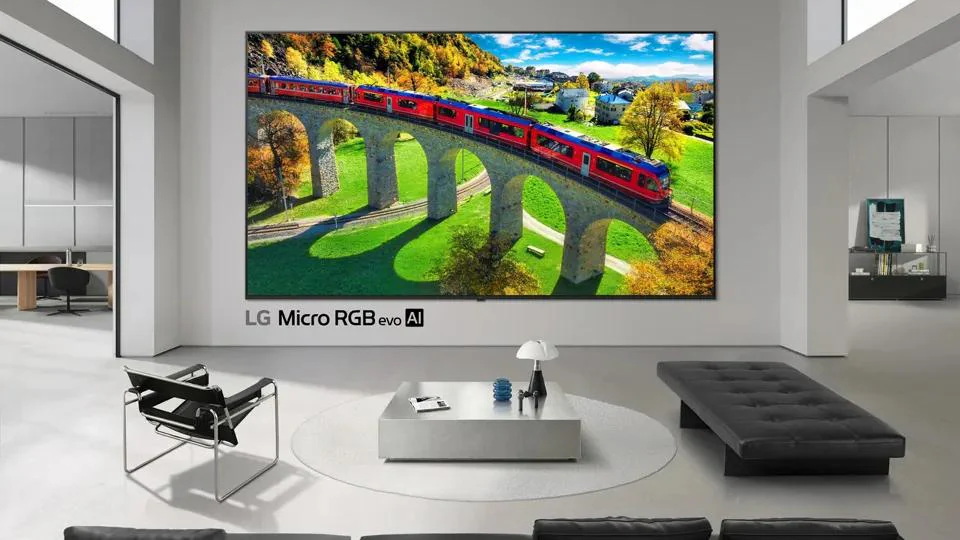
LG's 75-inch Micro RGB evo MRGB95B costs $3,600 and measured 4,011 nits peak brightness in HDR Filmmaker mode. That result comes from testing published Oct. 10, 2026, in The Verge review of LG's RGB LED TV.
The full name is LG Micro RGB evo AI MRGB95B 4K Smart TV 2026. It comes in 75-inch, 86-inch and 100-inch sizes, with 75-inch as the smallest. LG lists the 86-inch at $5,299.99 and the 100-inch at $6,999.99, and calls the line its first-generation RGB TV and its most advanced LCD TV.
Instead of a white backlight shining through a color filter, it uses separate red, green and blue backlights. A nit is a unit of brightness. The goal is purer color and higher sustained brightness from a standard LCD panel, without using self-emissive pixels that make their own light like OLED.
Measured color covered 100 percent of P3 and nearly 90 percent of BT.2020. P3 and BT.2020 are industry color standards, with BT.2020 the wider one. That range matters for HDR, where regular LCDs often lose saturation at high brightness. HDR support is listed as Dolby Vision, HDR10 and HLG. It supports Dolby Vision, but not Dolby Vision 2 or HDR10+.
For connections, there are four HDMI 2.1 ports, one with eARC for sending audio to a soundbar or receiver. For gaming, LG lists VRR (variable refresh rate for smoother motion), ALLM, Game Optimizer and G-Sync compatibility. Audio support is listed as Dolby Atmos, Dolby Atmos FlexConnect, Dolby Digital and Auracast. The system runs webOS and ships with LG's Magic Remote in the traditional remote shape.
The review also found more blooming than on other RGB LED TVs tested. Blooming is a halo around bright objects, and it showed when subtitles sat on dark screens. Backlight zoning is supposed to limit that stray light.
The broader context here is familiar from first-generation hardware. Brightness and color coverage are strong, while light control is less settled. The question is how much halo is acceptable in a dark room, and whether firmware updates can tighten control without lowering output.
In my view, worth flagging is the positioning. A 4,000-nit LCD with full P3 coverage changes what program makers can expect at the high end, even if OLED keeps its edge in per-pixel black. If RGB-backlit LCD can hold color where tone mapping now compresses highlights, HDR programs will carry over to the living room more directly. My kids grew up on dim older sets and later on phones that outshone them. They never asked about the backlight. They noticed when subtitles glowed in a dark scene. That is still the test. What this enables, if later versions improve control, is an LCD that does not have to pick between rich color and high brightness.