Egypt's Desert and Coastal Discoveries Reshape the Map of Roman-Era Settlement

Egypt's tourism and antiquities ministry announced on 4 July 2026 the excavation of a Byzantine-era city in the Dakhla oasis, located roughly 750 kilometres southwest of Cairo in the New Valley province, and a separate cache of 18 ancient tombs at Marina el-Alamein on the Mediterranean coast. Together, these finds extend what we know about how people settled and lived across Roman-period Egypt — both deep in the desert and at its maritime edges.
The Dakhla City
The mission, chaired by Mahmoud Massoud, uncovered a settlement built according to classical urban design: a grid of north–south streets crossed by east–west thoroughfares, all opening into public squares. A basilica-style church from the mid-fourth century sits at the centre of the settlement, overlooking the main streets. Watchtowers anchor the perimeter, and a deep defensive moat surrounds a heavily fortified residential area whose buildings still show thick outer walls, reception halls, and vaulted roofs — The Guardian reports the overall settlement dates to around the fourth century CE.
One structure offers a window into religious life: the house of Tisous, a church deacon, dated to the second half of the fourth century and interpreted as a domestic worship space that likely came before the large basilica was built. This pattern — small private chapels giving way to formal public churches — appears across the eastern Mediterranean as early Christian communities grew and eventually built dedicated religious architecture.
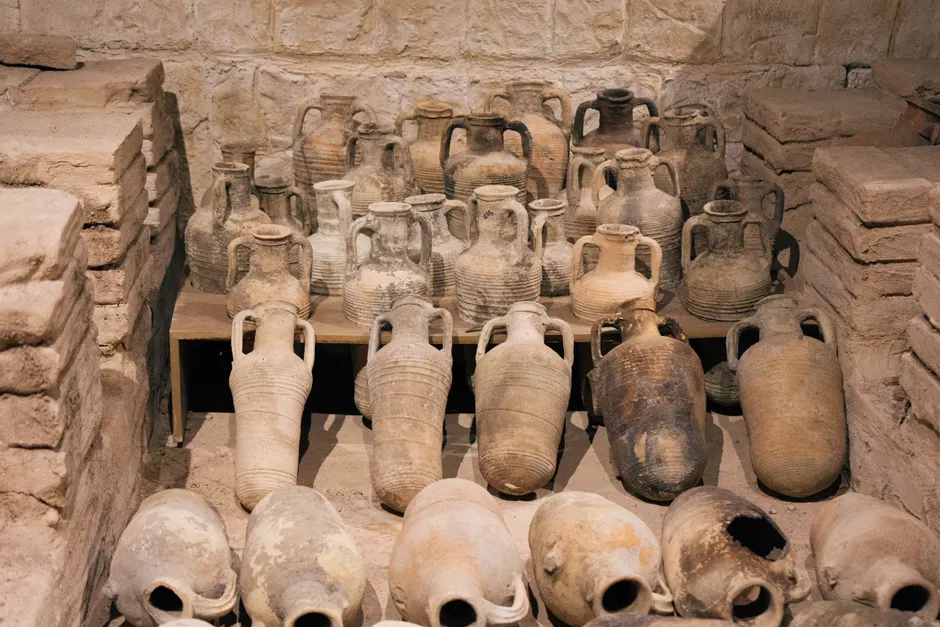
Coins, pottery, and written records sharpen the timeline. Gold coins from the reign of Constantius II (337–361 CE) provide a firm date for one occupation phase. Bronze coins bearing Byzantine imperial portraits alongside Latin and Christian symbols add further evidence. About 200 ostraca — pottery shards with scratched records of purchases, letters, and daily notes — reveal a working urban economy. Bread ovens, kitchens, and stone grinding tools confirm this was a functioning city, not merely a military or administrative station.
Hisham el-Leithy, secretary general of Egypt's supreme council of antiquities, and Diaa Zahran, head of the Islamic, Coptic and Jewish antiquities department, announced the find. The Dakhla oasis already sits on UNESCO's tentative World Heritage list, and discoveries of this significance typically inform Egypt's push toward full heritage status.
Dakhla as a Byzantine site tells us something important: the Roman empire extended its administrative grip deep into the Egyptian interior. The Western Desert oases — Dakhla, Kharga, Farafra — served as trade hubs along trans-Saharan routes and supplied agricultural goods to the Nile Valley. A settlement with this level of complexity — public squares, monumental church, defensive walls — was not a frontier outpost or supply depot. It was a regional centre of real consequence.
Marina el-Alamein
The second announcement concerns Marina el-Alamein, excavated since 1986 and identified as the ancient Greco-Roman port of Leukaspis, founded in the second century CE and occupied into the fourth. Mission chief Eman Abdel-Khaliq's team uncovered 18 new tombs — 11 cut into rock and 7 built above ground from limestone — bringing the documented total at Marina el-Alamein to 48.
Among the finds: a granite sarcophagus 2.5 metres long containing skeletal remains, and fragments of a plaster sphinx statue found nearby. Four gold pieces recovered from the mouths of some burials reflect the "golden tongue" practice, in which a gold coin or foil was placed in a deceased person's mouth to aid passage to the afterlife — a ritual known across Greco-Roman Egypt and found at multiple cemeteries in the Delta and along the coast.
The Marina el-Alamein tombs are less architecturally striking than the Dakhla city but cohere well with what archaeologists already understand about Leukaspis's Roman-era layers. Each additional tomb adds to the picture of who lived in this port community and how they buried their dead. Leukaspis was a trading hub whose commercial ties presumably stretched across the eastern Mediterranean during Rome's commercial peak.
The two announcements — separated by hundreds of kilometres and rooted in different archaeological traditions — reflect Egypt's sustained excavation output and the ministry's strategy of publicizing major discoveries to bolster tourism and international standing. The ostraca from Dakhla in particular may yield legible Greek or Coptic texts that could provide primary historical evidence of lasting scholarly value, beyond what the buildings themselves can tell us.