Apple HomeView: Apple's First Smart Display and Six-Device Home Lineup
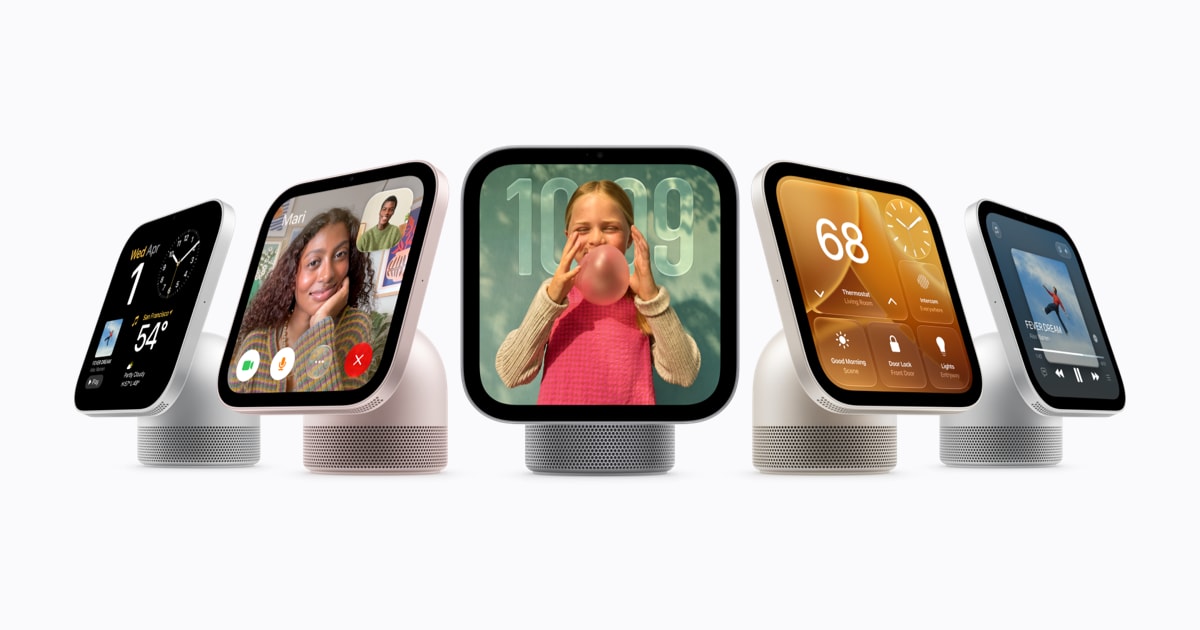
Apple announced Apple HomeView on October 13, 2026, alongside a six-device Apple Home Collection co-developed with LG Electronics and Schneider Electric. The collection covers a video doorbell, indoor and outdoor security cameras, a door lock, and two thermostats. All six can be controlled from HomeView or from other Apple products such as an iPhone. Apple
HomeView is Apple's first smart home display and sits at the center of the push. Apple showed the hardware following its "Welcome Home" event. Earlier reporting had referred to an Apple smart-home hub under the code name J490. Reuters
Pre-orders for HomeView opened October 13, 2026. Availability begins November 13. The device can be placed on a tabletop or wall-mounted.
HomeView hardware and interaction
HomeView uses a 7-inch Liquid Retina display, Apple's term for its high-resolution LCD panel, mounted on a domed speaker base. An aluminum enclosure connects to the base through a stainless steel hinge that provides smooth tilt. The tabletop configuration comes in silver, starlight, rose pink, and space gray, each with a matching cable. The wall-mounted version comes in space gray and silver.
Display behavior is tuned for the home environment. True Tone shifts screen color to match ambient light. Automatic brightness spans 500 nits, a measure of brightness, down to 0.3 nits for dark rooms. The interface also adjusts by distance. It shows simpler information from across the room and richer detail when a user steps closer.
Mounting for the wall version relies on three purpose-built mounts from Schneider Home. Apple lists self-installation and professional installation as options.
Identity is handled on-device by face recognition, meaning the check happens on HomeView itself. HomeView recognizes up to six people. Each person receives a personalized Home Screen with apps and widgets, plus access to personal content in Messages, FaceTime, Calendar, Reminders, and Find My.
Voice interaction runs through Siri AI, described as an entirely new version of Siri that is more capable and conversational. When paired with an Apple Intelligence-enabled device, Apple's system for personal AI, HomeView can draw on personal context from Calendar, Messages, and relevant information across apps.
Lock, doorbell, cameras and thermostats
The entry hardware comes from LG. The LG smart lock costs $349 and supports Apple Home Key for hands-free unlocking with UWB, or ultra-wideband, a short-range radio that measures distance precisely. It can also be opened with a PIN code or with a physical key through a keyhole beneath the keypad. The Verge
The LG video doorbell costs $249. It uses two cameras supporting up to 2.5K resolution, a sharp video format above 1080p, positioned to record visitors and to look down for package deliveries. A motion-activated light is built in.
Indoor coverage is a $199 plug-in camera from LG. It records up to 2.5K resolution. The camera tilts up and down automatically. It can be set to face downward when the user returns home.
Outdoor coverage is wired, with two tiers. A $399 model includes motion-activated floodlights. A $299 model omits the lights. Both sit inside the same Apple Home Collection.
Climate control splits across the two partners. LG supplies a round thermostat. Schneider Electric supplies a square model. Both cost $199 and both support Matter, the common smart-home standard that keeps setup and basic control working beyond a single vendor app.
The broader context here helps explain the split in who builds what. LG handles locks, doorbell, indoor camera, and one thermostat. Schneider Electric handles the second thermostat and the wall mounts for HomeView. Control stays on Apple surfaces such as HomeView and iPhone. Locks, mains-powered outdoor cameras, thermostats, and wall mounts all carry mechanical, electrical, and certification needs that favor specialist manufacturers.
In my view, the small choices will matter most in daily use. UWB for hands-free unlock removes the need to pull out a phone at the door. Dual cameras on the doorbell treat visitor identification and parcel detection as separate tasks. Automatic downward parking for the indoor camera gives occupants a clear, physical privacy signal. Face recognition for up to six users, paired with per-user Home Screens, tackles the shared-device problem that has limited kitchen-counter displays. My kids adopted shared tablets by negotiating profiles. A home display needs the same negotiation, handled faster and with less argument.
For households planning setup, it is worth noting the pairing rule around personal context. Siri AI runs on HomeView, but use of personal context from Calendar, Messages, and other apps requires pairing with an Apple Intelligence-enabled device. Plan device fleets and household setup accordingly. Brightness range and distance-aware layout also deserve testing in real rooms, not just spec-sheet comparison. A 0.3-nit floor and simplified far-field layout should help for hallways and bedrooms, but only in-situ checks will confirm legibility and false-trigger rates for motion lights, floodlights, and UWB unlock zones.
The longer-term picture is optimistic. A display that recognizes household members, dims for a dark bedroom, and talks to standards-based thermostats points toward a home system that adapts without constant configuration. If the sensors and identity hold up in daily use, the benefit is time returned to occupants rather than another dashboard to manage.


