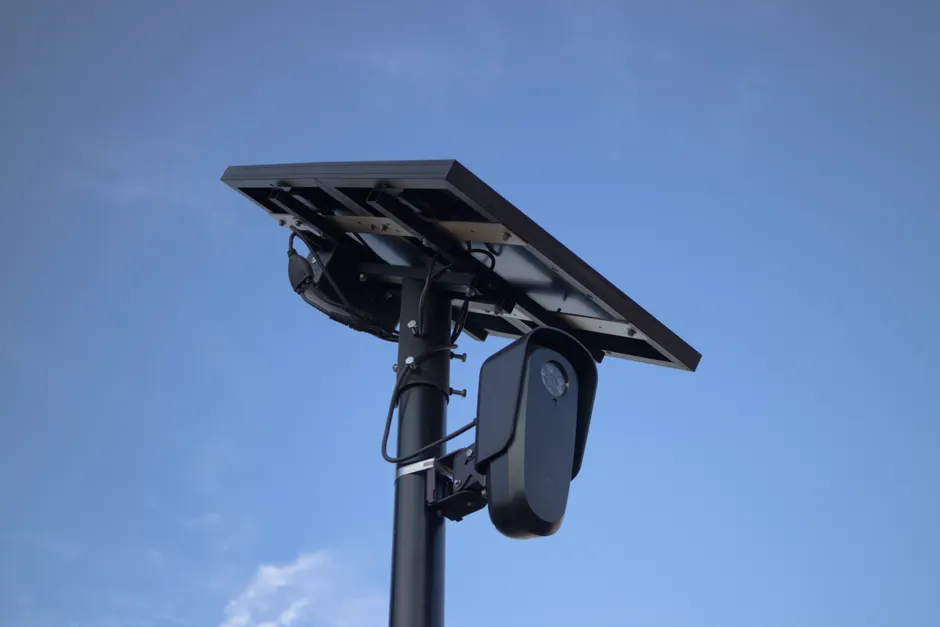
Flock CEO Defends License-Plate Cameras and Rejects a Pause

Flock founder and CEO Garrett Langley defended his company's surveillance hardware on stage at TechCrunch Disrupt 2026 in San Francisco.
His core argument was continued deployment. "If we want to live in a society where, if you commit a crime, you have a higher probability of being held accountable, we shouldn't pause progress," Langley said, according to TechCrunch.
Flock makes license plate cameras and other recording devices. The company states that its platform serves law enforcement, schools, businesses, and neighborhoods, and that it helps those organizations respond faster, investigate more effectively, and work together from the same platform.
Langley placed limits on what the hardware does. The cameras do not have facial recognition. He said Flock's microphones detect "just gunshots," a description tied to an audio-collection product for gunshot detection, according to TechCrunch. He did not concede the premise of the criticism, but said Flock is far from perfect during the Disrupt interview.
On governance, Langley positioned Flock as a supplier rather than a rulemaker. "We don't want to tell city leaders how to do their job," he said. Flock will provide recommendations and defaults while minimizing mandated features, functions, and policies.
TechCrunch had scheduled Langley in July to discuss the future of surveillance at Disrupt 2026. In August 2026, Flock Safety faced growing public outcry over concerns its surveillance technology could be misused, and Langley called for "compromise" as the backlash built, according to TechCrunch. Flock cut staff in October 2026 as the privacy backlash grew.
The broader context here is familiar to those who work with camera and sensor networks. The edge devices, meaning the cameras and detectors in the field, are relatively simple. The hard problems are retention (how long data is kept), search (how plates can be looked up), access control (who is allowed in), and audit (a log of who looked). Who can query what, across which jurisdictions, under what authorization, with what logging, tends to decide whether a system is trusted.
In my view, the defaults-versus-mandates distinction matters for practitioners. Recommendations and defaults reduce friction for buyers with different policies and legal constraints. They also push consequential choices to thousands of individual customers. That decentralization allows local control. It makes consistent enforcement difficult to verify from the outside.
Worth flagging for enterprise and public-sector buyers is the definitional work around audio and identity. "Just gunshots" is a scope claim about detection classes, meaning what the system is supposed to catch, not an architecture description. Buyers will want to understand sensor capabilities, processing location, what is discarded, what is stored, and how those assurances are tested. The same applies to the absence of facial recognition on cameras. That constraint is meaningful only alongside controls on how plate and vehicle data can be combined with other systems.
In this author's view, Langley's refusal to pause is not surprising. Vendors in this category rarely volunteer a moratorium. The more useful question is what measurable accountability looks like on both sides, higher clearance rates for criminal acts and auditable limits on misuse. Over the long arc, this kind of technology has given small agencies and businesses tools that once required far larger staffs. The benefit is real when investigations that stalled for lack of a witness or a timestamp can move forward. The cost is also real when data collected for one purpose becomes available for another without explicit public decision.