China's Submarine Missile Test Raises Questions About Pacific Transparency
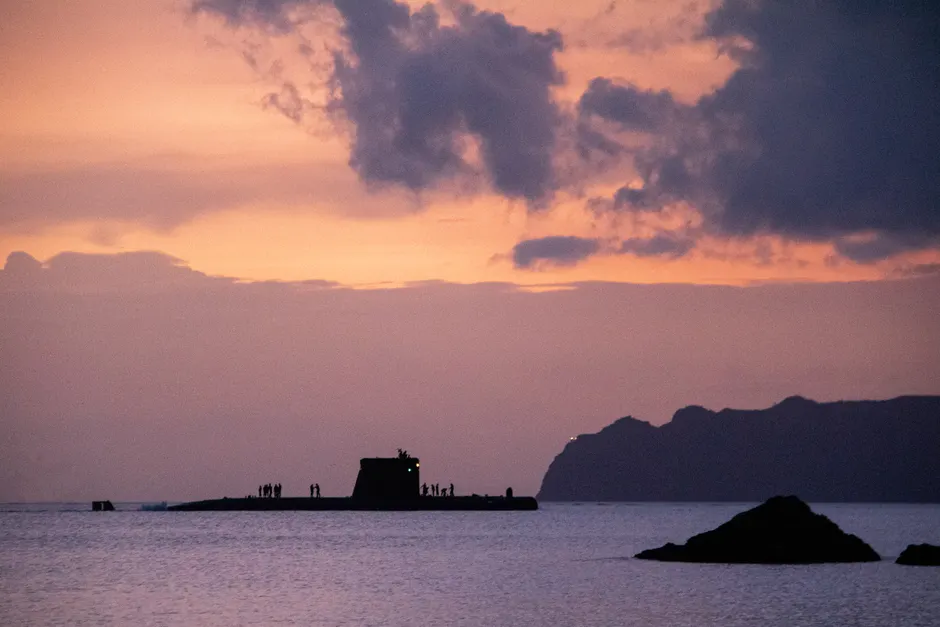
China launched a nuclear-capable ballistic missile from a submarine into the Pacific on July 6, prompting formal objections from the United States and Australia over inadequate advance notice. The Chinese military's state news agency, Xinhua, characterized the test as routine annual training using a dummy warhead. Yet the political reaction suggests the launch crossed into territory where a military exercise becomes a diplomatic problem The Guardian.
Australian media reported the test was imminent on July 5, according to Reuters. The launch occurred the next day from a nuclear-powered submarine into open waters, drawing alarm from regional governments. The PLA Navy said the missile landed in designated waters but withheld specifics. Taiwan's National Security Council secretary-general Joseph Wu released a flight-path map showing the missile traveling southeast from China, crossing over the Philippines, past Micronesia and Palau, and landing south of Nauru. Wu called it "a provocation that destabilizes the Indo-Pacific" and characterized China as "a bully on the block" The Guardian.
At Beijing's Ministry of Foreign Affairs press conference on July 6, spokesperson Mao Ning stated the test was a normal part of annual exercises, not directed at any specific country. She said relevant governments had been notified beforehand and urged observers to "not over-interpret" the event MFA transcript.
The core dispute hinges on what constitutes adequate notice. A US State Department spokesman asked China to establish a formal, advance notification system for all long-range ballistic missile and space launches, rather than issuing warnings only hours before a test window opens. Australia's response was more detailed. Cabinet minister Pat Conroy rejected China's assertion of legal compliance, calling the launch destabilizing and inconsistent with the Hague Convention framework — an international standard governing ballistic missile testing that calls for more advance warning and greater technical transparency than China provided. Conroy noted China gave only hours of notice before the missile fired The Guardian.
Foreign Minister Penny Wong, speaking in Suva, Fiji, contextualized the test within "a rapid military build-up by China" Penny Wong transcript. In a fuller interview with ABC's 7.30 program, she expanded on China's announcement. Deputy Prime Minister Richard Marles, on the Today Show the morning after, calibrated the threat assessment: the test was "not particularly close" to Australia but was nonetheless nuclear-capable, submarine-launched, and showed China deploying a much greater range for nuclear weapons than previously demonstrated in public Richard Marles transcript. Marles' comment underlined an asymmetry — the test may be distant from Australian territory, yet the capability it displays is unmistakably strategic and consequential.
The legal argument rests on notification norms that predate any binding global treaty on ballistic missile tests. The Hague Code of Conduct against Ballistic Missile Proliferation, which Conroy cited, is a voluntary agreement — not all states with advanced missile programs, including China, have signed on. This matters. Washington's demand is for a "regularized" notification system precisely because an existing treaty cannot be invoked; Beijing can argue it met whatever informal notice channels it deems sufficient, while Canberra and Washington contend that the practical reality — a submarine-launched strategic missile traveling thousands of kilometers through busy Pacific air and sea routes with only hours of public warning — falls short of the transparency standard other nuclear powers maintain for tests at this level.
The missile's path, if Wu's map is accurate, carried it near or over the exclusive economic zones of the Philippines, Micronesia, Palau, and waters adjacent to Nauru — nations with limited capacity to track or contest such transits in real time. This geography likely explains why criticism erupted swiftly from smaller Pacific and Southeast Asian capitals alongside Washington and Canberra. Beijing's claim that the test was routine and not aimed at any particular state sits uneasily against a diplomatic reality: a strategic-range, nuclear-capable launch through a densely populated maritime region registers as a signal to neighbors, whatever the stated intent. The timing compounds this — Wong herself had just described an accelerating Chinese military buildup, making a strategic weapons test through the same region read less as a training exercise and more as a demonstration.