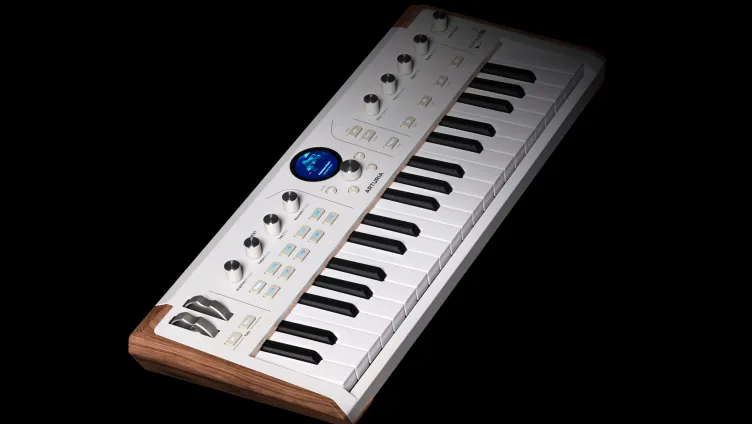
MiniFreak 49 Gives Arturia's Hybrid Synth Full-Size Keys
Arturia has added the MiniFreak 49 to its Freak line of digital synthesizers. It is available now with an MSRP of $849, as reported by The Verge.
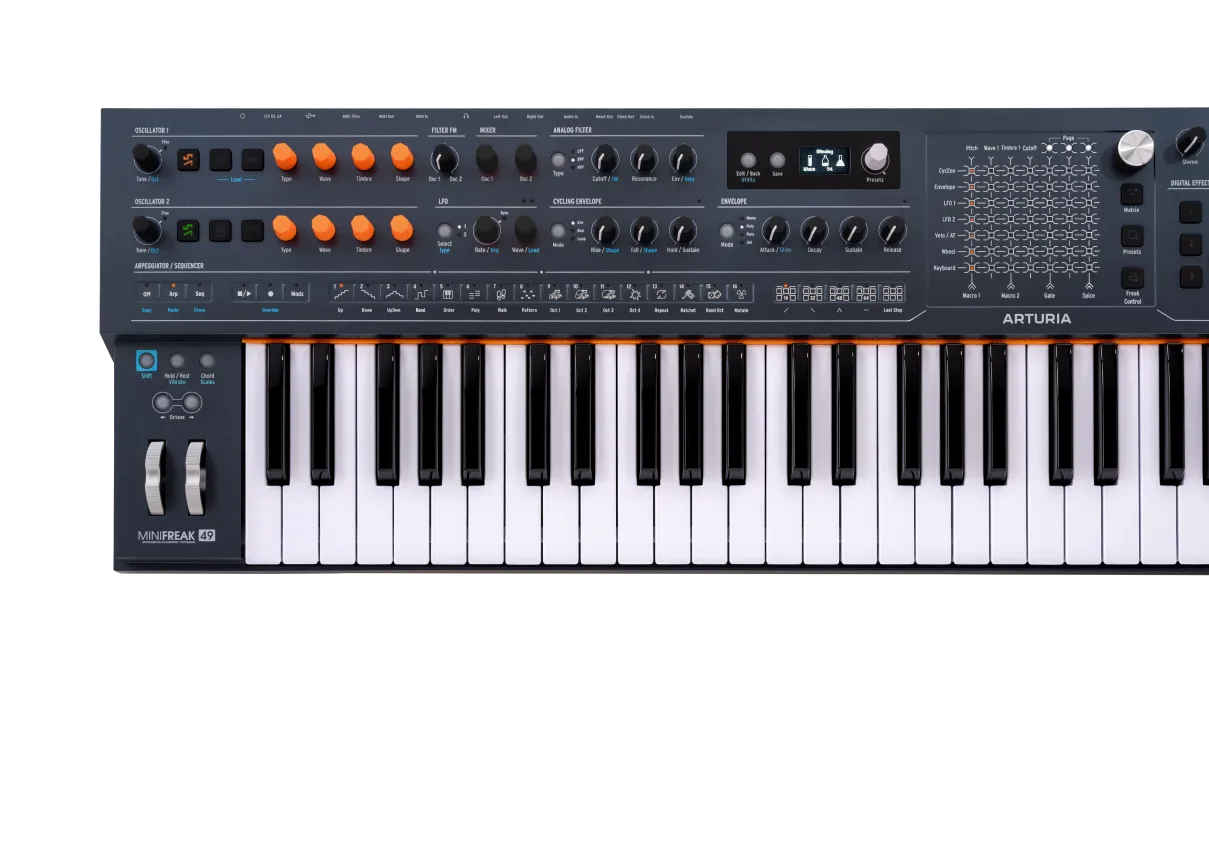
The main change is the keybed. The MiniFreak 49 has 49 full-size keys that are semi-weighted, meaning they offer some piano-like resistance but stay fast, and velocity-sensitive, meaning loudness follows touch. The original MiniFreak has 37 minikeys, while the MicroFreak has a 25-key touchplate with no moving keys. Arturia states the 49-key layout accommodates chords, melodic lines and two-handed playing.
The expression hardware changes with the larger frame. The MiniFreak 49 has mono aftertouch, which sends one pressure signal for all held notes, rather than polyphonic aftertouch, which sends separate pressure per note. It uses aluminum pitch and mod wheels instead of touchstrips. It also includes an XYZ touchpad for mod matrix control, which routes modulation sources to destinations, plus performance features and preset browsing.
The display and panel layout are also revised. The MiniFreak 49 has a larger LCD than the MiniFreak and MicroFreak. It has dedicated controls for its two sound engines.
Those engines pair over 30 digital oscillator types, the basic sound generators, with analog filters, circuits that shape tone. The MiniFreak 49 adds audio-rate filter FM, where the filter is modulated very fast for harsher tones. Storage is 256MB for user samples and wavetables, short recordings and looped waveforms you can load in. Arturia describes the MiniFreak 49 as a "Spontaneous algorithmic synthesizer" (Arturia).
The broader context here is keyboard feel and control density, not only oscillator count. A move to full-size, semi-weighted keys changes articulation, velocity response and hand fatigue during longer takes. It also changes who can use the instrument as a primary controller. Minikeys and touchplates reward compact sequencing and portability. A full-size 49-note surface rewards conventional piano technique and split-hand arrangements.
In my view, the performance tradeoffs are explicit and coherent. Wheels allow sprung pitch return and fine vibrato gestures that touchstrips approximate poorly, while touchstrips allow slides and abrupt resets that wheels do not provide. Mono aftertouch follows the same logic. Polyphonic aftertouch gives per-note expression under a held chord. Mono aftertouch gives one channel-wide signal. For filter opens, pad swells and global vibrato, channel pressure remains fast to use and simple to map. For independent lead-over-chord expression, it does less. Players who automate expression externally will feel that distinction less than players who rely on the keybed itself.
Looking at what this means for sound design workflow, dedicated engine controls and a larger display address a familiar constraint in compact hybrids. Two engines with more than 30 oscillator types create deep option trees. Direct access shortens the path from initial idea to edit, and a larger screen makes complex oscillator, modulation and matrix states easier to read while editing. Audio-rate filter FM extends that palette into harder, more unstable timbres that control-rate modulation cannot reach. Combined with onboard storage for user samples and wavetables, the structure favors iteration: load material, process it through digital oscillators and analog filtering, store the result.
What this enables, if the design holds in daily use, is longer playing and programming sessions without reaching for a second controller. A 49-note range keeps bass, chords and melody under two hands. The XYZ pad keeps matrix modulation and preset selection on the same surface. That consolidation has practical value in small studios and live rigs, where space and setup time carry real cost.