Teardown Points to iPhone Duo's Hinge as the Source of Cracked Screens
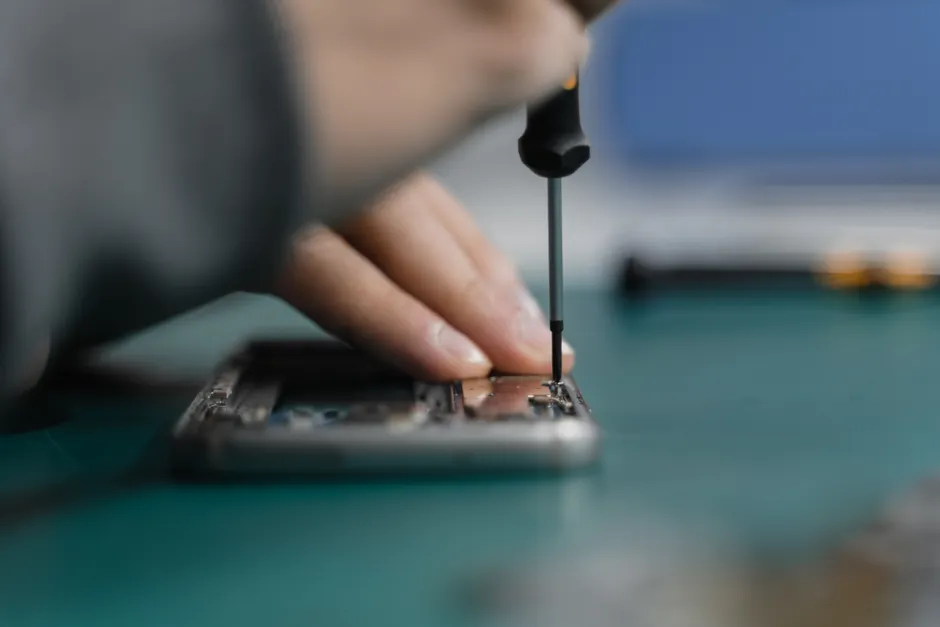
YouTuber CuriousHagi has reproduced the cracked display reported on Apple's iPhone Duo during durability testing, and a teardown of the device points to the central hinge assembly as the failure point. In a video covered by The Verge, CuriousHagi took the phone apart to find the cause of the hinge-related screen cracking.
The hinge, as the disassembly showed, is built from a gear-like central hinge flanked by two different types of linking hinges. These linked pieces, a set of small metal links that move in sequence, let the two halves of the phone fold together. The component that broke was a middle link thinner than the links above and below it. It snapped at a small notch, which sits at its weakest point. Marks on the hinge where it meets the support plate suggest where it may have caught during opening and closing.
Those findings line up with what owners have described. User reports say the screen cracks in the same place after the hinge catches and makes an audible crack. Mashable describes a large crack across the inner display running right along the hinge, with a pixel issue on the right-hand side of the panel. Photos shared on Reddit and the MacRumors forums show display cracks that users link to hinge problems, as MacRumors reported.
Apple has promoted the hinge as a central part of the device. Its September 2026 newsroom release introduced the iPhone Duo and described a precision hinge designed to feel effortlessly smooth, with support across the center of the display so it lies flat when open. An October newsroom page described a precision-engineered hinge offering a smooth, satisfying feel with every use. Apple has also made the hinge available to developers. A hinge API, meaning a set of software hooks that lets apps use a hardware feature, lets apps respond to the angle of the display as the phone opens and closes, according to Apple's developer announcement.
The device is Apple's first foldable iPhone and has a grade 5 titanium enclosure, per Apple's October manufacturing announcement. It is priced at $2,000, according to Reuters. Reuters also reported that IDC expects Apple to take 44% of foldable market value in 2026 on 31% of units. The same day, the New York Post reported that critics praised the foldable screen while some users were already complaining of cracked devices.
In my view, the teardown matters less for what it says about one unit than for what it says about the hinge as a system. A foldable's hinge has to deliver a smooth, flat fold and also durability across tens of thousands of open-and-close cycles. Those two goals pull against each other at the thinnest part of the linkage, and a link slightly thinner than its neighbours becomes the spot where that trade-off shows. Buyers will want to know whether the reproduced failure reflects a design margin, a manufacturing variance, or a usage pattern.
The broader context here is that the hinge is no longer only a mechanical part. With a developer API that reads the display angle, it is also a software input, so any change to its geometry or tolerances affects apps as well as the panel. For developers, that makes the hinge a dependency worth understanding at the component level. For owners, the immediate questions are practical: where the screen cracks, how the hinge behaves in daily use, and what Apple does next. Foldable engineering is improving, and a reproducible failure traced to a single link is the kind of specific finding that lets engineers move quickly.