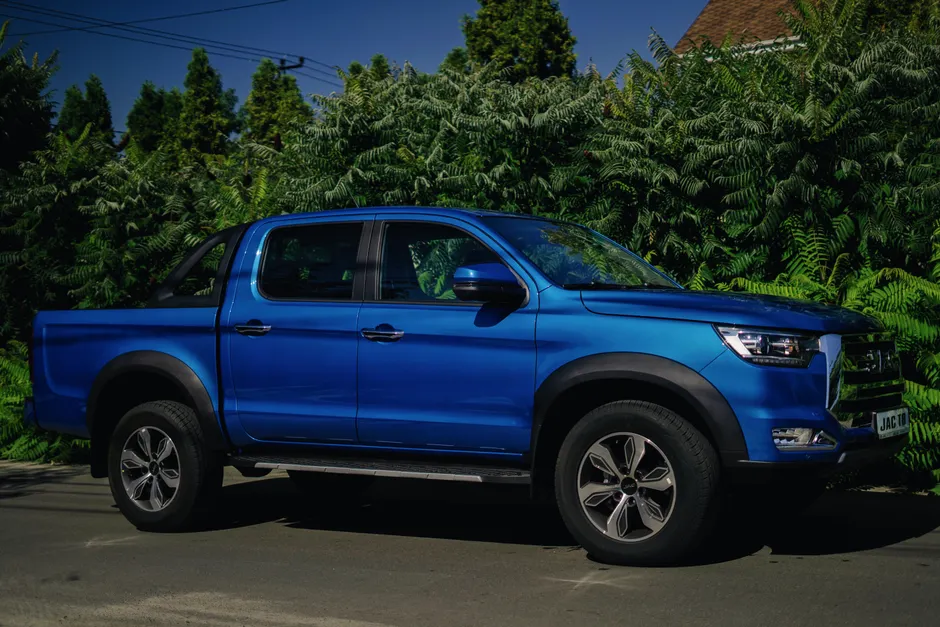
Ford's Fathom Pickup Aims to Run Your House From Its Battery

Ford's Fathom, a $28,000 electric pickup, places its inverter inside the truck's onboard "E-box" and produces more than 10 kW of AC power natively, according to The Verge.
An inverter converts a battery's DC output into the alternating current that household appliances run on. The architecture is the main departure from Ford's earlier approach. The discontinued F-150 Lightning required an external DC-to-AC wall inverter to supply household power from its battery. On the Fathom, the inverter is built into the truck. It converts battery energy into household electricity to run appliances, back up a home during an outage, or export energy to the grid.
Grid export is not possible on the truck alone. Owners will need the Ford Home Power Station to send power from the Fathom back to the grid. Ford is targeting a 50 percent discount on that unit compared with the existing $1,310 Ford Charge Station Pro, a plan rather than a finalized price.
Whole-home backup adds a second component. It requires pairing the Home Power Station with a backup panel, the distribution box that decides which circuits stay powered during an outage. Ford is aiming for an estimated $3,123 for that combination, against a typical $5,205, a reduction of roughly 40 percent. Finalized pricing is still pending.
The Fathom will be the first vehicle on Ford's new Universal Electric Vehicle Platform. Ford has also teamed with five power companies, Pacific Gas and Electric, American Electric Power, BC Hydro, Consumers Energy and Exelon, to standardize bidirectional charging rules, plugs and software. The utility work covers the interfaces outside the vehicle, where bidirectional charging has historically run into the most friction.
Ford's own product page lists a starting MSRP of $28,350 and says pre-orders begin in early 2027. Motor Trend reported on August 28, 2026 that the Fathom starts at $29,945 including the destination charge, and that the base model is rear-wheel drive with an LFP (lithium iron phosphate) battery. Motor Weekly, reporting on August 6, 2026, described the Fathom as a midsize electric pickup set to arrive in late 2027. The Verge's October 27, 2026 report uses the $28,000 figure in its headline.
The broader context here is that a pickup's battery becomes a household energy asset only when the vehicle, the charging hardware, the utility tariff and the software all agree. The inverter specification is the easiest part of that stack to quote. The harder part is the utility agreements, and the Fathom's launch will be the first real test of whether five utilities can standardize those rules across their territories.
In my view, the number that will matter most to buyers is the all-in cost of the backup configuration, not the sticker price of the truck. Ford's $3,123 target is an estimate, and until the Home Power Station and backup panel are priced, a buyer cannot judge whether the savings against the $5,205 typical figure hold up.
If the pricing targets and utility rules hold through launch, the Fathom would give owners a single vehicle that can run household loads, cover an outage, or send energy back to the grid, with the Home Power Station linking the truck to the grid. Ford's timeline puts that test in late 2027, and the details that remain open will decide how far the idea reaches.