Amazon Rolls Out Five New Echo Devices Through a Staggered October Launch

Amazon introduced five new Echo smart speakers and displays at a small event for journalists in New York City's financial district, where Panos Panay, the company's senior vice president of devices, Alexa, and Leo, presented the lineup (The Verge). Rather than hold one large fall hardware showcase, Amazon has released its devices through a series of smaller launches throughout October.
The new Echo lineup includes the Echo Show 16, the Echo Time smart alarm clock, the Alexa Photo Frame, the Echo Studio with Home Camera, and a new Echo Dot. Panay also teased two more launches still to come from Ring, along with news about “Echo on the Go.”
On the software side, the Echo Show features arriving with the Show 16 include dedicated home screens, an interactive 3D map view for smart home control, and a meal planning feature. Amazon also announced an updated version of Alexa Plus, its generative AI assistant, with deeper research capability. A new Card interface on Show devices collects Alexa Plus chats, and those cards also appear in the Alexa app and on Alexa.com.
The current lineup builds on hardware Amazon introduced in September 2025, when it launched four Echo devices purpose-built for Alexa+: the Echo Dot Max, Echo Studio, Echo Show 8 and Echo Show 11. The Dot Max, priced at $99.99, is the first Echo Dot engineered with two speakers, using a two-way design with a high-excursion woofer (a driver that moves a long way to produce low bass) and a custom tweeter. Amazon says it delivers nearly 3x the bass of the 5th-gen Echo Dot. The new Echo Studio is 40% smaller than the original.
Those devices run two custom silicon designs, AZ3 and AZ3 Pro, each with an AI Accelerator, a block of silicon built to run machine learning models locally. The Dot Max uses AZ3, while the Studio and both Show models use AZ3 Pro. Amazon says the AZ3 chip improves Alexa's wake-word detection (how reliably the device recognizes its trigger phrase) by over 50%. The new Show models include a 13-megapixel camera and the Omnisense sensor platform, which combines that camera with audio, ultrasound, Wi-Fi radar, an accelerometer and Wi-Fi CSI (channel state information, the radio signal data Wi-Fi hardware can read). Amazon also said any customer who orders a new Echo device gets access to Alexa+ out of the box (Amazon).
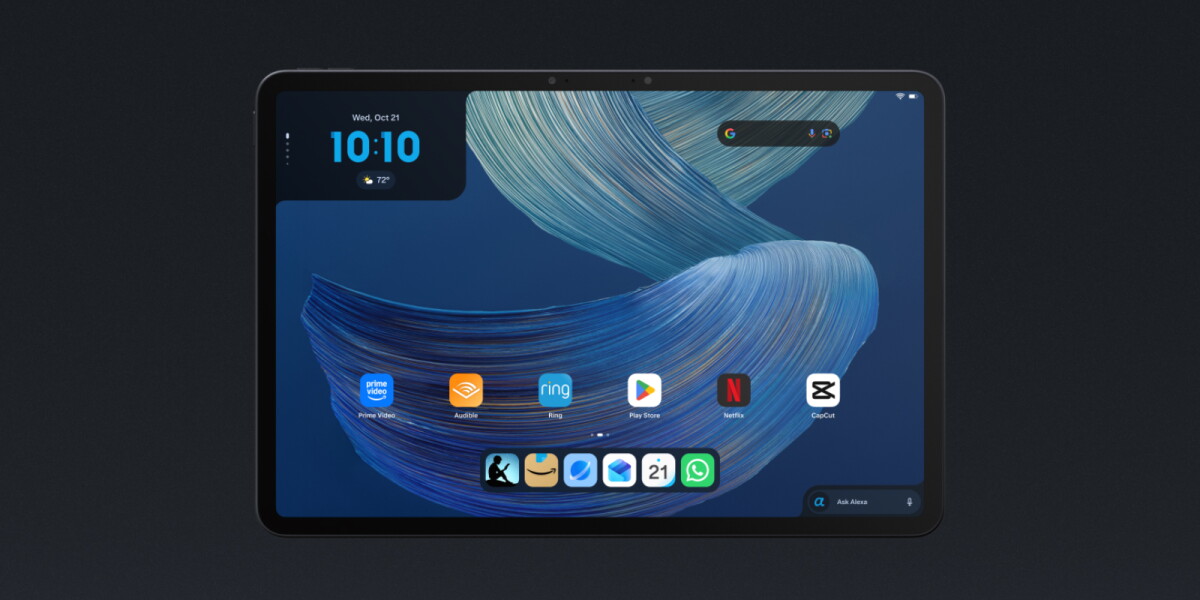
Earlier in October, Amazon's tablet and consumer device launches drew broader attention. Engadget reported that Amazon announced a new lineup of Alexa tablets that provide access to the Google Play Store without a workaround, along with a new batch of Kindles, fresh Ring smart home gear, an updated Fire TV Stick 4K, and first products from Bee, the maker of AI note-taking devices that has joined Amazon. Amazon also teased that more Alexa-branded devices are on the way (Engadget). Engadget reported that Amazon is transitioning away from Fire tablets toward a premium Alexa tablet lineup, available in the US, Mexico, Canada, the UK, Germany, France, Italy and Spain.
| Model | Price | Key specifications (per Amazon) |
|---|---|---|
| Alexa Tablet 8 | From $230 | 8.7-inch display, 8-core CPU, 2-core GPU, 4GB RAM, 64GB or 128GB storage, 0.3 inches thick, 16.4 oz, up to 14 hours video or 19 hours Kindle |
| Alexa Tablet 11 | From $330 | 11-inch 2.5K display, 90Hz, 16:10, fifth-gen MDLA NPU, 8GB RAM, dual Dolby Atmos speakers, up to 15 hours video |
| Alexa Tablet 12 Pro | $500 | 12-inch 280 PPI display, 120Hz, 3:2, 8-core CPU, 7-core GPU, 8th-gen MDLA NPU, 8GB RAM, 128GB storage, up to 16 hours video or 20 hours Kindle |
The Alexa Tablet 11 and 12 Pro include a fingerprint sensor. Amazon offers a Nanomatte anti-glare option for $50 more, and a $90 Pro Pen accessory for the Alexa Tablet 12 Pro.
Reuters reported that Amazon confirmed a shake-up in its Alexa leadership a day after the tablet announcement (Reuters). Panay has also said that only two products from Amazon's previous fall hardware event drew any attention (Engadget).
In my view, the staggered calendar is a practical answer to a product line that now depends on a software service evolving on its own schedule. Shipping hardware in smaller batches lets Amazon tie each device to a specific Alexa+ capability, and it spreads the press cycle across a month instead of a single afternoon. The harder question is whether customers who buy these devices use the features that justify them.
The broader context here is on-device processing. Dedicated NPUs (neural processing units, chips designed for AI workloads), edge-model accelerators and wake-word gains all move inference, the act of running a trained model to produce a result, closer to the room. That can reduce latency and limit how much audio and video must leave the home. The new Show's camera-and-sensor stack and the Card interface point to a device that tracks context over time. Whether that becomes useful daily routine, rather than another screen on the counter, will show up in use over the coming months.