Maine's Senate Race Becomes a Test of Data Center Politics

At the final debate of the Maine midterm campaign, an audience member shouted that he was terrified and that AI data centers are destroying the climate and poisoning water. Senator Susan Collins, the Republican incumbent, was defending her record at the time, and she tied the man to her Democratic challenger, Troy Jackson. The Verge
The exchange is the latest sign that data centers have become a central line of attack in the campaign. During a Senate debate, Collins responded to Jackson's criticism of data centers by pointing to her support for the Husted bill. Roll Call
The fight has a state-level history. In April, the Maine Legislature passed a bill that would have been the nation's first statewide moratorium, meaning a temporary pause on approvals, for large data centers. Gov. Janet Mills vetoed it 10 days after passage.
Local governments have moved faster than Augusta. Towns across Maine have adopted temporary moratoriums on data centers, and others are putting data center expansion to voters in November. A September poll of Mainers by UMass Lowell and YouGov found that 76 percent oppose building a data center in their community, and 58 percent are strongly opposed.
The money is following the issue. Maine's Senate race is set to be the most expensive Senate race per capita in U.S. history, with projected spending of $81 million by Democrats and $114 million by Republicans. Reuters puts total spending in the race at $199 million, and reports that Republican groups have outspent Democrats $76 million to $40 million. Reuters Tech billionaire money is one of the factors colliding with data center expansion in the contest.
The stakes extend beyond Maine. Collins is the last Republican incumbent senator in a Democratic-leaning state, and the outcome will help determine which party controls the Senate. Reuters describes Collins and Jackson as locked in a tight contest.
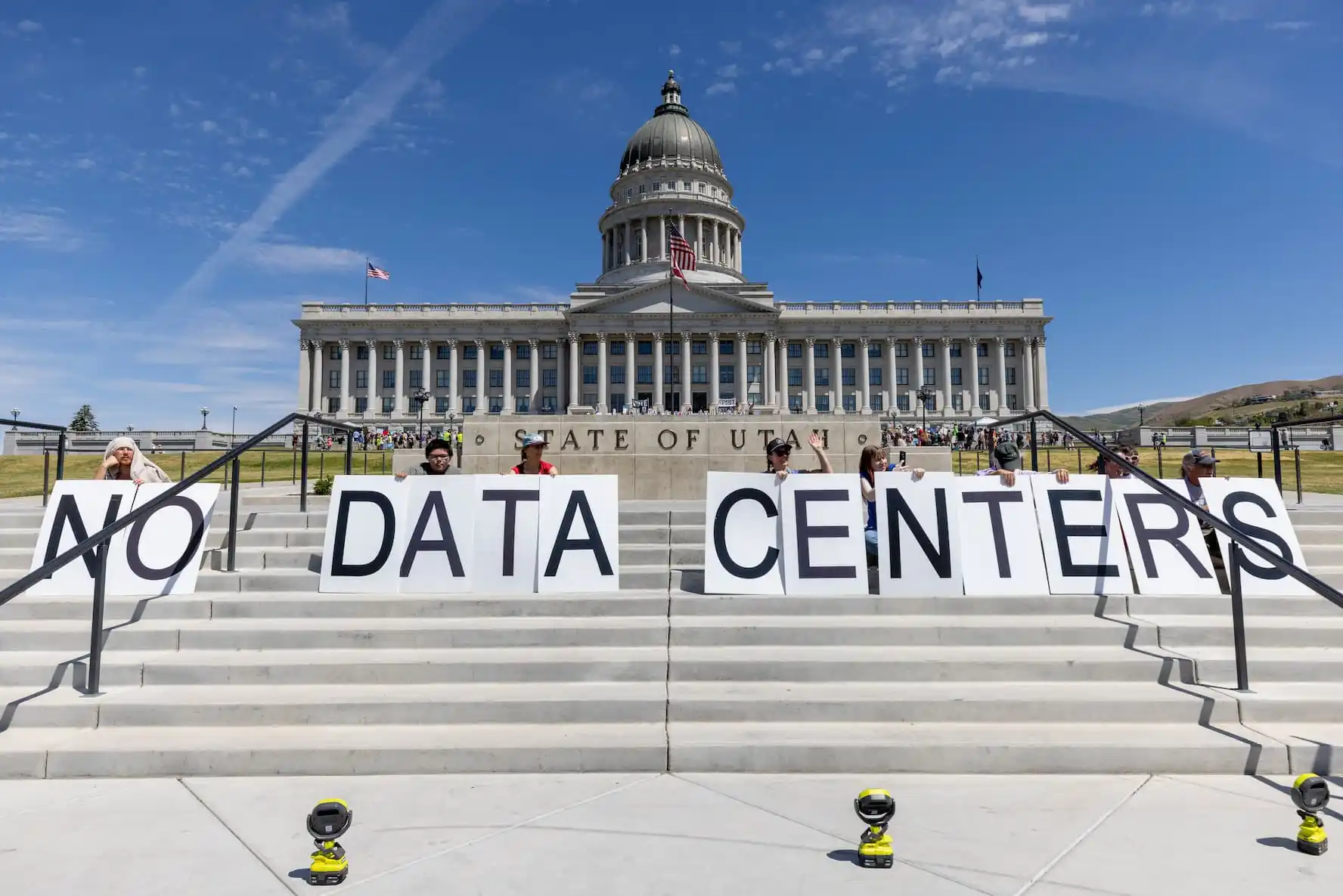
Opposition to data center construction is also showing up outside the ballot box. Protesters demonstrated outside a state office in Santa Fe, New Mexico, against the Project Jupiter data center. AP A nationwide protest against AI data center expansion included a demonstration in Imperial, California, on July 18, 2026. Brookings
In my view, the notable feature of the Maine episode is that the objections come from both ends of the political spectrum and from people who live closest to the sites. Data centers draw heavily on grid capacity and water. Who approves them, who pays for transmission upgrades, and who bears the local impact are now questions being put directly to voters. Whether siting rules, community agreements, or outright moratoriums become the prevailing model will shape how quickly the infrastructure behind AI can be built.
The broader context here is that the technology's physical footprint has become a political question. The November votes in Maine's towns, and the result of the Senate race, will show whether that footprint can be built with local consent, and what it costs to secure it.