Jackery Explorer 100D: A 96Wh LFP Power Station at $99 Through Walmart
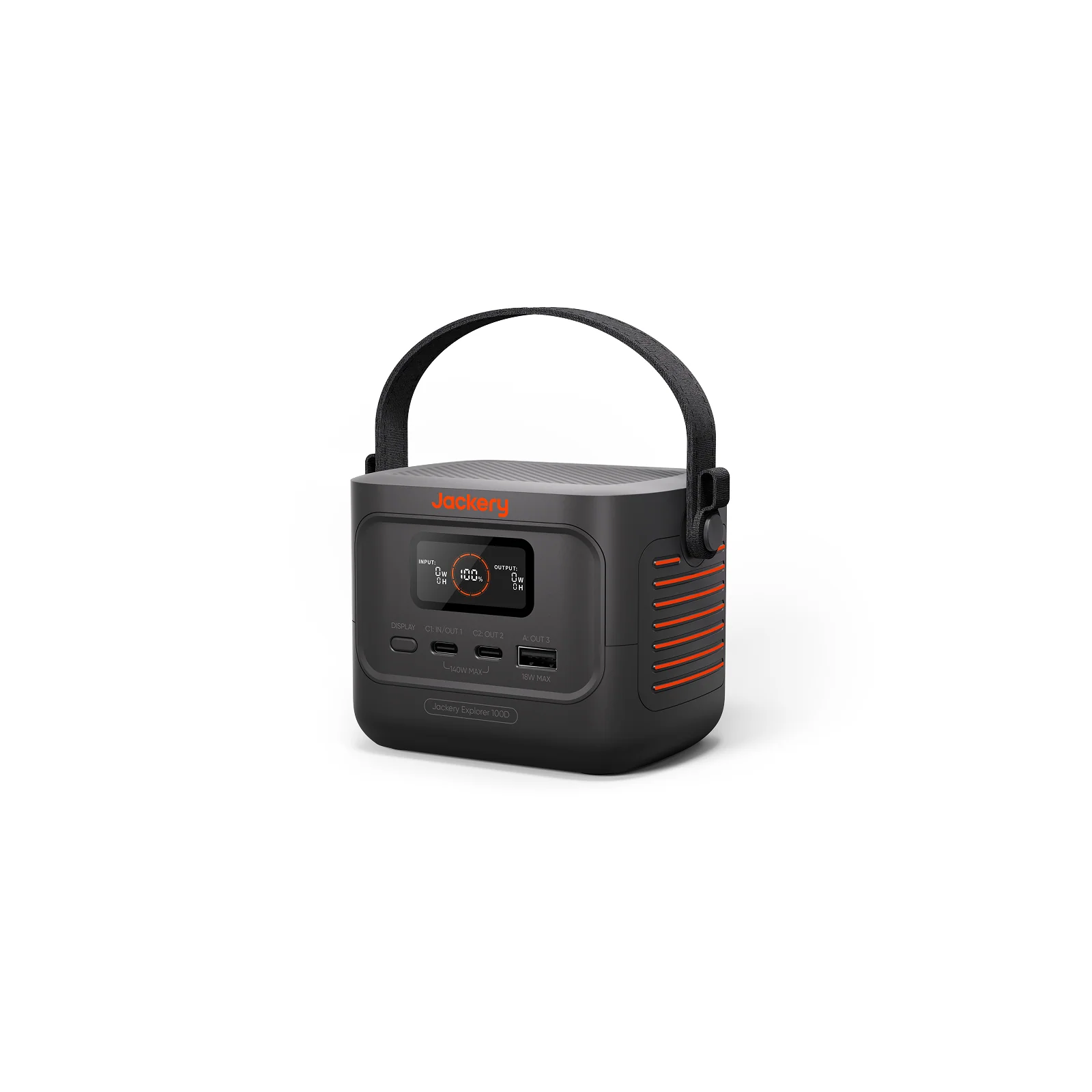
Jackery has announced the Explorer 100D, its smallest portable power station to date. Walmart will begin selling it on November 15 for $99.
Jackery first detailed the product in a GlobeNewswire release dated October 28, 2026. The company positions the Explorer 100D as a long-term mobile productivity partner for use on the ground, over the road, and in the air. The Verge, in coverage published November 2, lists the dimensions at 4.6 by 3.4 by 3.4 inches and the weight at 1.87 pounds. A syndicated copy of the release gives the same footprint as 11.9 by 8.3 by 8.7 centimeters.
The battery is rated at 96Wh (watt-hours, a measure of total stored energy), equivalent to 30,000mAh. It uses lithium iron phosphate (LFP) chemistry, a cell type that gives up some energy density in exchange for longer cycle life and better thermal stability. Jackery states that the LFP cells are engineered for up to 8 years of regular use and carry a 3,000-cycle lifespan, where one cycle is one full discharge and recharge. Jackery's product pages describe the unit as providing pure DC (direct current) power and as roughly the size of an adult palm, with a compact, square housing marketed for travel.
On the output side, the Explorer 100D has two 140W USB-C ports and one 18W USB-A port, with a maximum total output of 158W. Input is rated at up to 100W of direct solar.
Pricing and channels are split. Walmart carries the unit from November 15 at $99, while Costco offers a two-pack for $179.99.
In my view, the port specification deserves a closer look before buyers read it as a headline number. Two 140W USB-C ports add up to 280W, well above the 158W rated total, so the spec sheet does not support full-rate simultaneous draw on both USB-C ports. Power sharing behavior under real loads is the kind of detail independent testing tends to reveal, and it will matter more to a laptop user than the nominal port count.
The lifespan figures also merit a note. A 3,000-cycle rating works out to roughly eight years at one full cycle per day, so the cycle rating and the eight-year claim are consistent with each other.
The broader context here is a steady push toward smaller, lighter battery packs that can run phones, laptops, and small appliances without a grid connection. LFP chemistry has become common in stationary and mobile storage because of its cycle life and thermal stability. At 96Wh, the Explorer 100D sits at the small end of that category, and its value will depend on whether the cycle life and port performance hold up in everyday use.