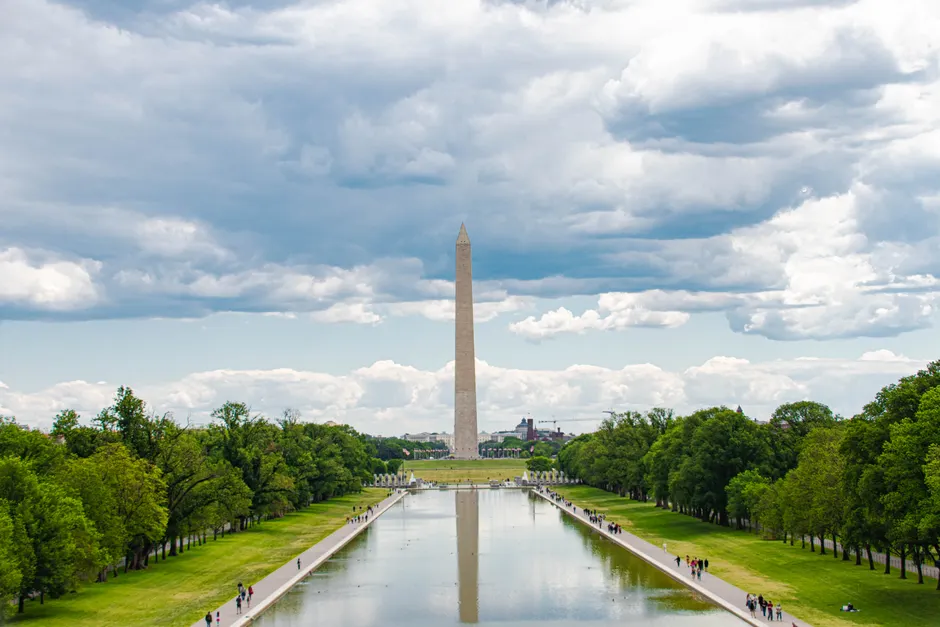
The Lincoln Memorial Reflecting Pool: How a Renovation Became a Political Test Case

Crews drained the Lincoln Memorial reflecting pool on Friday, July 10, the second full draining since a $14.7 million no-bid renovation finished earlier this year The Guardian. Interior Secretary Doug Burgum, whose department oversees the National Park Service, had announced the work publicly, citing debris left by the Independence Day fireworks display over the National Mall.
Burgum previewed the operation in an interview with podcaster Katie Miller — wife of deputy White House chief of staff Stephen Miller — released the week of July 6 The Guardian. His instructions were straightforward: "Drain the water, clean up the fireworks stuff. Repair the vandalism that was done. Fill it back up again." Days before, on CNN's State of the Union, he had suggested a partial draining might work CNN. The full draining Friday indicates either the initial assessment proved incomplete or the debris was more extensive than anticipated.
The reflecting pool, completed around 1922, had closed to the public from April 10 through June 10 for the renovation itself NPS. It faced additional closures between June 28 and July 9 for anti-scale fencing installation and removal NPS, then shut again for July 4. The sheer frequency of closures on a site meant for continuous public access has become notable in its own right.
President Trump has framed the pool's deterioration as a legacy failure from the Biden administration, describing it as "filthy dirty." The renovation pursued a specific aesthetic: a liner painted in the hue of the American flag. Rather than a simple architectural water feature, the administration sought to render the pool a patriotic symbol. The project's cost has climbed. Reuters reported the original contract value at $14.7 million in June Reuters; the Guardian's more recent accounting put estimated total costs above $16 million The Guardian.
The cost growth parallels problems that emerged post-renovation. Algae blooms turned the water greenish, and the blue liner began peeling within weeks of completion. A Reuters headline from June 18 captured the issue: "Paint is Already Peeling." The administration attributed the deterioration to vandalism. The National Park Service reported a June 9 incident in which a sharp knife or razor allegedly cut the new liner. Former Olympic cyclist David Hearn was indicted on a felony property-destruction charge related to the pool and pleaded not guilty The Guardian. Hearn's account differs: he says he reached in to examine peeled sealant and removed a chunk only when instructed by a park worker. His attorneys released a statement: "This indictment reflects the administration's effort to shift blame for their own failures. The justice system exists to determine facts, not to provide political cover."
There is tension between the vandalism narrative and the administration's public confidence in its original contractor. Burgum told CNN the administration would not seek competing bids for repairs, stating it would "use the same company because they did a fantastic job" — a claim that either predates or coexists with the algae blooms and liner failures that company's work produced. The contractor, Ohio-based Green Water Solutions (also operating as Greenwater Services), also received a separate $1.7 million contract for a water-purification system. Reports have surfaced of broader project contractors maintaining longstanding ties to Trump, prompting scrutiny of whether the selection process favored political loyalty over competitive procurement.
The reflecting pool work sits within a larger pattern of physical alterations Trump has pursued in the capital. He demolished the White House East Wing to make way for a $400 million ballroom and proposed a triumphal arch spanning the ground between the Lincoln Memorial and Arlington National Cemetery. In May, Trump posted that the reflecting pool would finish "prior to July 4th" and claimed the project was "ahead of schedule" — a characterization the subsequent closures, draining, and cost overruns have called into question.
What sets this episode apart from routine infrastructure problems is the symbolic weight the administration has placed on the site itself. For a century, a reflecting pool mirroring the Lincoln Memorial's colonnade has served as backdrop for demonstrations, inaugurations, and national mourning. Coating the liner in flag colors and then prosecuting someone for touching peeled sealant brings partisan framing into what has traditionally functioned as neutral federal parkland. The no-bid, single-contractor approach will eventually produce either a durable fix or another round of draining. In Washington, empirical questions about infrastructure tend to acquire political dimensions in the process.