Florida's Governor Race Becomes a Test of Data Center Opposition

Byron Donalds, the Republican nominee in Florida's gubernatorial election, faces Democrat David Jolly, a former U.S. Representative who has promised a one-year moratorium on data center developments in the state. Donalds holds Donald Trump's endorsement. Jolly is making opposition to data centers a closing argument of his campaign.
The contest is close. A University of North Florida survey put Jolly two points behind Donalds, within the poll's 2.8 percent margin of error, meaning the true gap could fall on either side of zero. According to a July University of North Florida poll, 68 percent of Floridians oppose data center developments in their communities. Jolly has used that sentiment directly. In September he said the vast majority of Floridians oppose new artificial intelligence data centers being built in the state.
Jolly's approach has a specific shape. He left the Republican Party in 2018, and he traveled to Loudoun County, Virginia, the cluster known as Data Center Alley, to see how hyperscale facilities, the very large campuses that run cloud and AI workloads, affect a community firsthand. He is counting on data centers to break the GOP's decades-long hold on Florida. That bet depends on whether anti-development sentiment crosses party lines in a state where the Republican machinery has been dominant for years.
Donalds has taken the opposite position. He has said he wants to make Florida the financial capital of the world and welcome data center developers to the state. In August he said, "There ain't no bans coming," in response to the moratorium debate. He has defended local control, meaning the authority of counties and cities to approve or reject construction, and he has said data centers would not drive up consumer utility bills. His campaign has $148 million in funds, much of it from the technology industry, a financial position few challengers in state races can match.
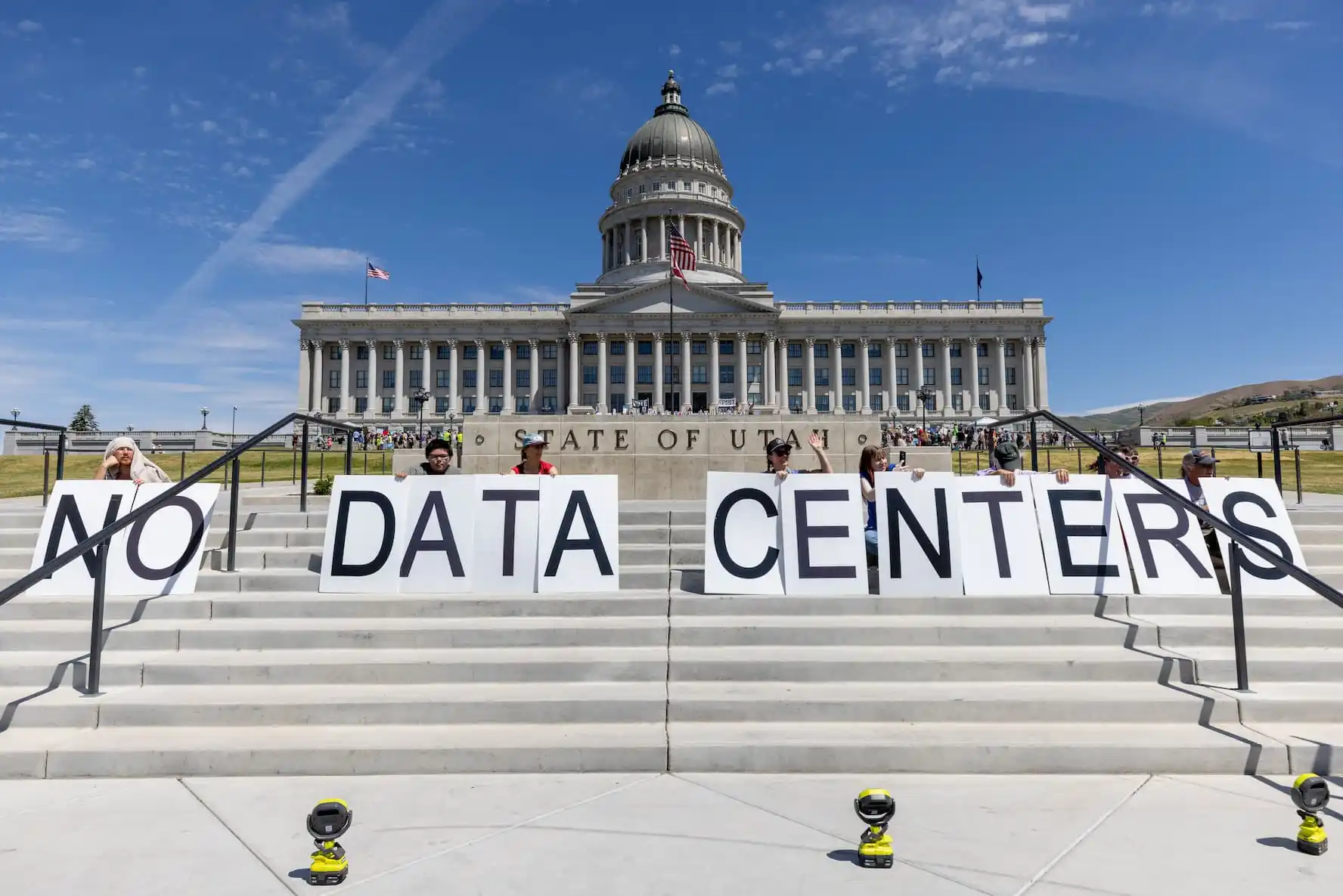
The local-control argument carries weight with a particular group of voters. Patti Zirhut, an organizer with the group No Data Center Hernando County, voted for Trump in 2016, 2020, and 2024. She says she will not vote for Donalds. Her case illustrates the fault line the campaigns are testing. Opposition to a specific facility in a specific county does not map neatly onto the partisan categories that usually shape Florida's statewide races. Local organizers are now a constituency both parties must weigh.
The pattern is not confined to Florida. The Associated Press reported in August that governors are shifting their stances or taking more steps to restrict data centers as the midterm elections approach. Reuters reported on October 22 that investors see risk to the AI trade from the U.S. midterms as data center backlash builds. The political and financial threads are converging on one question: where new compute capacity can be built, and on what terms.
In my view, the Florida race exposes a gap the industry has been able to leave unexamined. Hyperscale operators have typically negotiated with state economic development offices and utility commissions, while land use decisions and local objections have played out at the county level. A candidate promising a statewide pause and one promising an open door are both answering a question many communities feel they were never asked directly. Whichever way the November result falls, the next governor will inherit siting, power, and water questions that the current debate has barely begun to define.
For engineers and operators, the practical effect is uncertainty about where and how quickly capacity can come online. For residents, the debate has given a concrete vocabulary to a concern that was previously diffuse. Whether that leads to better-designed projects, clearer utility rate protections, or a more explicit public process will depend on what either candidate does with a mandate, and on how local governments use the authority they already hold.