Flipper One: A Pocket Linux Computer Split Across Two Processors
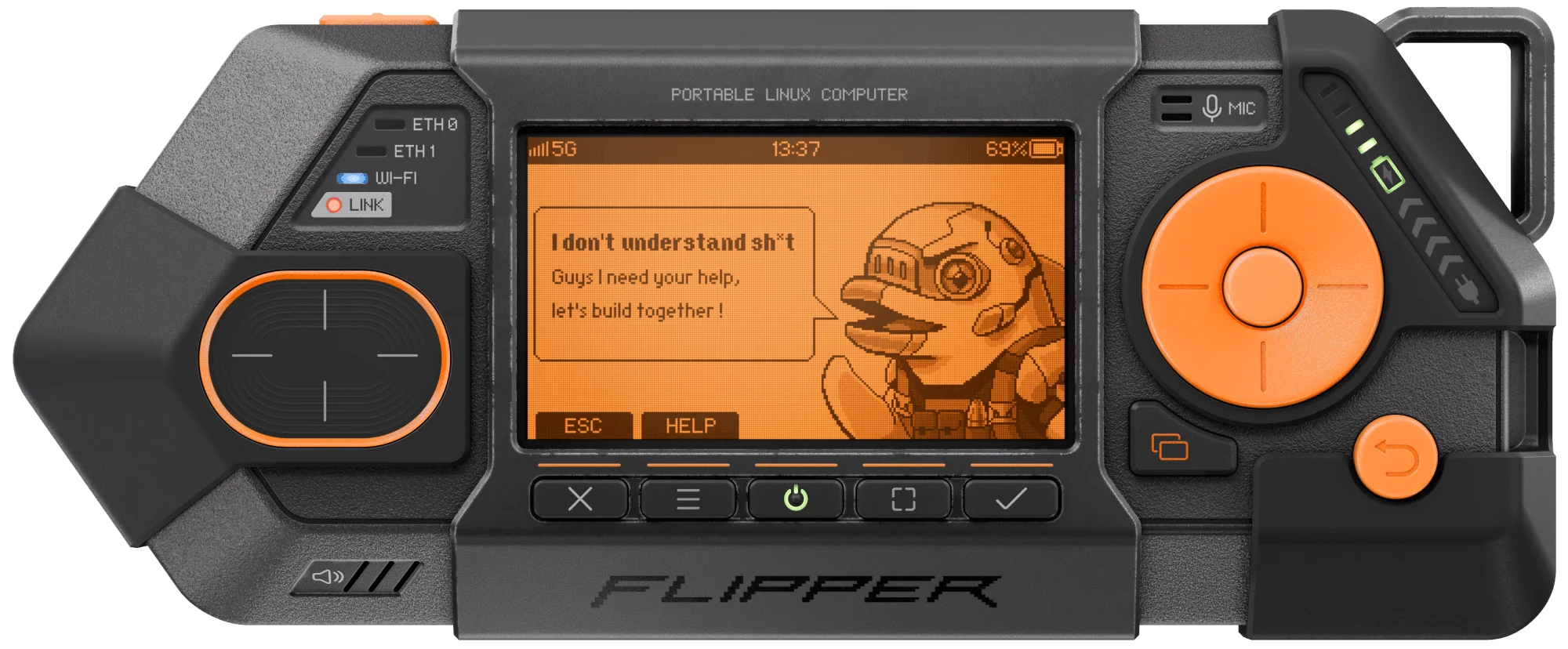
Flipper Devices has published a product page for the Flipper One, a pocket-sized Linux computer that divides its work between two processors running in parallel. The product page, dated 3 November 2026, describes open-source Linux firmware running on a mainline kernel. The company's blog points readers to the page at r.flipper.net/one.
The architecture is the most unusual part of the design. Each processor controls different sub-systems. The application processor is a Rockchip RK3576, an 8-core ARM system-on-chip (SoC, a single chip that combines CPU cores with other hardware blocks) that runs Linux. It integrates an NPU, or neural processing unit, for AI acceleration, and a GPU for graphics output over HDMI and DisplayPort.
The second processor is a Raspberry Pi RP2350 acting as a low-power microcontroller. It drives the LCD display, the physical buttons and the status LEDs. It also manages the power sub-system, and when the Linux sub-system is off, it controls the Linux boot parameters. In practical terms, the always-on housekeeping lives on the microcontroller, so the front panel and power management do not depend on the Linux side being awake.
Flipper says it partnered with Collabora to bring the RK3576 into the mainline kernel. Mainline support means the SoC's drivers live in the upstream kernel tree rather than in a vendor-maintained fork, which matters for anyone who has tracked board support packages (BSPs, the vendor-supplied driver bundles) through successive kernel releases.
Connectivity runs over a single USB cable. That one port handles SSH access (remote command-line login) and charging, because the device presents itself to a host as a virtual network adapter, a serial adapter and a mass-storage device at the same time.
Expansion runs through M.2 Key-B slots in 2230 (via extender), 2242, 3042 and 3052 sizes. The page lists supported modules including cellular or satellite modems, SDR modules, AI accelerators, NVMe or SATA SSDs, and Wi-Fi cards via adapters. Anyone populating the slots should check signal and lane assignments for each module type against Flipper's documentation, since Key-B connectors are electrically defined differently from Key-M.
Flipper's co-founder and CEO is Pavel Zhovner. In May 2026, The Verge described the Flipper One as a pocket-sized Linux computer and reported that the company planned a Kickstarter campaign at a price of around $350.
The company's crowdfunding history is relevant context. The original Flipper Zero raised roughly $4.6 million on Kickstarter in 2022, according to The Verge's coverage of that campaign. TechCrunch reported in 2023 that Flipper had sold almost $5 million worth of products as Kickstarter preorders.
The broader context here is a shift in what a handheld device can be. A pocket unit with a Linux application processor, an NPU, several radio options through M.2 and a microcontroller that owns the front panel and power path sits closer to a field workstation than to a single-purpose gadget. For developers, the appeal depends on how well the mainline kernel support holds up over time and how the two processors coordinate in practice.
In my view, the most useful test of the Flipper One will come from its expansion ecosystem. A device of this kind earns its keep when people build modules the vendor never imagined, and an open kernel, a documented USB gadget interface and a standard M.2 slot give that community the hooks it needs. Whether an ecosystem forms around the hardware will decide how far the platform travels beyond its launch specification.