Trump Says AI Safety Risk Is “Not Nearly as Real” as Industry Warns

President Donald Trump told Ross Douthat in a 60 Minutes interview that the AI safety risk warned of by AI executives is “not nearly as real” as they describe. CBS News billed the interview as its 2026 post-midterm elections interview, and it was published on November 9, 2026.
Trump said AI risk “can be managed, and it's managed.” He also claimed that the DOJ is managing that risk. The Verge reported the exchange.
The most specific claim concerned enforcement. Trump said his administration told a person reported to be “doing something bad with AI” to “Get ready to go to jail. Please give your wife a kiss good night.” He declined to name the person or the company, describing the individual as the leader of a big AI company, “One of the big ones.” According to Trump, after the threat of arrest, “this person totally changed everything.”
On legislation, Trump said he “absolutely would” work with Democrats on AI safety. He said “I don't mind guardrails,” but he does not want the U.S. “in a deep second position,” adding that the U.S. is “leading number one.”
Trump also turned to China. He said Beijing has no guardrails on AI except that “whatever President Xi says goes.” He said Xi is “all in to SI, as I call it,” with SI meaning super intelligence, a hypothetical AI that would outperform humans across most intellectual tasks. He argued the term is better because “it's not artificial.”
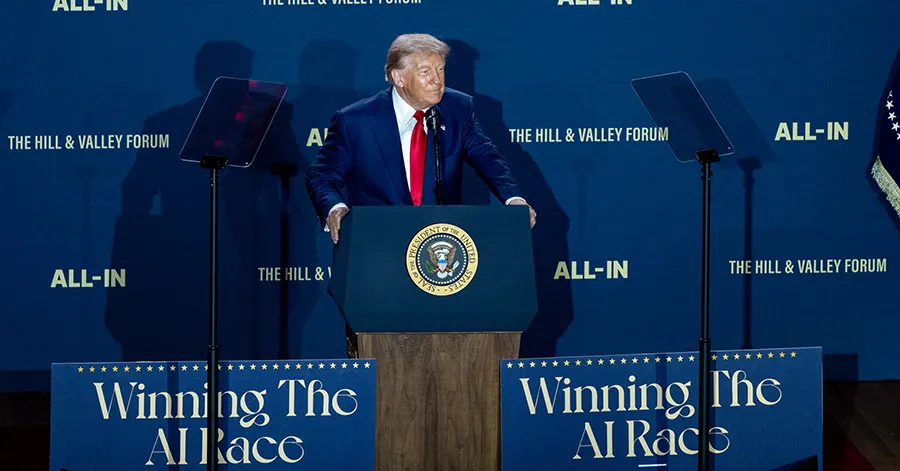
The interview follows a White House event on September 29, 2026. CBS News reported that Trump met with key AI leaders there and signed what he called an AI “constitution.” A separate CBS News segment from the same date described Trump and House Speaker Mike Johnson meeting with AI leaders to discuss the technology and potential safety guardrails.
The most checkable parts of the interview are the least specific. Trump declined to name the executive or the company. The same is true of the claim that risk is being managed.
The broader context here is the framing. Trump's two positions, that the risk is overstated and that guardrails are acceptable, are not obviously in conflict. Both can hold if “guardrails” means targeted enforcement against specific misconduct, rather than rules applied across model development, deployment, or compute (the hardware used to train and run models). That distinction carries most of the policy weight. The China comparison points the same way. A “super intelligence” race framing tends to favor speed over constraint, while Trump's stated wish to avoid a “second position” implies that the constraints themselves are negotiable.
The constructive reading is narrower but still useful. Both sides of the debate now accept that some form of guardrail is on the table, including at the highest level of government. The open question is what “managed” means in operational terms: which agencies act, on what standard, and whether enforcement can keep pace with the systems it governs. If the September signing and the White House meetings are the start of that work, the next useful test will be whether the commitments turn into published rules, named cases, or bipartisan language that practitioners can build against.