Trump Joins Huang Onstage by Phone as AI Pace Debate Sharpens
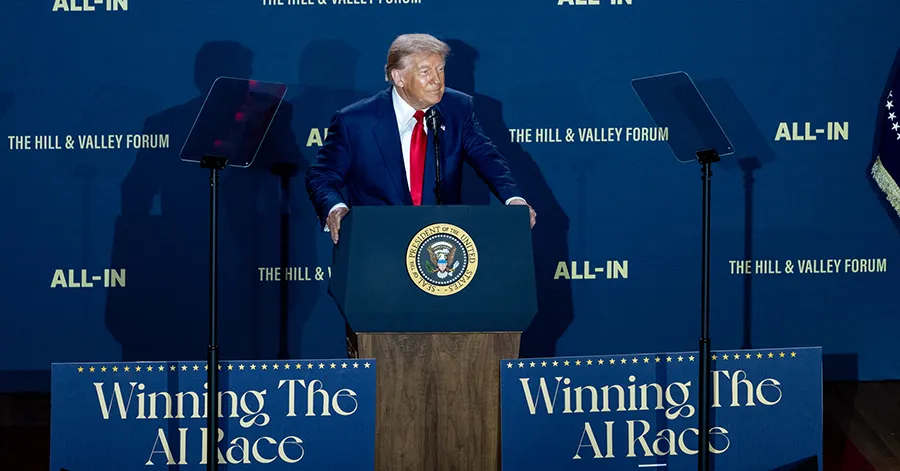
Nvidia CEO Jensen Huang took a call from President Donald Trump while onstage at the All-In Podcast's All-In Summit on Monday. Huang put Trump on speakerphone in front of the crowd and told him he was speaking to "thousands" of people. The Verge
Trump dismissed concerns about the pace of AI development. He called fears about AI a "hoax" and told the crowd "the robots will not be taking over." He said communities that would have been "dying" without data centers, large facilities full of computers that train and run AI systems, were now "really wealthy."
Huang answered with a line about domestic competition. "We're going to make sure that everybody wins in the AI race in America," he said during the call.
The call came after Anthropic CEO Dario Amodei published an essay titled "We Must Pace the Frontier" the weekend before. Amodei argued for slowing work on the most advanced AI models and for closer coordination between governments.
Huang, along with Microsoft CEO Satya Nadella, had been announced as a speaker for the All-In Summit 2026 in August. All-In
The speakerphone moment was not the first such contact to become public. Trump called Huang in the middle of Nvidia's all-hands staff meeting on a Thursday morning in late August. Wired
Huang was scheduled to meet Trump at the White House a day before traveling to China, according to reporting from July 2025. Reuters He was appointed to the President's Council of Advisors on Science and Technology in March. White House
Last July, Huang said "America's unique advantage that no country could possibly have is President Trump." White House Nvidia has said it will invest hundreds of billions of dollars over the next four years. White House In May, Huang described Chinese President Xi and Trump as inspiring and welcoming at their meeting in Beijing and called the Xi-Trump summit one of the most important summits in human history. Bloomberg
The broader context here is straightforward for anyone buying computing power or building with advanced models. One camp wants shared rules and a slower pace at the frontier, the cutting edge of AI capability. The other wants faster buildout of data centers and domestic supply, with local economic gains cited as part of the case. The All-In stage put both positions in the same frame, days apart, without reconciling them.
In my view, the business signal matters more than the stagecraft. Where data centers are sited, how power contracts are signed, and how accelerators are allocated will decide who gets to experiment and ship. Political access helps vendors navigate export rules and permitting, and public alignment with an administration helps sustain capital spending on infrastructure. For practitioners, the question is practical. Where does capacity come online, under what terms, and with what constraints on cross-border deployment.
Looking at what this means over the longer term, technology waves tend to produce this exact argument. One side warns about speed, the other points to jobs and regional investment. The split is public. Over time, both forces shape adoption. The buildout creates new tooling and lower costs for builders, even while governance questions stay open. If current capacity plans hold, more teams will get access to larger pools for training and running models, and the work of product integration, evaluation and security will expand with it.


