HoverAir Versa Review: A Handheld Gimbal Camera That Flies, With Limits
Engadget has rated the HoverAir Versa 8 out of 10 in a review published November 10, 2026, under the headline "Convenience and creativity with compromises." The device is priced at $539. Engadget
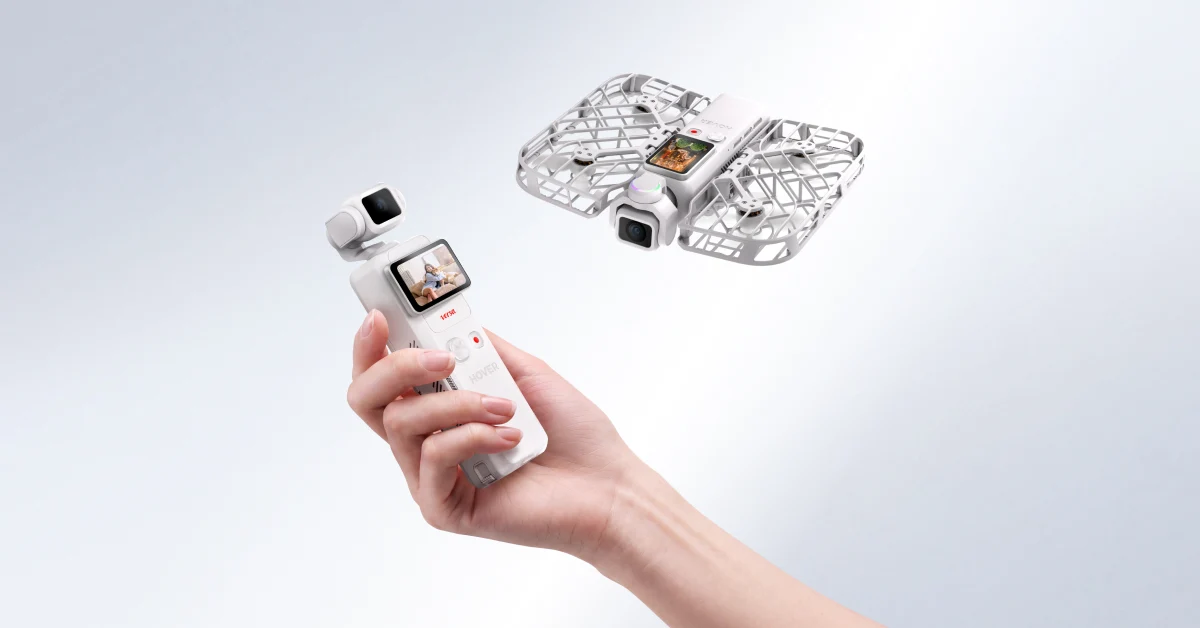
The Versa is a handheld gimbal camera, meaning a camera mounted on a motorised stabiliser that keeps footage level as the operator moves. A magnetic accessory turns it into a mini drone. In handheld form, it uses a 3-axis gimbal and a 1.64-inch screen. Its sensor, the chip that captures light, is 1/1.3-inch, and it records up to 4K at 60 fps (frames per second). The camera offers 2x in-sensor zoom, which crops and enlarges the sensor's own pixels, and captures 12-megapixel stills. Engadget
On dynamic range, the span between the darkest and brightest tones a camera can record, HoverAir claims 17.5 stops. Each stop is a doubling of light. The camera includes a 10-bit HDR mode. HoverAir says H-Log support is planned for a future update, so it is not a current feature. Internal storage is listed at 55GB of available space, with SD card expansion. Engadget
In drone mode, the Versa uses swappable batteries. Downward sensors handle position hold, which keeps the aircraft in place in the air, and palm takeoff and landing. The aircraft has no obstacle avoidance, a constraint that matters for any flight near people, trees, or buildings. Engadget
HoverAir describes three control modes: Auto Follow for tracking, Assisted Control for creative framing, and Manual Mode for direct command. The company states that its aircraft combine mechanical and electronic stabilization and are built from magnesium alloy and aerospace-grade materials. Accessories include Beacon and JoySticks, which HoverAir presents as tools for tracking and control. The company also says its PowerCase charges at temperatures as low as -20°C (-4°F). HoverAir
Engadget reported that US availability is unclear because of an FCC certification issue. Buyers in that market should confirm the status of the regulatory filing before expecting a shipping unit.
HoverAir markets the product as a "2-in-1 Handheld & Self-Flying Camera," aimed at handheld moments and aerial footage from the same kit. The pairing of a 1/1.3-inch sensor with a gimbal and a flight module is a practical trade for creators who want both modes without carrying two systems.
In my view, the trade-offs are the story. A gimbal camera that can fly is only useful if the flight envelope is one the operator can manage without obstacle sensing, and the Versa's downward-only sensing puts that burden on the pilot. The stated 17.5-stop figure and the planned H-Log support will matter most to colorists who grade footage, and both depend on how the HDR pipeline performs in practice.
The broader context here is a category that sits between action camera, gimbal, and micro-drone, with few products that cover all three. Engadget's 8/10 rating indicates a product that works within those limits. Whether the regulatory question in the US is resolved, and when H-Log arrives, will determine how far the Versa's creative case extends.