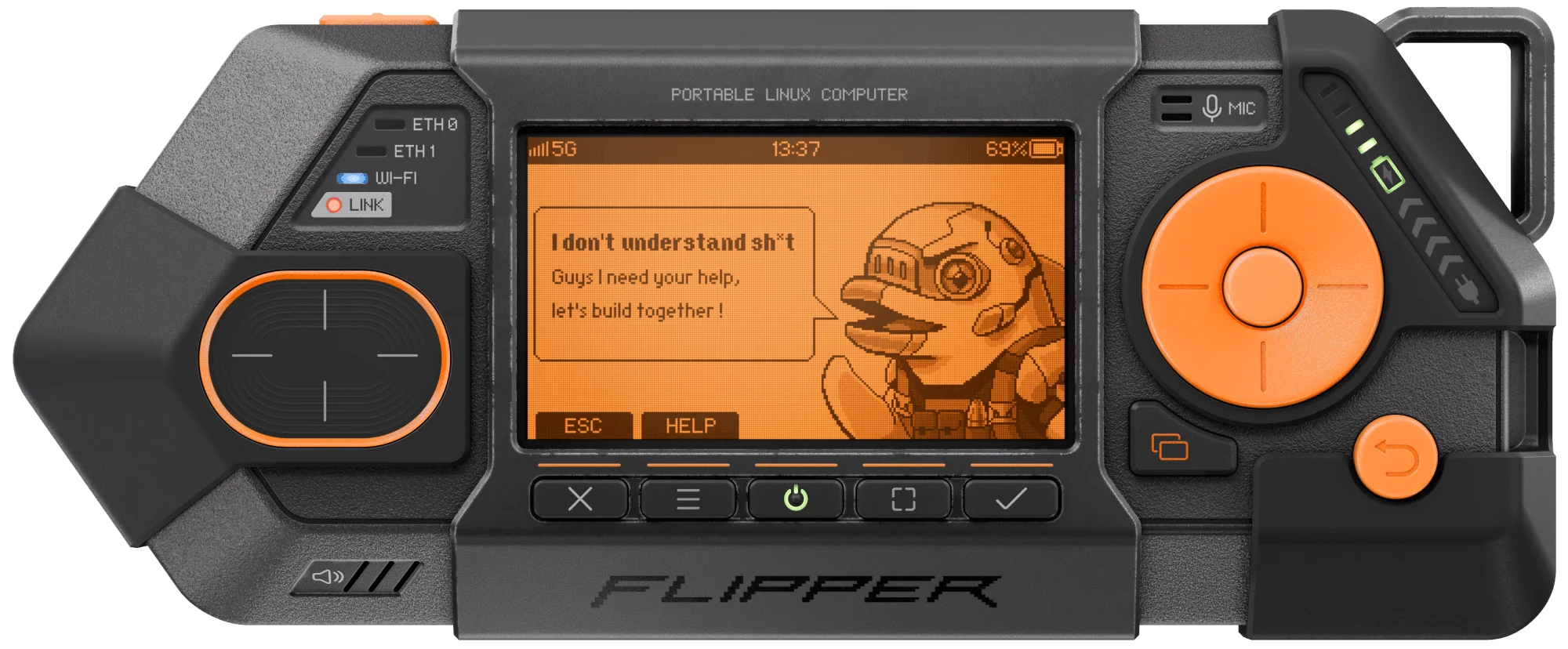
Flipper One: A Linux Multi-Tool Aimed at Networking and Edge Compute

Flipper Devices has launched a Kickstarter campaign for the Flipper One, a Linux multi-tool with a preorder price of $399. The launch was reported on November 17, 2026, in The Verge. Flipper Devices first announced the device in May. Shipping is expected to begin in July 2027.
The company describes the Flipper One as an open Linux multi-tool built for high-performance computing and IP networking. It is not a successor to the Flipper Zero, the wireless hacking multitool that is currently available for $169. Flipper Devices positions the two products as separate devices for different workloads, not as a generational update to the handheld.
The compute core is an 8-core RK3576 ARM processor with a dedicated NPU, a neural processing unit built to run machine learning inference. A GPU supports connecting an external display over USB-C or HDMI.
The networking hardware is where the device differs most from its predecessor. The Flipper One has two gigabit Ethernet ports, Wi-Fi 6e support, and PCIe, SATA and USB 3.0 interfaces. An M.2 slot accepts add-on modules, including a 5G modem and a mesh networking LoRa radio, a long-range, low-power radio often used for sensor networks. According to the report, the LoRa module can turn the unit into a walkie-talkie.
The software stack is Flipper OS, which is based on Debian Linux. The company says Flipper OS includes open source firmware for developing apps, tools, and other uses for the device.
In my view, the defining trade here is the combination itself: a Debian userland, a standard ARM Linux board support path and an NPU, packed into a unit small enough to carry as a multi-tool.
A Kickstarter preorder at $399 commits money before the hardware is in volume production. The July 2027 shipping date is the campaign's expected delivery window, not a confirmed ship date. Backers are relying on the schedule holding while the hardware moves from prototype to manufacturing, and radio certification for the cellular and LoRa modules is among the steps that can affect timing.
In my view, the more useful question for this audience is how much of the Flipper One's appeal depends on the M.2 expansion path. A gigabit-class network appliance, a field radio and a Linux development board each exist already, but few are combined in one handheld with an open firmware model. Whether the M.2 ecosystem fills out with third-party modules will determine how far the device can reach beyond its launch configuration.
The broader context here is a shift in what small hacking hardware is expected to do. The Flipper Zero established a market for pocket tools aimed at security researchers and hobbyists. The Flipper One moves the same idea toward networking and edge compute, where the work involves protocol handling, local inference on the NPU, and mesh or cellular backhaul. For developers who already work on Linux and embedded ARM, the device offers a single open platform to carry into the field, with a Debian base and open firmware to build on rather than work around.