Voyager 1 Reaches One Light-Day From Earth, and Its Signal Now Takes a Day Each Way
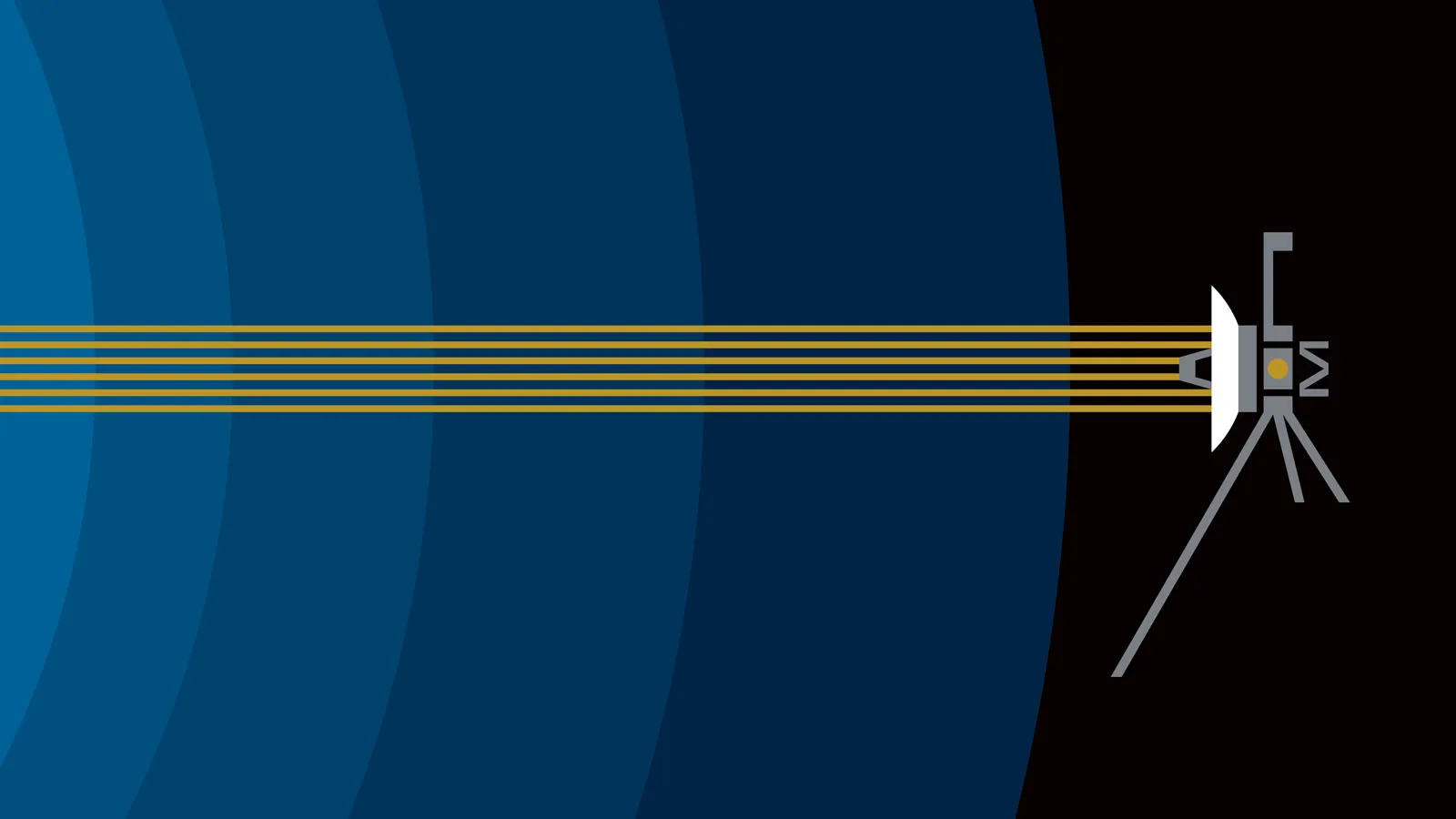
NASA's Voyager 1 is now one light-day from Earth, at a distance of 16.094 billion miles. The spacecraft crossed that threshold on Wednesday, 18 November 2026, at 5:16 a.m. ET, according to The Verge.
A light-day is the distance light covers in 24 hours. At that range, radio signals take a full day to travel between Earth and the probe. A command sent from the ground arrives roughly 24 hours later, and any telemetry reply needs another day to return. Mission operations therefore run on a round-trip latency measured in days, not the seconds or minutes that ground teams are used to managing on long-haul links.
Voyager 1 has been travelling for 49 years, and it is the most distant human-made object ever sent from Earth, per The Verge. It is moving at nearly 38,000 miles per hour. Its present heading is toward the star Gliese 445 in the constellation Ursa Minor. That star is 17 light-years away, and the spacecraft will pass it in around 40,000 years.
The probe is still operational. It continues to return readings on plasma waves, magnetic fields and energetic particles in the space it is crossing. These are in-situ measurements, taken where the spacecraft actually is rather than from a distance, and they are the same class of data that informed studies of the heliosphere, the bubble of solar wind surrounding the Sun, over the past decade. The instrument complement is aging, so each downlink is a small, carefully managed exercise in power budgeting and data prioritisation.
The mission's original objectives were completed in 1980, when Voyager 1 flew past Jupiter and Saturn, according to The Verge. NASA describes the twin spacecraft as having completed the first in-depth reconnaissance of the outer planets, and says their current mission is to chart the edge of interstellar space (NASA). The two probes are leaving the solar system in different directions, each at more than 3 astronomical units per year. One astronomical unit, the Earth-Sun distance, is about 93 million miles (NASA).
Voyager 2 launched 16 days before its sibling. It is expected to reach one light-day from Earth in 2035, per The Verge. Both probes carry the Golden Record, whose contents were selected for NASA by a committee led by Carl Sagan of Cornell University (NASA).
In my view, the milestone is best read as a measure of endurance rather than distance. A spacecraft whose primary work ended in 1980 is still returning usable physics nearly half a century after launch, and the engineering that keeps that link alive is done by teams working with a signal that now takes a day each way. The number is simple to state. The operational discipline behind it is considerably less simple.
The broader context here is the scale of the region the probes are now sampling. Plasma and magnetic field data from beyond the heliosphere are rare, and each additional year of coverage extends a dataset that no other instrument currently replicates at that range. For the engineers and physicists who work with these measurements, the milestone is a reminder that some of the most durable data infrastructure in the field was built decades ago and is still answering queries.


