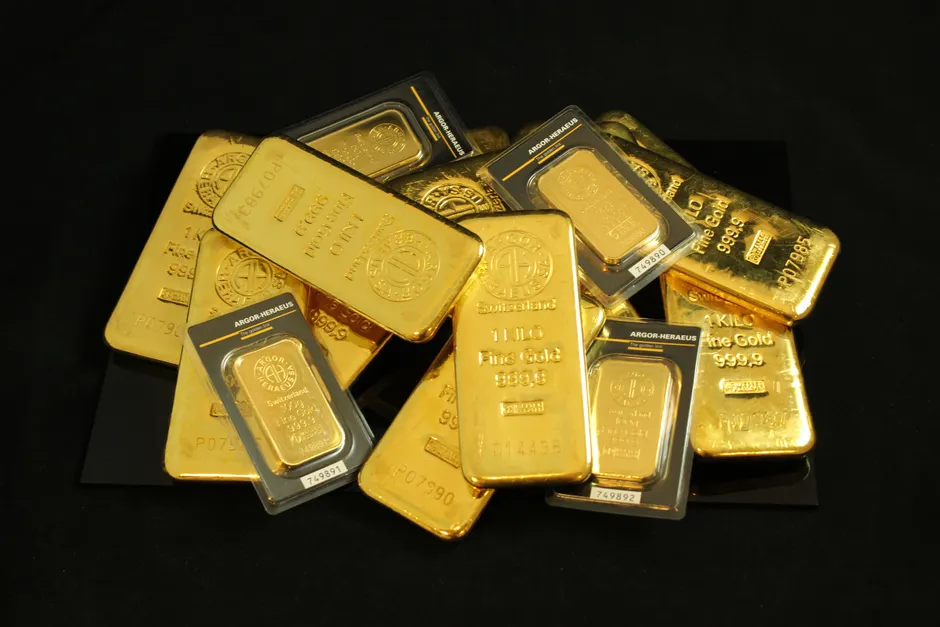
Gold's June 17 Drop: Why the Fed Still Moves a $5,000 Metal

Gold prices fell more than 1% on June 17, 2026, after the U.S. Federal Reserve held its benchmark interest rate steady but signaled a possible rate hike rather than the cuts markets had been expecting. The signal pushed up expectations for "real rates" — interest rates adjusted for inflation — which makes gold, an asset that pays no yield, less attractive to hold (Reuters).
The drop came against an extraordinary backdrop for the metal. Gold hit a then-record of $3,790.82 per ounce in September 2025, broke through $5,000, and most recently topped $5,100 in February 2026 (Reuters; Reuters).
That February surge past $5,100 was driven by central banks and investors seeking refuge from geopolitical risks and Trump-induced market volatility, according to Reuters. The rally added roughly $1,300 per ounce, or about 35%, to gold's value in the five months following the September 2025 record. Platinum moved in sympathy during the September 2025 rally, surging about 5% to an over-11-year high at the same time gold pushed to its then-record (Reuters).
CME Group analysis frames this price path within a well-established inverse relationship between gold and rate expectations. Gold rose from 2019 to mid-2020 and again from 2023 to early 2026, both periods when rate expectations were falling. The June 17 Fed decision introduced the possibility of a rate hike rather than the cuts that had been priced in, directly testing this relationship and producing an immediate decline exceeding 1% on the day of the announcement (CME Group; Reuters).
Underlying the price action is sustained central bank accumulation that operates on a different time horizon than rate-driven trading. Central banks purchased a net 244 tonnes of gold in the first quarter of 2026, a pace above both quarterly and longer-term averages (Sprott). State Street Global Advisors' gold monitor team projects that 2026 will mark the 17th consecutive year of net central bank gold purchases since the global financial crisis (SSGA). This unbroken accumulation streak, beginning in 2009, has run through multiple Fed tightening and easing cycles, suggesting that official-sector demand is driven by reserve diversification and geopolitical considerations that operate independently of short-term rate expectations.
J.P. Morgan Global Research analysts expect gold to reach $6,000 per ounce by year-end 2026 (J.P. Morgan). A move from the February 2026 level of $5,100 to $6,000 would require an additional gain of approximately 17.6% over roughly ten months.
The broader context here is a tug-of-war between two forces pulling gold in opposite directions. On one side, a central bank signaling a potential rate hike pressures gold through what economists call the "real-rate channel": higher short-term rates raise the opportunity cost of holding a zero-yield asset like gold. Think of it this way — if a Treasury bond starts paying more in interest, the appeal of holding gold, which generates no income, naturally dims. On the other side, quarterly central bank purchases of 244 tonnes, running above long-term averages and extending a 17-year accumulation streak, provide a persistent demand floor that has absorbed rate-driven sell-offs throughout the current bull cycle.
What matters for market participants is how these forces interact. CME Group's analysis indicates that gold's rallies have historically been driven by falling rate expectations, and the June 17 price drop confirmed that this relationship still functions on the downside. Yet the sheer magnitude of central bank demand — exceeding 244 tonnes in a single quarter — has materially tightened the above-ground market. That tightening may be amplifying gold's responsiveness to dovish shifts (when rate-cut expectations rise) while partially cushioning hawkish ones. If the Fed follows through on its rate-hike signal, gold faces near-term headwinds through the rate channel. If the signal proves transitory and expectations revert toward cuts, the structural demand backdrop could accelerate price appreciation toward the levels J.P. Morgan's analysts project.
The June 17 decline also shows that even a market trading above $5,000 per ounce remains anchored to monetary policy fundamentals. Geopolitical risk premiums and central bank demand have lifted the price floor substantially, but they have not decoupled gold from the rate-expectation mechanism that CME Group identifies as the primary driver across multiple cycles. The September 2025 platinum rally, concurrent with gold's record, further suggests that precious metals broadly are responding to the same macro signals rather than moving on idiosyncratic supply-demand dynamics alone.